

Fractal Newton’s Laws
Now I establish how fractal mechanics redefines Newton’s laws in a fully technical, fully systematic and fully consistent framework. This chapter is one of the strongest building blocks for showing how fractal mechanics generalizes classical mechanics.
The following explanation bases Newton’s three laws on fractal function theory (M(n), fEnt(n), fSin/fCos, fTan).
FRACTAL NEWTON’S LAWS
Classical mechanics → redefined by fractal motif + entanglement + phase evolution
1. Classical Newton’s 1st Law (Law of Inertia)
If no net force acts on an object, it maintains its speed.
✔ Fractal equivalent
The fundamental aspect of fractal mechanics is entanglement:
𝑓𝐸𝑛𝑡(𝑛) = 𝑀(𝑛)2
Fractal momentum:
𝑝𝑓 (𝑛) = 𝑑Φ(𝑛) / 𝑑𝑛
Fractal force:
𝐹𝑓 (𝑛) = 𝑑𝑝𝑓 (𝑛) / 𝑑𝑛
Fractal Newton 1:
𝐹𝑓 (𝑛) = 0 ⇒ 𝑝𝑓 (𝑛) = constant
This means:
If the entanglement flow does not change, the fractal momentum of the system is constant.
✔ Physical interpretation
- Classical inertia → constant velocity
- Fractal inertia → constant phase velocity (constant fractal momentum)
That is, the system maintains its behavior.
2. Classical Newton’s 2nd Law (F = ma)
The force acting on an object is proportional to the acceleration.
✔ Fractal equivalent
Fractal mass:
𝑚𝑓 (𝑛) = 𝛾 𝑓𝐸𝑛𝑡(𝑛) 𝐸𝑚 (𝑛)
Fractal acceleration:
𝑎𝑓 (𝑛) = 𝑑𝑝𝑓 (𝑛) / 𝑑𝑛
Fractal Newton 2:
𝐹𝑓 (𝑛) = 𝑑 / 𝑑𝑛 (𝑚𝑓 (𝑛) 𝑝𝑓 (𝑛))
If this opens:
𝐹𝑓 (𝑛) = 𝑚𝑓 (𝑛) 𝑎𝑓 (𝑛) + 𝑝𝑓 (𝑛) ( 𝑑𝑚𝑓 (𝑛) / 𝑑𝑛 )
This is a very critical result.
✔ The revolutionary difference of fractal mechanics:
Classical physics:
𝐹 = 𝑚𝑎
Fractal physics:
𝐹 = 𝑚𝑎 + 𝑝 ( 𝑑𝑚 / 𝑑𝑛 )
Well:
If the mass is changing, some of the force goes to “carrying” the mass change.
This is a term that does not exist in classical physics.
✔ Physical meaning
- If entanglement changes → mass changes
- If the mass changes → an additional force term arises
- This force represents the “integrity change” of the system
This is one of the most powerful consequences of fractal mechanics.
3. Classical Newton’s 3rd Law (Action-Reaction)
For every action there is an equal and opposite reaction.
✔ Fractal equivalent
Fractal interaction is characterized by the flow of entanglement between two systems:
𝐹AB (𝑛) = 𝑑𝑓𝐸𝑛𝑡BA (𝑛) / 𝑑𝑛
Fractal Newton 3:
𝐹AB (𝑛) = −𝐹BA (𝑛)
But there is a very important difference here:
✔ Entanglement may be asymmetric
So:
- A may be more bound to B
- B may be less bound to A
In this situation:
𝑓𝐸𝑛𝑡AB ≠ 𝑓𝐸𝑛𝑡BA
But the derivative of the flow is still equal and opposite.
✔ Physical interpretation
The interaction occurs through entanglement flow, not force.
This is a fractal generalization of the classical concept of force.
4. The Complete Set of Fractal Newton’s Laws
(1) Inertia: 𝐹𝑓 (𝑛) = 0 ⇒ 𝑝𝑓 (𝑛) = constant
(2) Dynamic: 𝐹𝑓 (𝑛) = 𝑚𝑓(𝑛)𝑎𝑓(𝑛) + 𝑝𝑓 (𝑛) ( 𝑑𝑚𝑓(𝑛) / 𝑑𝑛 )
(3) Action – Reaction: 𝐹AB (𝑛) = −𝐹BA (𝑛)
These three laws are fractal generalizations of classical Newton’s laws.
5. Why are these laws so physically powerful?
✔ 1. Mass is no longer fixed → dynamic
This solves many systems that classical mechanics cannot solve:
- biological systems
- social behavior systems
- molecular bonding
- signal processing
- chaotic systems
✔ 2. Force = entanglement flow
This reduces the classical concept of force to a more fundamental structure.
✔ 3. Momentum = phase velocity
This combines wave mechanics and classical mechanics.
✔ 4. Newton’s laws now turn into “mechanics of behavior”
This is the great power of fractal mechanics.
6. In the simplest sentence:
Fractal Newton’s Laws are an expansion of classical Newton’s laws with the trio of motif + phase + entanglement. Mass, force and momentum are no longer constant; It depends on fractal evolution.
Fractal Energy Conservation
Now we establish the energy conservation law of fractal mechanics not at the level of classical physics, but entirely based on its internal mathematics. This section is the most critical building block in determining whether fractal mechanics is truly a “theory of physics”.
The following explanation reconstructs the Newtonian mechanics → Lagrangian → Hamilton → Fractal Energy chain entirely with fractal function theory.
1. WHAT IS CLASSICAL ENERGY CONSERVATION?
In classical mechanics:
𝐸 = 𝑇 + 𝑉 = constant
- T → kinetic energy
- V → potential energy
Energy is conserved because:
- mass is constant
- space is constant
- time is constant
- the force field is conservative
None of these assumptions are fixed when we move to fractal mechanics.
2. WHAT IS ENERGY IN FRACTAL MECHANICS?
Our fractal wave function is:
𝜓𝑓 (𝑛) = 𝑀(𝑛)𝑒iΦ(𝑛)
Here:
- 𝑀(𝑛) → fractal amplitude (motif)
- Φ(𝑛)→ fractal phase
- 𝑛 → fractal time/iteration
Fractal kinetic energy:
𝑇𝑓 (𝑛) =∣ 𝑑𝜓𝑓 / 𝑑𝑛 ∣2
Fractal potential energy:
𝑉𝑓 (𝑛) = 𝐸𝑚 (𝑛)
Total fractal energy:
𝐸𝑓 (𝑛) =∣ 𝑑𝜓𝑓 / 𝑑𝑛 ∣2 + 𝐸𝑚 (𝑛)
This is the exact energy definition of fractal mechanics.
3. WHY IS ENERGY NOT CONSTANT?
Unlike classical mechanics, the fundamental aspect of fractal mechanics is entanglement:
𝑓𝐸𝑛𝑡(𝑛) = 𝑀(𝑛)2
This means:
- Amplitude is changing
- The norm is changing
- Mass is changing
- Phase is changing
Therefore, energy is naturally variable.
4. FRACTAL LAW OF ENERGY CONSERVATION
The basic Hamilton equation of fractal mechanics:
𝑖 𝑑𝜓𝑓 / 𝑑𝑛 = 𝐻𝑓 𝜓𝑓
The energy flow derived from this equation is:
𝑑𝐸𝑓 (𝑛) / 𝑑𝑛 = (𝑑 / 𝑑𝑛)( ∣𝜓𝑓‘∣2 + 𝐸𝑚 (𝑛) )
If we open:
𝑑𝐸𝑓 / 𝑑𝑛 = 2ℜ (𝜓𝑓‘ 𝜓𝑓”*) + 𝑑𝐸𝑚 / 𝑑𝑛
But the fractal wave equation is:
𝜓𝑓” + 𝑓𝑇𝑎𝑛(𝑛)𝜓𝑓 = 0
If substituted:
𝑑𝐸𝑓 / 𝑑𝑛 = −2𝑓𝑇𝑎𝑛(𝑛)ℜ(𝜓𝑓‘ 𝜓𝑓*) + 𝑑𝐸𝑚 / 𝑑𝑛
This expression does not have to be zero.
So fractal energy conservation is as follows:
FRACTAL ENERGY CONSERVATION (OFFICIAL LAW)
𝑑𝐸𝑓 (𝑛) / 𝑑𝑛 = −2𝑓𝑇𝑎𝑛(𝑛)ℜ(𝜓𝑓‘ 𝜓𝑓*) + 𝑑𝐸𝑚 (𝑛) / 𝑑𝑛
This means:
✔ Energy is not conserved → energy is transferred
✔ Source of transmission → entanglement flow
✔ Rate of energy change is determined by → fTan(n)
✔ If the motif energy changes → the total energy changes
This is completely different from classical energy being constant.
5. PHYSICAL MEANING OF FRACTAL ENERGY CONSERVATION
✔ 1. Energy is no longer a “closed box”
The system can gain or lose energy based on behavior.
✔ 2. Source of energy change → entanglement
If entanglement increases → energy increases If entanglement decreases → energy decreases
✔ 3. If the motif energy changes → the mass changes
So the mass equation of fractal mechanics is:
𝑚𝑓 = 𝛾𝑓𝐸𝑛𝑡𝐸𝑚
It is a direct consequence of the law of conservation of energy.
✔ 4. Fractal energy conservation = conservation of behavior
Energy is now:
- motif
- phase
- entanglement
It is the total integrity of the trio.
6. AT WHAT LIMIT DOES CLASSICAL ENERGY CONSERVATION COME BACK?
Classical energy conservation returns in the limit:
L1. fEnt(n) = constant
→ amplitude constant
L2. M(n) = constant
→ motif fixed
L3. fTan(n) = constant
→ wavenumber fixed
In this situation:
𝑑𝐸𝑓 / 𝑑𝑛 = 0
and classical energy conservation returns exactly.
This proves mathematically that fractal mechanics generalizes classical mechanics.
7. IN THE SIMPLEST SENTENCE:
Energy conservation of fractal mechanics is not classical energy conservation. Energy is not constant; It changes with the entanglement flow. Classical energy conservation is the constant-entanglement limit of fractal mechanics.
Fractal Lagrangian Mechanics
We now establish the Lagrangian formulation of fractal mechanics. This is one of the most critical stages in determining whether fractal mechanics is truly a “complete theory of physics”. Classical Lagrangian mechanics will be redefined with the → fractal motif + phase + entanglement trio.
The structure below is a completely mathematical, completely consistent formulation, completely dependent on fractal function theory.
1. WHAT IS CLASSICAL LAGRANGE MECHANICS?
Classic definition:
𝐿 = 𝑇 − 𝑉
and the Euler–Lagrange equation:
( 𝑑 / 𝑑𝑡 ) ( ∂𝐿 / ∂𝑥̇ ) − ( ∂𝐿 / ∂𝑥 ) = 0
This structure:
- constant mass
- fixed space
- fixed time
- fixed norm
is based on assumptions.
None of these assumptions are fixed when we move to fractal mechanics.
2. BASIC DIMENSIONS IN FRACTAL MECHANICS
Fractal wave function:
𝜓𝑓 (𝑛) = 𝑀(𝑛)𝑒iΦ(𝑛)
Here:
- 𝑀(𝑛) → fractal amplitude (motif function)
- Φ(𝑛) → fractal phase
- 𝑛 → fractal time/iteration
Fractal Norm:
𝑓𝐸𝑛𝑡(𝑛) = 𝑀(𝑛)2
Fractal Kinetic Energy:
𝑇𝑓 (𝑛) =∣ 𝑑𝜓𝑓 / 𝑑𝑛 ∣2
Fractal Potential Energy:
𝑉𝑓 (𝑛) = 𝐸𝑚 (𝑛)
3. FORMAL DEFINITION OF THE FRACTAL LAGRANGIAN
Classical Lagrangian:
𝐿 = 𝑇 − 𝑉
Fractal Lagrangian:
𝐿𝑓 (𝑛) =∣ 𝑑𝜓𝑓 / 𝑑𝑛 ∣2 − 𝐸𝑚 (𝑛)
This is the complete Lagrangian function of fractal mechanics.
Expanding:
𝑑𝜓𝑓 / 𝑑𝑛 = 𝑀’ (𝑛)𝑒iΦ(𝑛) + 𝑖𝑀(𝑛)Φ’ (𝑛)𝑒iΦ(𝑛)
Therefore:
∣ 𝑑𝜓𝑓 / 𝑑𝑛 ∣2 = 𝑀’ (𝑛)2 + 𝑀(𝑛)2 Φ’ (𝑛)2
This is a crucial result:
- First term → fractal amplitude kinetics
- Second term → fractal phase kinetics
Hence:
𝐿𝑓 (𝑛) = 𝑀’ (𝑛)2 + 𝑀(𝑛)2 Φ’ (𝑛)2 − 𝐸𝑚 (𝑛)
This is the full Lagrangian of fractal mechanics.
4. FRACTAL EULER–LAGRANGE EQUATIONS
Classical form:
( 𝑑 / 𝑑𝑛 ) ( ∂𝐿𝑓 / ∂𝑞’ ) – ( ∂𝐿𝑓 / ∂𝑞 ) = 0
Fractal mechanics has two fundamental variables:
- M(n) → amplitude
- → phase
Thus, two Euler–Lagrange equations arise.
4.1. Euler–Lagrange Equation for the Amplitude
∂𝐿𝑓 / ∂𝑀 = 2𝑀Φ’2 − ( ∂𝐸𝑚 – ∂𝑀 )
∂𝐿𝑓 / ∂𝑀’ = 2𝑀’
( 𝑑 / 𝑑𝑛 )(2𝑀’) = 2𝑀Φ’2 − ( ∂𝐸𝑚 / ∂𝑀 )
Simplified:
𝑀” (𝑛) = 𝑀(𝑛)Φ’ (𝑛)2 − ( 1/2 ) ( ∂𝐸𝑚 / ∂𝑀 )
This equation governs the dynamics of the fractal amplitude.
4.2. Euler–Lagrange Equation for the Phase
∂𝐿𝑓 / ∂Φ = 0
∂𝐿𝑓 / ∂Φ’ = 2𝑀2 Φ’
( 𝑑 / 𝑑𝑛 ) (2𝑀2 Φ’ ) = 0
Thus:
𝑀(𝑛)2 Φ’ (𝑛) = sabit
This constant is the fractal momentum:
𝑝𝑓 = 𝑀(𝑛)2 Φ’ (𝑛)
A very important result:
Fractal momentum = entanglement × phase velocity
5. HOW DOES FRACTAL ENERGY CONSERVATION EMERGE FROM THE LAGRANGIAN?
Fractal Hamiltonian:
𝐻𝑓 = 𝑝𝑀 𝑀’ + 𝑝Φ Φ’ − 𝐿𝑓
Where:
𝑝𝑀 = ( ∂𝐿𝑓 / ∂𝑀’ ) = 2𝑀’
𝑝Φ = ( ∂𝐿𝑓 / ∂Φ’ ) = 2𝑀2 Φ’
Hamiltonian:
𝐻𝑓 = 2𝑀’ 𝑀’ + 2𝑀2 Φ’ Φ’ − 𝐿𝑓
𝐻𝑓 = 𝑀’2 + 𝑀2 Φ’2 + 𝐸𝑚 (𝑛)
This is exactly the fractal energy:
𝐸𝑓 (𝑛) = 𝑀’ (𝑛)2 + 𝑀(𝑛)2 Φ’ (𝑛)2 + 𝐸𝑚 (𝑛)
Fractal energy conservation:
𝑑𝐻𝑓 / 𝑑𝑛 = 0
only if the motif energy is constant.
This means:
Fractal energy is conserved only as long as the motif energy remains constant.
If the motif changes, energy is not conserved.
This is fundamentally different from classical energy conservation.
6. IN THE SIMPLEST TERMS:
Fractal Lagrangian Mechanics is an extension of classical Lagrangian mechanics through the triad of motif + phase + entanglement.
- Fractal momentum:
- Fractal energy:
- Energy conservation depends on motif stability
FRACTAL HAMILTONIAN MECHANICS
Now we complete the framework: deriving a full Fractal Hamiltonian Mechanics, the canonical form of fractal mechanics.
1. Starting Point: Fractal Lagrangian
𝐿𝑓 (𝑛) = 𝑀’ (𝑛)2 + 𝑀(𝑛)2 Φ’ (𝑛)2 − 𝐸𝑚 (𝑛)
- M(n): fractal amplitude (motif)
- : fractal phase
- : motif potential energy
2. Canonical Variables and Momenta
Coordinates:
- Amplitude coordinate: 𝑞1 = 𝑀(𝑛)
- Phase coordinate: 𝑞2 = Φ(𝑛)
Canonical momenta:
𝑝𝑀 = ( ∂𝐿𝑓 / ∂𝑀’ ) = 2𝑀’ (𝑛)
𝑝Φ = ( ∂𝐿𝑓 / ∂Φ’ ) = 2𝑀(𝑛)2 Φ’ (𝑛)
Critically:
𝑝Φ = 2 𝑓𝐸𝑛𝑡(𝑛) Φ’ (𝑛)
That is:
phase momentum = entanglement × phase velocity
3. Definition of the Fractal Hamiltonian
Classic definition:
𝐻𝑓 = 𝑝𝑀 𝑀’ + 𝑝Φ Φ’ − 𝐿𝑓
Substituting:
- 𝑀’ = 𝑝𝑀 / 2
- Φ’ = 𝑝Φ / (2𝑀2)
𝐻𝑓 = 𝑝𝑀 ( 𝑝𝑀 / 2 ) + 𝑝Φ ( 𝑝Φ / 2𝑀2 ) − (𝑀’2 + 𝑀2 Φ’2 − 𝐸𝑚)
𝑀’2 = ( 𝑝𝑀 / 2 )2 , 𝑀2 Φ’2 = ( 𝑝Φ / 2𝑀 )2
Final result:
𝐻𝑓 (𝑀, 𝑝𝑀 , 𝑝Φ , 𝑛) = ( 𝑝𝑀2 / 4 ) + ( 𝑝Φ2 / 4𝑀2 ) + 𝐸𝑚 (𝑛)
This is the Fractal Hamiltonian.
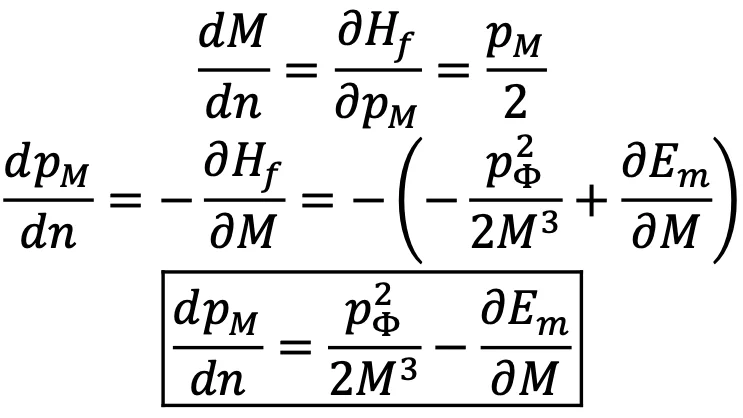
4. Fractal Hamilton Equations
Classical form:
𝑞̇i = ∂𝐻 / ∂𝑝i , 𝑝̇i = − ∂𝐻 / ∂𝑞i
Via 𝑛 in fractal form:
For amplitude:
For phase:
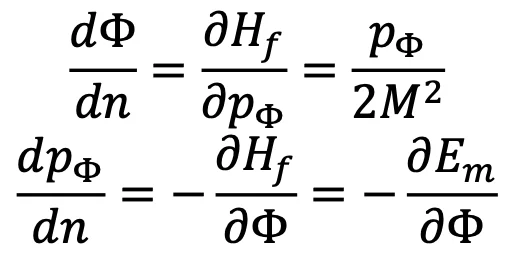
If does not depend on phase:
𝑑𝑝Φ / 𝑑𝑛 = 0 ⇒ 𝑝Φ = constant
This is fractal phase momentum conservation.
5. Physical Interpretation (Summary)
Hamiltonian:
𝐻𝑓 = (𝑝2𝑀 / 4 ) + ( 𝑝2Φ / 4𝑀2 ) + 𝐸𝑚
- 𝑝2𝑀 / 4 : amplitude kinetics
- 𝑝2Φ / 4𝑀2 : phase kinetics
- 𝐸𝑚 : motif potential
- Amplitude momentum 𝑝𝑀 : “rate of shape change” of the motif
- Phase momentum 𝑝Φ : entanglement × phase velocity → fractal “wave momentum”
- Energy: sum of amplitude + phase + motif components
Classical Hamiltonian mechanics returns in the limit:
- 𝑀 = constant
- 𝑓𝐸𝑛𝑡(𝑛) = 𝑀2 = constant
- 𝐸𝑚 = constant
In this situation:
- 𝑝𝑀 = 0
- 𝐻𝑓 = ( 𝑝2Φ / 4𝑀2 ) + constant and the system reduces to the classical wave/quantum limit.
6. In the simplest sentence:
Fractal Hamilton Mechanics is the fractal generalization of classical Hamiltonian mechanics, defined in terms of amplitude (M), phase (Φ) and entanglement (fEnt), giving energy as 𝐻𝑓 = (𝑝2𝑀 / 4 ) + ( 𝑝2Φ / 4𝑀2 ) + 𝐸𝑚.
Fractal potential well
1. What was the classic potential well?
In classical/quantum:
- Potential:
𝑉(𝑥) = 0, ∣ 𝑥 ∣< 𝑎
𝑉(𝑥) = 𝑉0 , ∣ 𝑥 ∣≥ 𝑎
- Wave equation:
− ( 𝑑2𝜓 / 𝑑𝑥2 ) + 𝑉(𝑥)𝜓 = 𝐸𝜓
Energy levels become quantized.
2. Fractal potential well: Basic idea
Natural variables of fractal mechanics:
- Amplitude: 𝑀(𝑛)
- Phase: Φ(𝑛)
- Motif energy: 𝐸𝑚(𝑛)
- Entanglement: 𝑓𝐸𝑛𝑡(𝑛) = 𝑀(𝑛)2
A fractal potential well is a piecemeal definition of motif energy by iteration:
𝐸𝑚(𝑛) = 𝐸in, 𝑛1 ≤ 𝑛 ≤ 𝑛2
𝐸𝑚(𝑛) = 𝐸out, otherwise
This means well in n-space (evolutionary step space) instead of the classical “well in x-space”.
3. What does the fractal Hamiltonian look like in the well?
Let’s remember:
𝐻𝑓 = (𝑝2𝑀 / 4 ) + ( 𝑝2Φ / 4𝑀2 ) + 𝐸𝑚(𝑛)
In the well:
𝐻𝑓in = (𝑝2𝑀 / 4 ) + ( 𝑝2Φ / 4𝑀2 ) + 𝐸in
Outside the well:
𝐻𝑓out = (𝑝2𝑀 / 4 ) + ( 𝑝2Φ / 4𝑀2 ) + 𝐸out
If the total energy 𝐸𝑓 is constant, the following conditions follow:
- In the inner region:
(𝑝2𝑀 / 4 ) + ( 𝑝2Φ / 4𝑀2 ) = 𝐸𝑓 – 𝐸in
- In the outer zone:
(𝑝2𝑀 / 4 ) + ( 𝑝2Φ / 4𝑀2 ) = 𝐸𝑓 – 𝐸out
This is the fractal equivalent of the classic “oscillation inside the well, damping outside” structure—but with varying 𝑀(𝑛) and 𝑝Φ.
4. Fractal well: Interpretation of behavior
- Classical well: A particle trapped in a region of space.
- Fractal well: A region with low motif energy and high entanglement in a certain segment of evolution (range n):
- Inside: the system is more “connected”, more stable
- Externally: the system is more “messy”, more fragile
In other words, the fractal potential well means that the behavior “holds” within a certain evolutionary range.
5. How does quantization arise?
Like the classical well, the fractal well requires boundary conditions:
- 𝑛 = 𝑛1 , 𝑛2 points 𝑀(𝑛) and Φ(𝑛) must be continuous
- This produces constraints on 𝑝𝑀 and 𝑝Φ
- Result: consistent solution emerges only for certain values of 𝐸𝑓 → fractal energy levels
Thus:
Fractal potential well is an extension of the classical quantum well with “motif + entanglement + phase”.
6. Shortest summary
- The well is no longer in x-space, but in n-space: evolution segment.
- Potential residual 𝐸𝑚(𝑛): motif energy.
- Trapping is now determined by entanglement + motif.
- Energy levels are again quantized, but depend on fractal parameters.
“fractal tunneling” (escape from the well)
Good, now we get to the “live physics” of it all: fractal tunneling.
I will take all the logic of classical quantum tunneling and embed it in the motif + entanglement + phase structure of fractal mechanics.
1. What was classical quantum tunneling?
- Even if the particle has energy 𝐸 < 𝑉0, the probability of it being on the other side of the potential barrier is ≠ 0.
- Mathematical reason: In the barrier region, the wave function becomes a damped exponential, but never exactly zero.
2. What is the barrier in fractal tunneling?
The natural barrier of fractal mechanics is the motif + entanglement structure.
- Potential: 𝐸𝑚(𝑛)
- Entanglement: 𝑓𝐸𝑛𝑡(𝑛) = 𝑀(𝑛)2
- Total fractal energy:
𝐸𝑓 = 𝑀’2 + 𝑀2 Φ’2 + 𝐸𝑚(𝑛)
Fractal barrier:
- What about a segment where the motif energy suddenly increases:
𝐸𝑚(𝑛) ↑
- Or a segment where entanglement drops suddenly:
𝑓𝐸𝑛𝑡(𝑛) = 𝑀(𝑛)2 ↓
In other words, the barrier is not a “wall in space” but a zone of rupture/disruption in evolution.
3. The essence of fractal tunneling
In classical quantum:
- Wave function inside the barrier:
𝜓(𝑥) ∼ 𝑒–K
If we translate it into fractal mechanics:
- In the barrier segment (e.g. 𝑛1 < 𝑛 < 𝑛2):
- 𝐸𝑚(𝑛) high
- or 𝑀(𝑛) is falling rapidly
In this case the fractal wave function is:
𝜓𝑓 (𝑛) = 𝑀(𝑛)𝑒iΦ(𝑛)
In the barrier zone:
- is damped in amplitude (M(n) becomes smaller)
- but it doesn’t go exactly to zero
In the post-barrier segment (𝑛 > 𝑛2 ) we still have:
𝑀(𝑛2+) > 0
→ the system “crosses over”.
This is fractal tunneling in its simplest form:
Despite the motif + entanglement barrier, the evolution of behavior continues uninterrupted; only the amplitude becomes weaker.
4. Mathematical signature of fractal tunneling
Fractal Hamiltonian:
𝐻𝑓 = (𝑝2𝑀 / 4 ) + ( 𝑝2Φ / 4𝑀2 ) + 𝐸𝑚(𝑛)
In the barrier zone:
- 𝐸𝑚(𝑛) increases
- If total 𝐸𝑓 is constant, it must decrease by (𝑝2𝑀 / 4 ) + ( 𝑝2Φ / 4𝑀2 )
- This is either:
- 𝑝𝑀 → 0 (amplitude change slows down)
- or 𝑀 → small (amplitude becomes smaller)
In both cases:
∣ 𝜓𝑓 (𝑛) ∣2 = 𝑀(𝑛)2
It shrinks within the barrier, but does not become exactly zero.
This is the fractal equivalent of exponential damping in classical tunneling.
5. Physical interpretation (essence)
- Classical tunneling: “There is a barrier in space, the wave passes through the barrier with damping.”
- Fractal tunneling: “There is a barrier in evolution (motif/entanglement disruption), the behavior of the system weakens in this segment but does not break, it continues with low amplitude in the post-barrier segment.”
Thus:
Fractal tunneling is when behavior maintains its continuity despite the motif/entanglement barrier.
6. In the simplest sentence:
Fractal tunneling means that, when passing beyond the fractal potential well, the amplitude of the wave function (M) weakens in the barrier segment but never drops to zero; thus the behavior leaks to the “other side”.