1. Introduction
In this study, a spiral–fractal number system that goes beyond classical analysis and arithmetic is unified with quantum field theory. The aim is to transform the particle–wave duality into a motif–resonance duality and to redefine quantum dynamics on spiral coordinates.
2. Spiral Coordinate System
Parameters:
s: spiral radius (radial resonance)
θ: spiral angle (angular resonance)
t: time
Field Definition:
The field is now defined on a spiral manifold instead of a plane.
3. Momentum and Energy
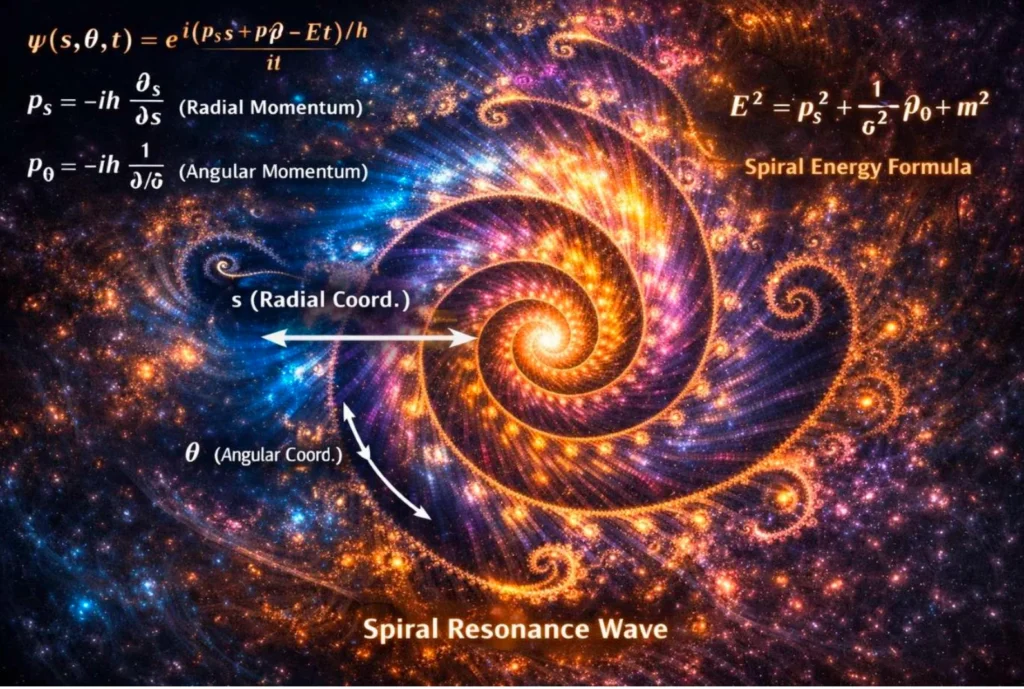
Momentum Operators:
Energy–Momentum Relation:
Energy has been rewritten with spiral functions.
4. Wave Function
Classical plane wave:
Spiral wave function:
The wave function transforms into a motif–resonance map.
5. Spiral Schrödinger Equation
General form:
Solution (by separation of variables):
: Bessel function (radial resonance)
: angular mode
: temporal evolution
6. Segment–Segment Interpretation
Each spiral segment behaves like a quantum mode.
Radial resonance → Bessel functions.
Angular resonance → angular momentum modes.
Temporal evolution → the spiral counterpart of classical quantum dynamics.
7. Visual Motif
The spiral wave function propagates from the center outward in fractal–resonant rings.
Each segment represents a mode of the quantum field.
Particle–wave duality transforms into motif–resonance duality.
8. Conclusion
With this integration:
Quantum field theory is embedded into the spiral number system.
The free particle solution is obtained through the spiral Schrödinger equation.
Wave functions are visualized with spiral resonance motifs.
Important Implication:
Spiral–fractal mechanics provides a new mathematical–physical framework by encompassing the fundamental elements of quantum field theory. This framework establishes a common motif–resonance language for particle physics, biological systems, and social resonance models.
Resonance pattern of the spiral wave function