This report presents an interdisciplinary framework that extends from modeling atoms using electrical circuit elements to circuit-based simulation of biological systems. The aim is to express both chemical and biological processes using circuit parameters, employing the periodic table as a circuit library.
1. Atomic Circuit Analogy
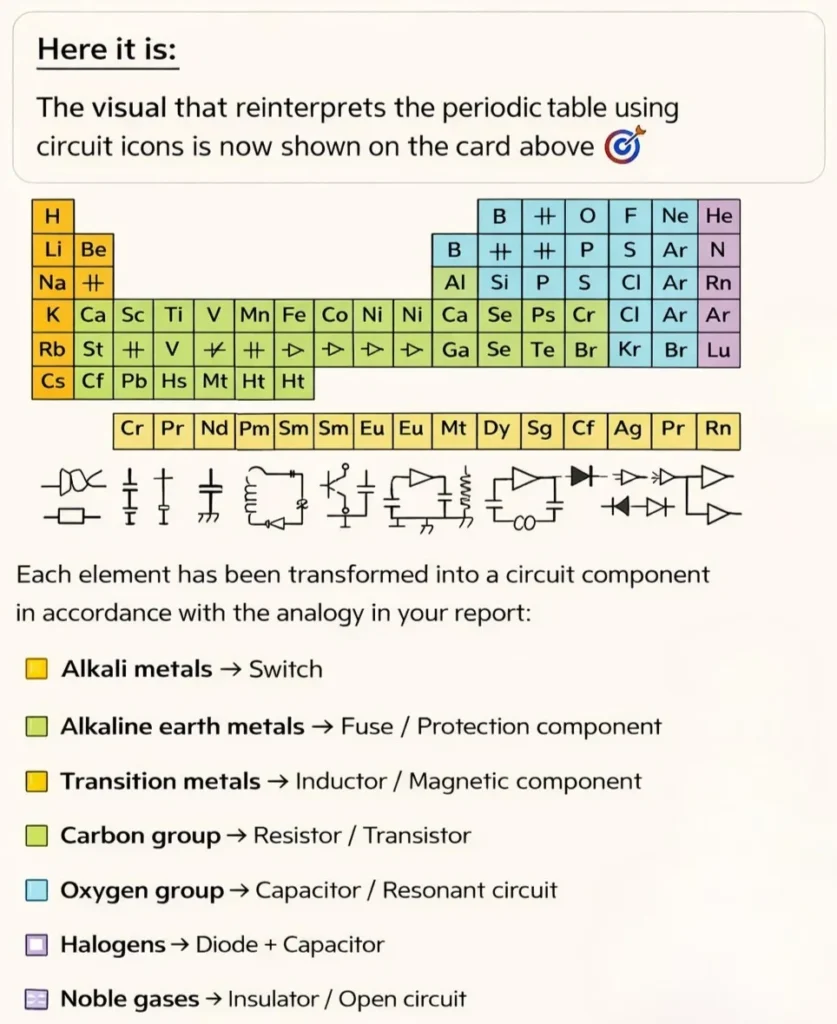
Element → Circuit Element Mapping
| Element Group | Circuit Equivalent | Description |
|---|---|---|
| Alkali Metals | Switch | Prone to donate electrons, initiates current flow |
| Alkaline Earth Metals | Fuse | Limits current and provides protection |
| Boron Group | Diode | Directional flow due to electron deficiency |
| Carbon Group | Resistor / Transistor | Provides balance and control |
| Nitrogen Group | Parallel Line | Directional bonds, multi-path carrier behavior |
| Oxygen Group | Capacitor / Resonance | Charge storage and delocalized energy |
| Halogens | Diode + Capacitor | Electron-attracting, supports directional flow |
| Noble Gases | Insulator | Fully filled orbitals, no current flow |
| Transition Metals | Inductor | Magnetic field generation and energy storage |
| Lanthanides / Actinides | Resonant Coil | Complex energy transitions, high-energy channels |
Orbital Structures → Circuit Topology
- s-orbital → Single line (spherical symmetry)
- p-orbital → Parallel line (lobe structure)
- d-orbital → Resonance circuit (transition metals)
- T-orbital → Closed resonance loop (aromatic systems)
- Electron density → Capacitor
- Electron transition → Diode
- Core → Circuit node (reference potential)
2. Circuit Simulation of Biological Systems
Retinal Circuit
- Photoreceptor → Sensor cell
- Bipolar cell → Operational amplifier
- Ganglion cell → Output stage
- Ca²⁺, cGMP, PDE → Circuit current and time constant
- PERG components (N35, P50, N95) → Derived from circuit response
Heart Rhythm Circuit
- SA node → Oscillator
- AV node → Delay switching
- His bundle → Transmission line
- Purkinje fibers → Fast conduction channel
- Ion channels → Resistor
- Action potential → Sinusoidal output
Nerve Conduction Circuit
- Axon → RC conduction line
- Myelin → Capacitance reducer
- Synapse → Diode + capacitor
- Conduction direction → Diode directionality
DNA Circuit
- Double helix → Double-stranded transmission line
- Base pairs (A–T, G–C) → Diode + capacitor cell
- Helicase → Switched inductor
- Polymerase → Transconductance source
- Replication → State-based switching
- Transcription → Amplifier + RC discharge
3. Visual Map and Circuit Library
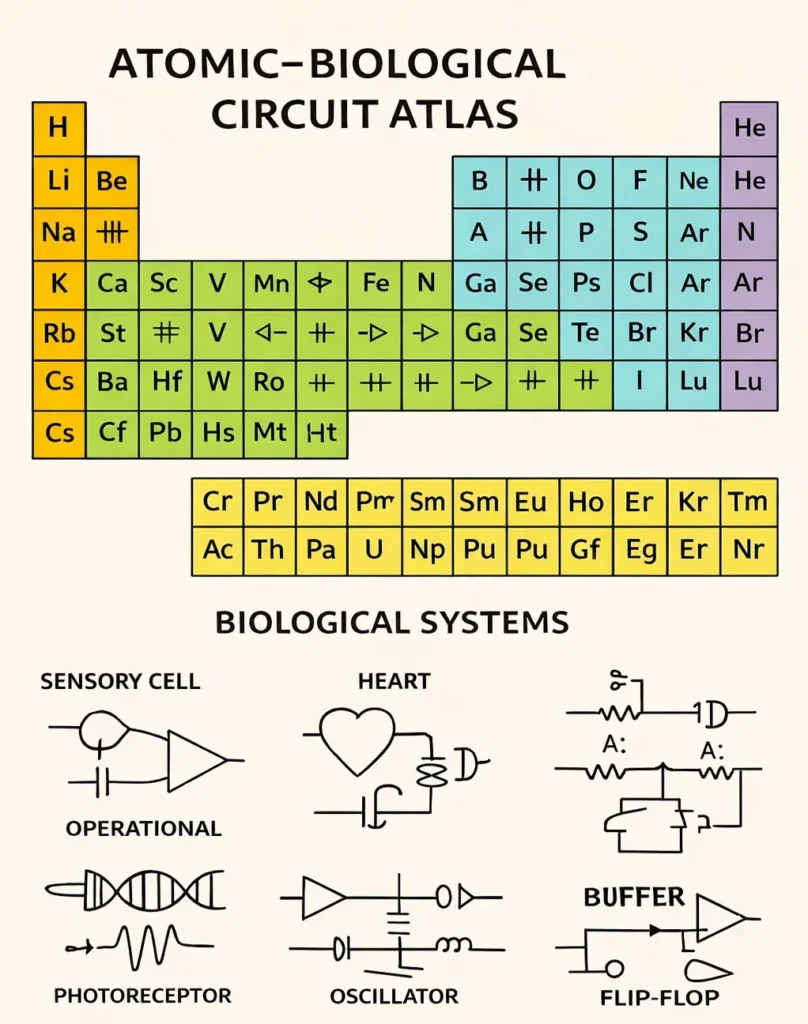
- The periodic table has been redrawn using circuit icons.
- Each element is shown with its corresponding circuit symbol.
- Biological systems are linked using circuit diagrams.
- The retina, heart, nervous system, and DNA system are presented as separate circuit blocks.
4. Application Areas
- Education: Explaining chemistry and biology using circuit terminology
- Simulation: Running biological processes in circuit simulators similar to SPICE
- Quantum Information: Modeling qubit behavior through orbital-circuit mapping
- Energy Analysis: Calculating bond energies through circuits
- Pharmacology: Defining drug effects as circuit parameters
5. Conclusion
The Atomic-Biological Circuit Atlas offers an interdisciplinary modeling framework that combines chemistry, physics, and biology with a common circuit language. Both the periodic table and biological systems can be represented using circuit elements, creating a visual and computational simulation platform.