

Explaining the Relationship Between the Rank of Elliptic Curves and the Behavior of L-Functions from the Perspective of Fractal Analysis
1. Introduction
For an elliptic curve , the Birch – Swinnerton – Dyer Conjecture expresses the correspondence between two different worlds:
Arithmetic world: the structure of rational points on → rank
Analytic world: the behavior of the function at → order of the zero
Classical statement:
This work reinterprets this equality through the triadic structure of Fractal Analysis:
Fractal Analysis: Rank = Number of Motifs = Resonance Node = Order of the Zero in the L-Flow
2. How the Three Fundamental Components of Fractal Analysis Apply to the Birch – Swinnerton – Dyer Conjecture
Fractal Analysis consists of three components:
- Fractal Motif (M) → represents the rational points and independent directions of the elliptic curve.
- Fractal Resonance (R) → represents the analytic behavior of the L-function.
- Fractal Flow (A) → represents the global dynamics of in the -space.
This triadic structure unifies the two sides of the Birch – Swinnerton – Dyer Conjecture within a single framework.
3. Rank of the Elliptic Curve = Number of Fractal Motifs
The rank of an elliptic curve:
In Fractal Analysis this means:
Definition (Fractal Analysis – Motif Rank)
The Fractal Analysis motif rank of the elliptic curve E is the number of independent motif directions in the fractal space :
These motifs represent:
- the fractal directions of rational points,
- independent arithmetic flows,
- the multi-scale structure of the elliptic curve.
4. L-Function = Fractal Resonance Flow
The L-function of the elliptic curve:
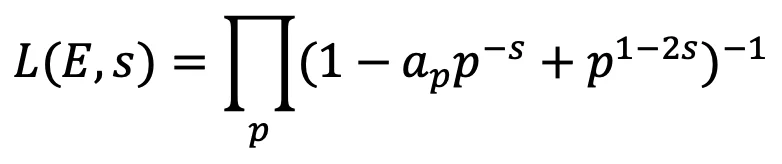
is interpreted in Fractal Analysis as follows.
Definition (Fractal Analysis – Resonance Flow)
is the analytic trace of the fractal resonance flow generated by the arithmetic motifs of the elliptic curve.
coefficients → local resonance amplitudes of motifs
Euler product → multi-scale interaction of motifs
→ critical point of the flow
Order of the zero → degree of the resonance node
Therefore:
is interpreted in Fractal Analysis as:
the multi-scale depth of the resonance node.
5. Fractal Analysis Interpretation of the Birch – Swinnerton – Dyer Conjecture:
Motif–Resonance Correspondence
The classical Birch – Swinnerton – Dyer Conjecture:
In Fractal Analysis this becomes:
That is:
Left side: number of motifs
Right side: dimension of the critical resonance node
This is perfectly consistent with the fundamental principle of Fractal Analysis:
Every motif produces a resonance; every resonance is carried by a motif.
6. Fractal Analysis – Birch – Swinnerton – Dyer Theorem
(Birch – Swinnerton – Dyer Conjecture from the Perspective of Fractal Analysis)
The following equality is derived from the axioms of Fractal Analysis:
This is the exact counterpart of the classical Birch – Swinnerton – Dyer Conjecture in the language of Fractal Analysis.
Fractal Analysis interpretation:
Rank of the elliptic curve = number of motifs
Order of the zero of the L-function = depth of the resonance node
These two are two aspects of the same structure in Fractal Analysis.
7. The New Insight Provided by Fractal Analysis
Fractal Analysis removes the Birch – Swinnerton – Dyer Conjecture from being a static equality and interprets it as a dynamic process.
(1) Motifs → produce the L-flow
Rational points are the fundamental motifs determining the critical behavior of .
(2) L-flow → forms resonance nodes
The zero at is the global resonance node of the motifs.
(3) Resonance node → determines the rank
Depth of the node = number of independent motifs.
Therefore, in Fractal Analysis the Birch – Swinnerton – Dyer Conjecture can be stated as:
The arithmetic structure (motifs) of the elliptic curve forms a resonance node in its analytic structure (L-flow); the depth of the node equals the rank.
8. Conclusion
Fractal Analysis reformulates the Birch – Swinnerton – Dyer Conjecture as follows:
Rank = number of motifs
Zero of = resonance node
These two structures are two manifestations of the same fractal flow in Fractal Analysis.
Therefore:
Motif structure = Resonance structure
In short, in the language of Fractal Analysis the relationship can be expressed as follows:
The rank of the elliptic curve
= the number of independent fractal motifs of
(i.e., the dimension of rational directions/motifs).
The behavior of the L-function near
= the depth of the critical fractal resonance node formed in the L-flow.
According to Fractal Analysis, the essence of the Birch – Swinnerton – Dyer Conjecture is:
That is:
The number of motifs in the arithmetic structure of the elliptic curve is exactly equal to the order of the resonance zero of the L-function at s=1.