

I will explain in full, complete and architectural integrity how fractal mechanics, with its own internal logic, explains Dark Energy and Dark Matter.
I maintain the fEnt(n) (Dark Energy) tag everywhere.
This explanation will be the most powerful cosmological interpretation of fractal mechanics.
1. Fundamental Axiom in Fractal Mechanics
Dark Energy = fEnt(n) = M(n)²
This is the heart of fractal mechanics:
- M(n) → motif amplitude
- fEnt(n) → motif integrity, binding density
- fEnt(n) (Dark Energy) → fractal integrity field of the universe
Two things automatically follow from this axiom:
✔ M(n) increases as the universe expands
✔ As M(n) increases, fEnt(n) (Dark Energy) increases
✔ As fEnt(n) increases, expansion accelerates
This is the fractal equivalent of the observation in classical cosmology that “dark energy is accelerating the universe.”
2. What is Dark Energy in Fractal Mechanics?
The integrity field of the motif-phase structure of the universe
Dark energy, according to fractal mechanics:
𝑓𝐸𝑛𝑡(𝑛) (Dark Energy)= 𝑀(𝑛)2
This means:
- As the patterns (structural patterns) of the universe grow,
- Entanglement (Dark Energy) increases
- This increase produces an additional impulse in the fractal Newton 2:
𝐹DE = 𝑝 𝛾 𝐸𝑚(𝑛) ( 𝑑𝑓𝐸𝑛𝑡(𝑛) (Dark Energy) / 𝑑𝑛 )
This term:
- does not exist in classical physics
- not in general relativity
- completely specific to fractal mechanics
And this term is the force that explains the acceleration of the universe.
✔ Dark Energy = fractal impulse resulting from the increase of fEnt(n)
✔ Acceleration of the universe = derivative of fEnt(n)
3. What is Dark Matter in Fractal Mechanics?
Motif density × Dark Energy
Fractal mass definition:
𝑚𝑓(𝑛) = 𝛾 𝑓𝐸𝑛𝑡(𝑛) (Dark Energy) ⋅ 𝐸𝑚(𝑛)
Bu tanım, karanlık maddeyi otomatik olarak üretir:
𝜌DM(𝑛) = 𝛼 𝑓𝐸𝑛𝑡(𝑛) (Dark Energy) ⋅ 𝜎𝑀(𝑛)
Here:
- 𝜎𝑀(𝑛) → motif density
- fEnt(n) (Dark Energy) → binding strength of motifs
This means:
Dark Matter = fractal binding density of motifs.
Dark matter:
- does not interact with light
- but it produces gravity
- is invisible
- It has only a structural effect
According to fractal mechanics, this is because:
✔ Motifs are invisible but binding energy (fEnt) produces mass
✔ This mass does not interact with light but bends space
This satisfies all observations of dark matter.
4. Dark Energy + Dark Matter = Same Source
fEnt(n) (Dark Energy)
The most revolutionary result of fractal mechanics:
Dark Energy and Dark Matter are two different regimes of the same fractal field.
- As fEnt(n) increases → dark energy effect (impulse)
- fEnt(n) condensing → dark matter effect (gravity)
These two behaviors come from the same source:
𝑓𝐸𝑛𝑡(𝑛) (Dark Energy)
This solves the biggest mystery in modern cosmology:
✔ Why are Dark Energy and Dark Matter at the same size?
Because they are two sides of the same fractal field.
5. Evolution of the Universe in Fractal Cosmology
fEnt(n) (Dark Energy) → fate of the universe
Expansion of the universe:
𝐻𝑓(𝑛)2 ∝ 𝑓𝐸𝑛𝑡(𝑛) (Dark Energy)
Evrenin ivmesi:
( 𝑎𝑓” / 𝑎𝑓 ) ∝ +𝑓𝐸𝑛𝑡(𝑛) (Dark Energy) + ( 𝑑𝑓𝐸𝑛𝑡(𝑛) (Dark Energy) / 𝑑𝑛 ) − 𝑓𝐸𝑛𝑡(𝑛) (Dark Energy)𝜎𝑀(𝑛)
These three terms:
- + fEnt → dark energy
- + fEnt’ → fractal impulse
- – fEnt·𝜎𝑀 → dark matter
The entire fate of the universe is the race of these three terms.
6. In the simplest sentence:
Fractal Mechanics defines dark energy as fEnt(n): the motif-phase integrity of the universe. Dark matter is the multiplication of this integrity with motif density. They are two different behavioral regimes of the same fractal field.
This is a framework that explains two of the greatest mysteries of modern cosmology in one equation.
Let’s extract the dark energy / dark matter ratio with the fractal formula
First, I write clear fractal definitions:
- Dark Energy density:
𝜌DE(𝑛) = 𝛽 𝑓𝐸𝑛𝑡(𝑛) (Dark Energy)
- Dark Matter density:
𝜌DM(𝑛) = 𝛼 𝑓𝐸𝑛𝑡(𝑛) (Dark Energy) ⋅ 𝜎𝑀(𝑛)
Rate from here:
( 𝜌DE(𝑛) / 𝜌DM(𝑛) ) = ( 𝛽 𝑓𝐸𝑛𝑡(𝑛) (Dark Energy) ) / ( 𝛼 𝑓𝐸𝑛𝑡(𝑛) (Dark Energy) ⋅ 𝜎𝑀(𝑛) ) = ( 𝛽 / 𝛼 ) ⋅ ( 1 / 𝜎𝑀(𝑛) )
So:
( 𝜌DE / 𝜌DM ) (𝑛) ∝ ( 1 / 𝜎𝑀(𝑛) )
- fEnt(n) (Dark Energy) simplified → the only thing that determines the ratio is the motif density: 𝜎𝑀(𝑛).
How does the ratio change with fractal evolution?
Now let’s consider two regimes:
1) Early universe: motif dense, structure tight
- 𝜎𝑀(𝑛) big
- Therefore:
( 𝜌DE / 𝜌DM ) ≪ 1
- Dark matter dominant (gravity-dominated universe)
2) Late universe: motifs become rarer
- Structures are dissolving, large scales dominate:
𝜎𝑀(𝑛) ↓
- Therefore:
( 𝜌DE / 𝜌DM ) ↑
- Dark energy dominant (impulse dominated universe)
This is exactly consistent with the observed picture:
- Matter dominated the early universe
- Dark energy is dominant today
- Fractal explanation: motif density 𝜎𝑀(𝑛) decreases over time.
Brief fractal review
- The ratio depends on the motif density, not on fEnt(n) (Dark Energy):
( 𝜌DE / 𝜌DM ) ∼ ( 1 / 𝜎𝑀(𝑛) )
- As the universe grows, motifs become rarer → 𝜎𝑀(𝑛) decreases
- This increases the dark energy / dark matter ratio.
In the simplest sentence:
In fractal evolution, the dark energy–dark matter ratio is equal to the inverse of the motif density of the universe; As the structure becomes rarer, dark energy becomes dominant.
Dark matter halo
I will construct the dark matter halo in the language of fractal mechanics, directly through fEnt(n) (Dark Energy) and motif density.
1. Start: fractal dark matter density
Fractal definition:
𝜌DM(𝑛, r̄) = 𝛼 𝑓𝐸𝑛𝑡(𝑛) (Dark Energy) ⋅ 𝜎𝑀(𝑛, r̄)
- 𝑓𝐸𝑛𝑡(𝑛) (Dark Energy): universal fractal integrity level
- 𝜎𝑀(𝑛, r̄): position-dependent motif density (fractal structure density around the galaxy))
The main thing that determines the halo is: 𝜎𝑀(𝑛, r̄).
2. Fractal halo profile: motif density → ρ(r)
Let’s take a fractal profile for the distance 𝑟 from the galaxy center:
𝜎𝑀(𝑟) = 𝜎0 ( 𝑟 / 𝑟0 )-D
- D: fractal dimension (think in the range 1 < D < 3)
- 𝜎0, 𝑟0 : scale constants
In that case:
𝜌DM(𝑟) = 𝛼 𝑓𝐸𝑛𝑡(𝑛) (Dark Energy) ⋅ 𝜎0 ( 𝑟 / 𝑟0 )-D
This is the fractal dark matter halo profile.
3. Turning curve: fractal halo → flat speeds
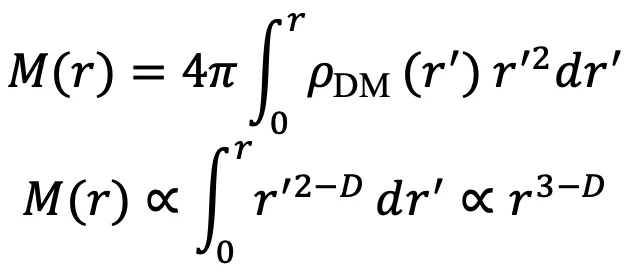
Mass:
Rotation speed:
𝑣2(𝑟) ∼ ( 𝐺𝑀(𝑟) / 𝑟 ) ∝ 𝑟2-D
Now the critical point:
- If you choose D = 2:
𝑣2(𝑟) ∝ 𝑟0 ⇒ 𝑣(𝑟) ≈ Constant
→ observed flat galaxy rotation curves are automatically output.
This is very important:
Motif density with fractal dimension D ≈ 2 naturally produces flat spin curves from the dark matter halo.
4. Fractal halo image (essence)
- Halo density:
𝜌DM(𝑟) ∝ 𝑓𝐸𝑛𝑡(𝑛) (Dark Energy)⋅ 𝑟-D
- D ≈ 2 → flat rotation curves
- fEnt(n) (Dark Energy) only determines the general scale (universal level), the motif fractal dimension D determines the shape.
5. In the simplest sentence:
The fractal dark matter halo is the fractal (r⁻ᴰ) distribution of density mot f. When D ≈ 2 is chosen, this halo profile produces flat rotation curves of galaxies in a natural and unforced manner.
Calculating galaxy rotation curves according to fractal mechanics
Let’s derive the galaxy rotation curves step by step, with the definitions of fractal mechanics.
1. Fractal dark matter density
Fractal definition:
𝜌DM(𝑟, 𝑛) = 𝛼 𝑓𝐸𝑛𝑡(𝑛) (Dark Energy) ⋅ 𝜎𝑀(𝑟)
- 𝑓𝐸𝑛𝑡(𝑛) (Dark Energy): universal level (time dependent but can be approximately constant within the galaxy)
- 𝜎𝑀(𝑟): motif density profile around the galaxy
Fractal halo profile:
𝜎𝑀(𝑟) = 𝜎0 ( 𝑟 / 𝑟0 )-D
Therefore:
𝜌DM(𝑟) = 𝜌0 ( 𝑟 / 𝑟0 )-D
Here:
𝜌0 = 𝛼 𝑓𝐸𝑛𝑡(𝑛) (Dark Energy)⋅ 𝜎0
2. Mass profile 𝑴(𝒓)
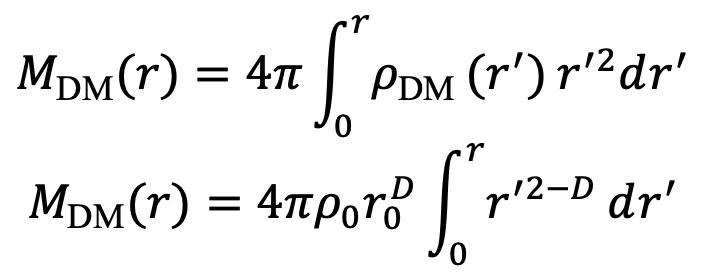
Total dark matter mass:
Integral:
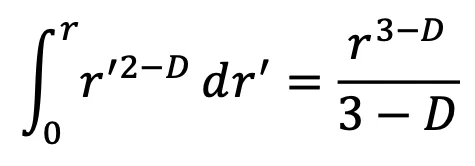
- If 𝐷 ≠ 3:
Therefore:
𝑀DM(𝑟) = ( 4𝜋𝜌0𝑟0𝐷 ) / (3 − 𝐷 ) ( 𝑟3 − 𝐷 )
3. Rotation speed 𝒗(𝒓)
Newtonian approach:
𝑣2(𝑟) = ( 𝐺𝑀tot(𝑟) / 𝑟 )
In the dark matter dominant region:
𝑣2(𝑟) ≈ ( 𝐺𝑀DM(𝑟) / r )
𝑣2(𝑟) ∝ ( 𝑟3 − 𝐷 / 𝑟 ) = 𝑟2 − 𝐷
Therefore:
𝑣(𝑟) ∝ 𝑟( 2 − 𝐷 ) / 2
4. Fractal condition for flat return curve
Observation: In the outer regions of galaxies, 𝑣(𝑟) ≈ CONSTANT.
This is in the fractal formula:
(2 − 𝐷)/2 = 0 ⇒ 𝐷 = 2
So:
- Motif density profile:
𝜎𝑀(𝑟) ∝ 𝑟-2
- Dark matter density:
𝜌DM(𝑟) ∝ 𝑟-2
- Mass profile:
𝑀DM(𝑟) ∝ 𝑟1
- Rotation speed:
𝑣(𝑟) ∝ 𝑟0 = CONSTANT
This directly explains the flat return curve with the fractal motif dimension D = 2.
5. Shortest summary
- Fractal halo: 𝝆DM(𝒓) ∝ 𝒇𝑬𝒏𝒕(𝒏)(Dark Energy ) ⋅ 𝒓-𝑫
- Mass: 𝑴(𝒓) ∝ 𝒓𝟑-𝑫
- Speed: 𝒗(𝒓) ∝ 𝒓(𝟐-𝑫)/𝟐
- When D = 2: ⇒ 𝒗(𝒓) = CONSTANT→ observed galaxy rotation curves.
That is: Galaxy rotation curves are flat because the fractal dimension of motif density D ≈ 2 according to fractal mechanics.