1. Classical Definition
The photoelectric effect is the emission of an electron when a photon strikes a metal surface. Quantum mechanics explains this with the formula:
𝐸 = ℎ𝜈 − 𝑊
Here, ℎ𝜈 is the photon energy, and 𝑊 is the work function. In the classical approach, 𝑊 is assumed to be constant.
2. Fractal Mechanics Perspective
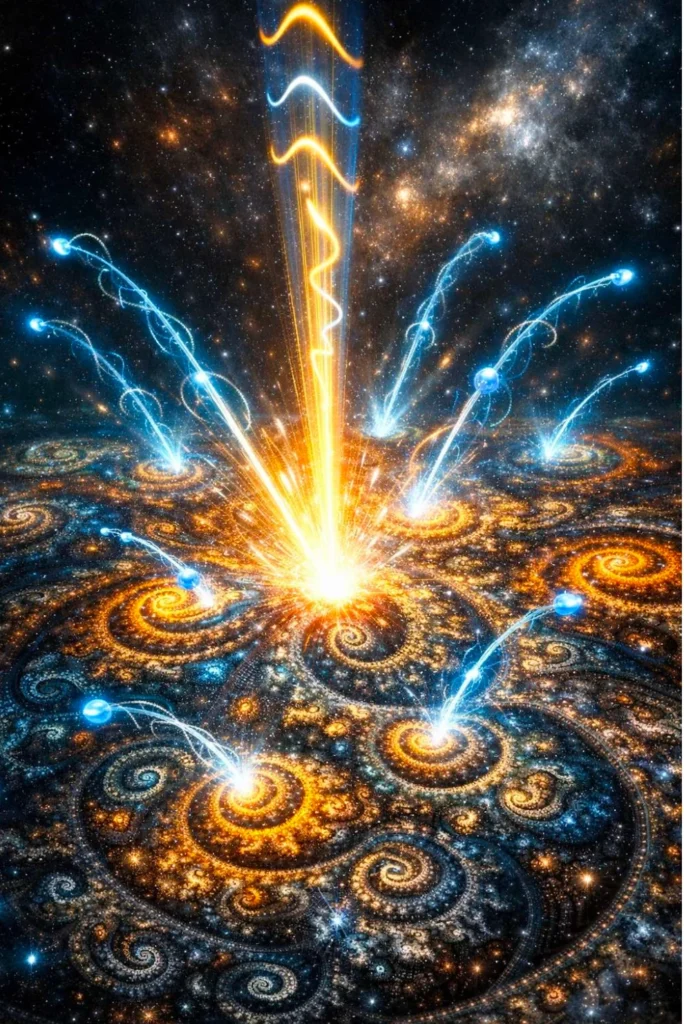
Fractal mechanics defines surface morphology using spiral–fractal motifs. In this case:
The energy levels where electrons reside are not determined by a single center but by multi-centered spiral resonances.
The work function is not constant but varies as a fractal function:
𝑊fractal (𝑟, 𝜃) = 𝑊0 + ∑i=1n 𝛼i ⋅ sin (𝑘i𝑟 + 𝜙i) ⋅ 𝑒-𝛽i𝜃
Here, 𝑟 and 𝜃 are spiral coordinates, while 𝛼i, 𝑘i, 𝜙i, and 𝛽i are fractal motif parameters.
3. Energy Transfer
When photon energy strikes the surface, it is distributed according to the spiral motifs:
𝐸transfer(𝑟, 𝜃) = ℎ𝜈 ⋅ (1 − 𝛾 ⋅ 𝑓motif (𝑟, 𝜃))
𝑓motif (𝑟, 𝜃): Spiral motif density
𝛾: Energy loss coefficient
Electron emission occurs under the following condition:
𝐸transfer (𝑟, 𝜃) ≥ 𝑊fractal (𝑟, 𝜃)
4. Effect of Surface Morphology
Micro-fractal structures differentiate electron emission thresholds.
As spiral density on the surface increases, more electrons are emitted → efficiency increases.
Processes such as thermal annealing optimize efficiency by organizing spiral motifs.
Surface morphology controls photon–electron interaction through deterministic coverage.
5. Cosmic and Biological Analogies
A photon striking the surface is like energy falling into a galactic center.
Electron emission represents local break points of energy transport along spiral arms.
Like the spiral structure of DNA, energy transfer operates through multi-centered fractal resonances.
6. Conclusion
When the photoelectric effect is interpreted through fractal mechanics:
It is not a linear threshold event, but a process determined by multi-centered spiral resonances.
Surface morphology directly controls efficiency.
This approach can be used to develop fractal optimization strategies in solar cells and surface coating technologies.
The impact of photons on a surface covered with spiral–fractal motifs, and the emission of electrons from different spiral centers, is illustrated below.