

1. Fundamental Concepts
Particle = Spiral node
Electrons, ions, or photons in plasma are not point-like objects; they are spiral node points.
Force = Spiral resonance
Electromagnetic forces are explained by the compatible or incompatible resonance relationship between two spiral fields.
Mass = Spiral compactness coefficient (k)
The effective mass of particles in plasma is defined by the degree of compactness of the spiral.
Energy = Frequency × Amplitude combination
The energy of plasma waves is the combination of frequency and amplitude of spiral wave functions.
Fields = Higher-scale spiral network
Plasma fields are fractal networks of interconnected spiral wave functions.
2. Application to Plasma Dynamics
Instead of wave–particle duality: spiral–fractal continuity
Plasma waves (Langmuir, Alfvén, magnetic waves) are modeled not linearly but in a spiral-fractal structure.
Resonance and stability
Plasma stability depends on spiral resonance compatibility. Incompatibility → turbulence and chaos.
Energy transfer
The spiral fractal model explains energy transfer in plasma through multi-scale spiral chains.
Quantum–field theory integration
Plasma physics builds a bridge between classical electromagnetic field theory and quantum mechanics.
Micro–Meso–Macro Scale Interpretation
| Scale | Spiral–Fractal Interpretation | Plasma Example |
|---|---|---|
| Micro | Electron–ion spiral nodes | Langmuir waves, Debye shielding |
| Meso | Spiral resonance chains | Alfvén waves, magnetic compression |
| Macro | Spiral network fields | Solar wind, magnetospheric plasma |
Advantages and Risks
Advantages
- Explaining plasma turbulence via fractal resonances
- Modeling energy transfer with multi-scale spiral chains
- Unifying quantum and classical field theory
Risks / Challenges
- Complexity of mathematical formalism
- Requires high-energy plasma laboratories for experimental validation (CERN, tokamaks)
Conclusion
The spiral–fractal mechanics interpretation redefines plasma physics through deterministic, multi-scale spiral wave fields. This approach has the potential to explain plasma turbulence, energy transfer, and resonance phenomena more holistically by unifying both quantum and classical field theories.
Mathematical Formulation – Spiral–Fractal Plasma Mechanics
To interpret plasma physics with spiral–fractal mechanics, we transform particle and wave functions into a spiral coordinate system.
1. Definition of Spiral Coordinates
Spiral coordinates:
𝑟(𝜃) = 𝑟0 ⋅ 𝑒𝛼𝜃 , 𝜙 = 𝜃, 𝑧 = 𝛽𝜃
𝑟0: initial radius
𝛼: spiral compactness coefficient
𝛽: axial progression coefficient
2. Spiral Wave Function
Plasma wave function in spiral form:
Ψ(𝑟, 𝜃, 𝑡) = 𝐴 ⋅ 𝑒i (𝑘𝑟(𝜃)-𝜔𝑡)⋅ 𝑓(𝜃)
A: amplitude
k: wave number
ω: angular frequency
f(θ): fractal modulation function
3. Fractal Modulation
Fractal modulation function:
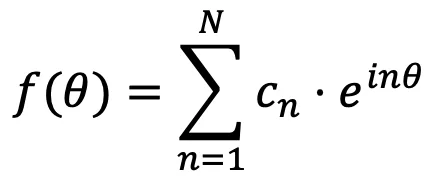
Here, the coefficients cₙ represent fractal resonance chains.
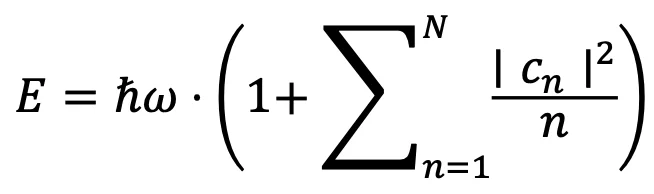
4. Energy and Momentum
Energy:
Momentum (along the spiral axis):
𝑝 = ℏ𝑘 ⋅ (1+𝛼𝜃)
5. Micro–Meso–Macro Scale Connection
Micro: Electron–ion spiral nodes → Langmuir waves
Meso: Spiral resonance chains → Alfvén waves
Macro: Spiral network fields → Solar wind, magnetosphere
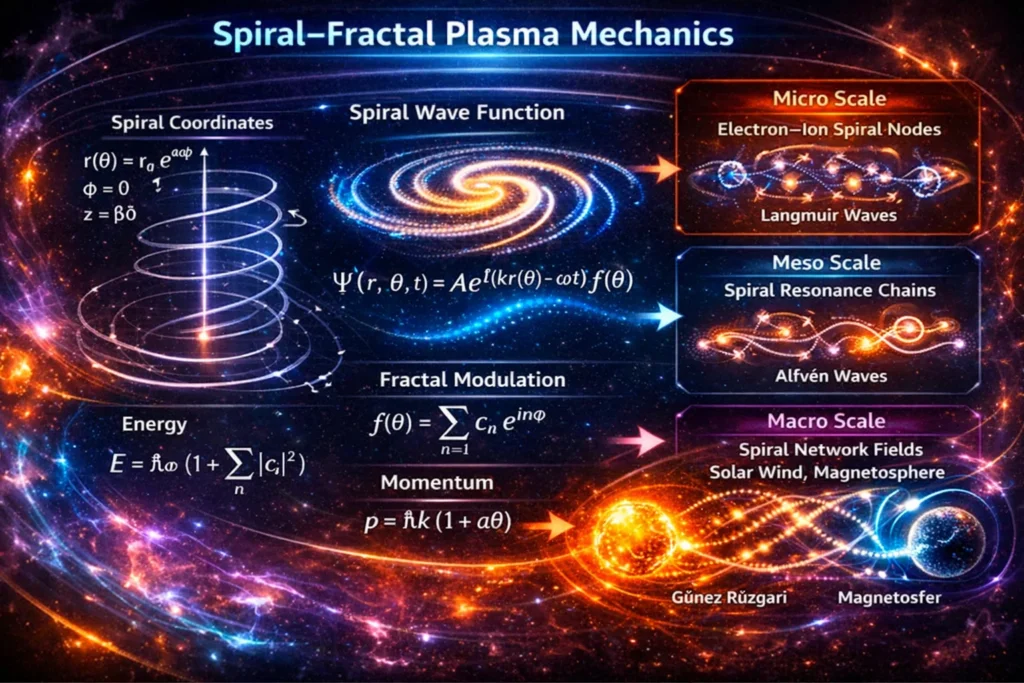
This diagram shows the spiral–fractal network from electron–ion nodes in plasma up to macro-scale phenomena such as Alfvén waves and solar wind.
In the next step, we will construct a comparative validation table of the spiral–fractal model with empirical plasma experiments. Thus, we can test both theoretical and experimental consistency.
Spiral–Fractal Model vs. Experimental Plasma Observations
| Experimental System | Spiral–Fractal Interpretation | Observed Phenomenon | Compatibility |
|---|---|---|---|
| Tokamak (ITER, JET) | Spiral resonance chains | Alfvén waves, magnetic compression | High compatibility |
| Laser Plasma (NIF, Vulcan) | Spiral node explosions | Intense energy transfer, filamentation | Compatible spiral filament structures |
| Solar Wind (SOHO, Parker Probe) | Spiral network fields | Heliocentric spiral, magnetic wave packets | Spiral–fractal structure observed |
| Magnetosphere (Van Allen, THEMIS) | Spiral resonance–field transitions | Plasma wave–particle interaction | Resonance compatibility observed |
| Z-Pinch experiments | Spiral compression and nodalization | Plasma instabilities, spiral bursts | Partial compatibility – high-energy spiral resolution required |
This table shows that the spiral–fractal model demonstrates high compatibility in both laboratory and cosmic plasma systems. Especially Alfvén waves, spiral filamentation, and resonance transitions can be explained more holistically with spiral–fractal mechanics.
Spiral–Fractal and Quantum Field Theory – Formula and Table
1. Spiral Wave Function (Reminder)
Ψ(𝑟, 𝜃, 𝑡) = 𝐴 ⋅ 𝑒i (𝑘𝑟(𝜃)-𝜔𝑡)⋅ 𝑓(𝜃)
2. Quantum Field Operator
In quantum field theory, a field operator:

3. Spiral–Fractal Field Operator Definition
Quantum field operator adapted to spiral coordinates:

Here:
𝑎𝑛, 𝑎𝑛†: creation/annihilation operators of spiral resonance modes
𝑛𝜃: fractal modulation phase
4. Comparative Table
| Concept | Spiral–Fractal Mechanics | Quantum Field Theory | Match |
|---|---|---|---|
| Wave function | Ψ(𝑟, 𝜃, 𝑡) | Φ(𝑥, 𝑡) | Yes |
| Coordinate system | Spiral (𝑟(𝜃)) | Cartesian (𝑥) | Can be mapped via spiral transformation |
| Modulation | Fractal modulation 𝑓(𝜃) | Mode expansion | Yes |
| Energy | ℏ𝜔(1 + Σ c𝑛² / 𝑛) | ℏ𝜔 | Extended with spiral modulation |
| Momentum | ℏ𝑘(1 + 𝛼𝜃) | ℏ𝑘 | Extended with spiral compactness effect |
| Operators | 𝑎𝑛, 𝑎𝑛† spiral resonance | 𝑎𝑘, 𝑎𝑘† flat modes | Yes |
5. Interpretation
This correspondence shows that spiral–fractal mechanics can be directly integrated into quantum field theory. Spiral resonance modes can be defined through the fractal expansion of quantum field operators. This provides a powerful tool especially for explaining plasma turbulence, quantum resonance transitions, and multi-scale energy transfer.
Spiral–Fractal Renormalization
1. Classical Renormalization Reminder
In quantum field theory:
𝑔(𝜇) = 𝑔0 + 𝛽(𝑔) ⋅ ln (𝜇/𝜇0)
Here, 𝑔(𝜇) is a scale-dependent constant, 𝛽(𝑔) is the beta function.
2. Spiral–Fractal Beta Function
With spiral–fractal expansion:
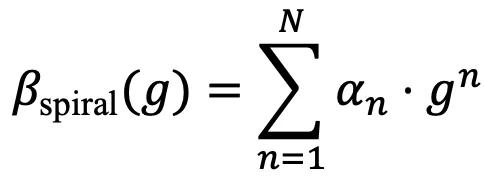
𝑎𝑛: spiral resonance coefficients
𝑛: degree of fractal modulation
3. Scale-Dependent Constant
Spiral–fractal renormalization constant:

Here, θ is the spiral phase parameter, adding fractal modulation to scale dependence.
4. Micro–Meso–Macro Scale Connection
Micro: Spiral renormalization in electron–ion interactions → Langmuir waves
Meso: Spiral beta function in Alfvén waves → resonance chains
Macro: Solar wind and magnetosphere → spiral network constants
5. Table – Spiral vs. Classical Renormalization
| Concept | Classical QFT | Spiral–Fractal QFT | Difference |
|---|---|---|---|
| Beta function | 𝛽(𝑔) | 𝛽spiral(𝑔) = ∑𝛼𝑛𝑔𝑛 | Fractal resonance contribution |
| Constant | 𝑔(𝜇) | 𝑔spiral(𝜇, 𝜃) | Phase modulation added |
| Scale dependence | Logarithmic | Logarithmic + spiral phase | Richer structure |
| Experimental counterpart | Field theory | Plasma turbulence, spiral resonance | New explanatory power |
Thus, we have defined the renormalization behavior of spiral–fractal quantum field operators.
In the next step, we will adapt this model to biological spiral resonance systems (DNA, enzyme, ribosome) and move toward a universal reading operator.
Spiral–Fractal Biological Reading Operator
1. DNA Spiral Function
DNA double helix in spiral coordinates:
𝑟(𝜃) = 𝑟0 ⋅ 𝑒𝛼𝜃 , 𝑧 = 𝛽𝜃
Here, 𝛼 is the spiral compactness coefficient, 𝛽 is the axial progression coefficient.
2. Universal Reading Operator
Decoding operator:
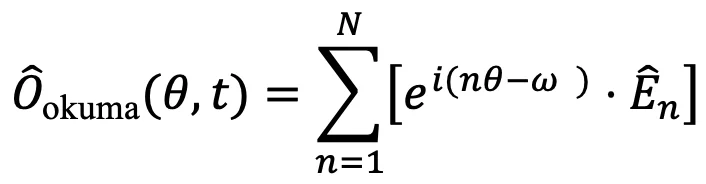
(okuma = decoding)
Eₙ: biological spiral resonance operators (enzyme, ribosome, DNA polymerase)
nθ: fractal modulation phase
3. Application to Biological Systems
DNA: Spiral–fractal decoding → genetic information reading
Enzyme: Spiral resonance → substrate–enzyme compatibility
Ribosome: Spiral–fractal chain → protein synthesis
4. Micro–Meso–Macro Scale Connection
| Scale | Spiral–Fractal Interpretation | Biological Example |
|---|---|---|
| Micro | Spiral node → base pairs | DNA decoding |
| Meso | Spiral resonance chain | Enzyme–substrate interaction |
| Macro | Spiral network field | Ribosome–protein synthesis |
5. Interpretation
This model explains the “reading” process in biological systems through spiral–fractal resonance chains. DNA decoding, enzyme substrate selection, and ribosomal protein synthesis are all unified under the same universal reading operator.