
7- Let’s expand the fractal analysis chain with fractal probability distributions (𝑷𝒇).
This is a motif-repeating, multi-scale version of classical probability theory and provides entirely new definitions for uncertainty, risk, and variational systems.
Classical Probability Distribution
The classical probability density for a random variable 𝑋:
𝑃(𝑥) ≥ 0, ∫-∞∞ 𝑃(𝑥) 𝑑𝑥 = 1
It is a single-scale distribution.
Fractal Probability Distribution
In its fractal version, the distribution becomes scale-repeating:
𝑃f (𝑥) = ( 1/𝑍 ) ∑n=0∞ ( 1/𝑏n )𝑃(𝑟n𝑥)
- r : fractal scale ratio (e.g., 1/2, 1/3).
- b : motif base, resonance coefficient.
- Z : normalization constant, to equate the total probability to 1.
Each term represents the repetition of the distribution at different scales.
Result: Instead of a single distribution, a fractal distribution spectrum is formed.
Features
- Multi-scale uncertainty: Contains both micro and macro probability contributions simultaneously.
- Motif resonance: Probability is not just a single distribution, but distributions repeating along a motif chain.
- New definition of risk: While classical variance is single-scale, fractal variance becomes a motif-repeating chain.
Concretization
Let’s think in terms of music: Classical probability defines the likelihood of a note being played on a single plane. Fractal probability, on the other hand, defines the likelihood of the same note being played in a motif chain that repeats across octaves. Thus, not just a single probability, but the entire fractal probability structure is calculated.
Application
- Physics: Multi-scale probability distributions in chaotic systems (e.g., particle motions).
- Biology: Motif-repeating probability models in protein folding or gene expression.
- Economics: Fractal risk distributions of crisis waves.
- Society: Multi-scale uncertainty analysis in behavior models.
- Art/Music: Probability calculations of motif-repeating improvisations.
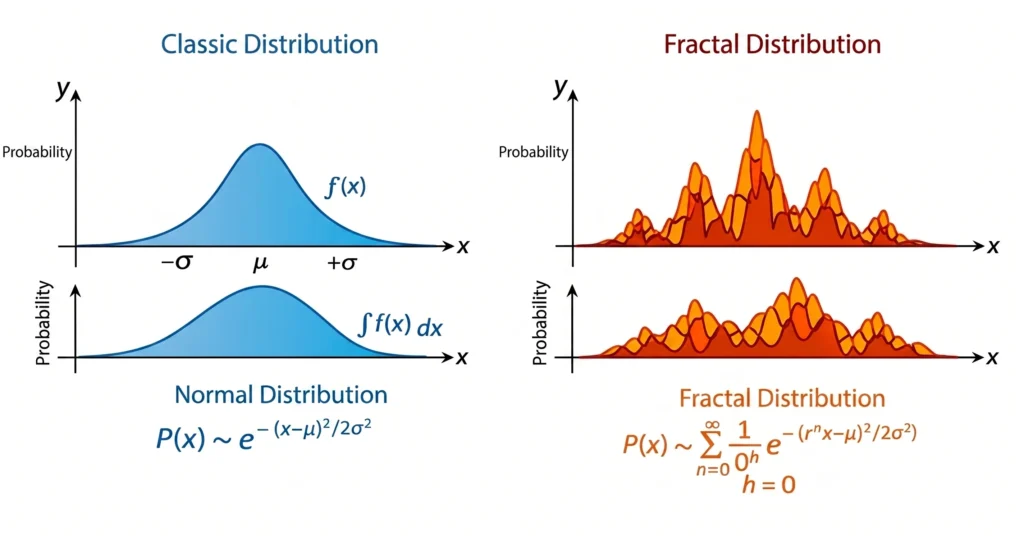
In this visual, the classical normal distribution and the fractal probability distribution are located side by side:
- On the left is the classical single-peaked, symmetrical Gaussian curve 𝑃(𝑥) ∼ 𝑒 -(𝑥-𝜇)2 / 2𝜎2.
- On the right is the fractal distribution 𝑃(𝑥) ∼ ∑(1/𝑏n)𝑒 -(𝑟n𝑥-𝜇)2 / 2𝜎2, meaning a motif-repeating, multi-scale probability structure.
This difference visually and clearly demonstrates that fractal statistics carries a much richer information structure than classical distribution: while the classical distribution operates on a single plane of uncertainty, the fractal distribution distributes uncertainty in a resonant manner across scales.
8- Fractal statistics (𝑆𝑓)
Now let’s expand the fractal analysis chain with fractal statistics (𝑆𝑓). This is a motif-repeating, multi-scale expansion of classical statistical concepts (mean, variance, correlation, etc.).
Classical Statistics
- Mean:
𝜇 = (1/𝑁) ∑i=1𝑁 𝑥i - Variance:
𝜎2 = (1/𝑁) ∑i=1𝑁 (𝑥i − 𝜇)2
These are single-scale definitions.
Fractal Statistics
In its fractal version, every measurement becomes scale-repeating:
- Fractal Mean
𝜇𝑓 = (1/𝑍) ∑n=0∞ (1/𝑏n) ( (1/𝑁) ∑i=1𝑁 (𝑥i ⋅ 𝑟n) ) - Fractal Variance
𝜎𝑓2 = (1/𝑍) ∑n=0∞ (1/𝑏n) ( (1/𝑁) ∑i=1𝑁 (𝑥i ⋅ 𝑟n − 𝜇𝑓)2 ) - Fractal Correlation
𝜌𝑓 (𝑋, 𝑌) = (1/𝑍) ∑n=0∞ (1/𝑏n) ⋅ 𝜌(𝑋 ⋅ 𝑟n , 𝑌 ⋅ 𝑟n )
Here:
- r : fractal scale ratio
- b : motif base
- Z : normalization constant
Result: Instead of a single statistical value, a fractal statistics spectrum is formed.
Features
- Multi-scale mean and variance: Contains both micro and macro contributions simultaneously.
- Motif resonance: A statistic is not just a single measurement, but measurements repeating along a motif chain.
- New definition of uncertainty: While classical variance is single-scale, fractal variance becomes a motif-repeating chain.
Concretization
Let’s think in terms of music: Classical statistics measures the average pitch of a piece. Fractal statistics, on the other hand, measures the mean and variance chain repeating across octaves of the same piece. Thus, not just a single value, but the entire fractal statistical structure is revealed.
Application
- Physics: Multi-scale statistical analysis in chaotic systems.
- Biology: Fractal mean and variance in processes like gene expression and protein folding.
- Economics: Fractal risk statistics of crisis waves.
- Society: Multi-scale correlation analysis in behavior models.
- Art/Music: Statistical resonance analysis of fractal motifs.
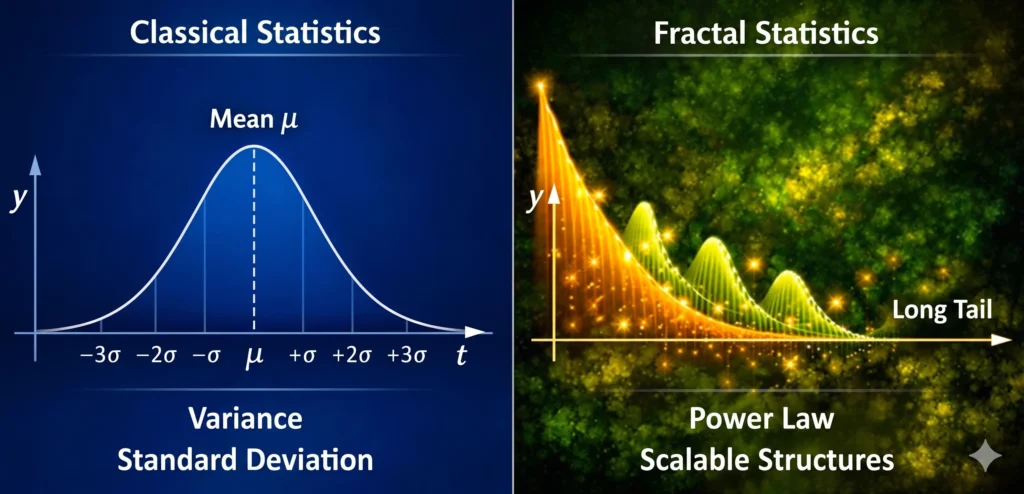
Here is the side-by-side visual comparison of classical and fractal statistics:
- Classical Statistics (left): Normal distribution bell curve, symmetrical around the mean. Variance and standard deviation are defined by fixed parameters.
- Fractal Statistics (right): Power-law distribution, long-tailed, and motif-repeating structures across scales. The mean alone is not sufficient; the tails show the complex nature of the system.
This visual clearly presents the classical approach that tries to explain nature with a single-scale “mean” versus the fractal approach that captures the complex, multi-scale distributions in nature.
9- Fractal geometry measures (𝐺𝑓)
Now let’s expand the fractal analysis chain with fractal geometry measures (𝐺𝑓). This is a motif-repeating, multi-scale expansion of classical geometry measures (area, volume, dimension).
Classical Geometry Measures
- Area:
𝐴 = ∫ ∫ 𝑑𝑥 𝑑𝑦 - Volume:
𝑉 = ∫ ∫ ∫ 𝑑𝑥 𝑑𝑦 𝑑𝑧 - Dimension:
Classically 1 (length), 2 (area), 3 (volume).
Fractal Geometry Measures
In its fractal version, measurements become scale-repeating:
- Fractal Area
𝐴𝑓 = ∑n=0∞ (1/𝑏n) ∫ ∫ 𝑓(𝑟n𝑥, 𝑟n𝑦) 𝑑𝑥 𝑑𝑦 - Fractal Volume
𝑉𝑓 = ∑n=0∞ (1/𝑏n) ∫ ∫ ∫ 𝑓(𝑟n𝑥, 𝑟n𝑦, 𝑟n𝑧) 𝑑𝑥 𝑑𝑦 𝑑𝑧 - Fractal Dimension
𝐷𝑓 = limn → ∞ log (𝑁(𝑟n)) / log (1/𝑟)
Here:
- r : fractal scale ratio
- b : motif base
- 𝑁(𝑟n) : number of motifs at scale 𝑟
Result: Instead of a single measurement, a fractal measurement spectrum is formed.
Features
- Multi-scale area and volume: Contains both micro and macro geometric contributions simultaneously.
- Motif resonance: Geometry is not just a single measurement, but measurements repeating along a motif chain.
- New definition of dimension: While the classical dimension is fixed, the fractal dimension becomes a motif-repeating chain.
Concretization
Let’s think in terms of art: Classical geometry measures a single area of a painting. Fractal geometry, however, measures the motif-repeating area chain of the same painting. Thus, not just a single surface, but the entire fractal surface structure is revealed.
Application
- Physics: Multi-scale space-time geometry, cosmic structures.
- Engineering: Fractal area and volume calculations of material surfaces.
- Biology: Fractal dimensions of cell membranes and vascular networks.
- Economics/Sociology: Fractal geometric measurements of network structures.
- Art/Music: Geometric resonance analysis of fractal motifs.
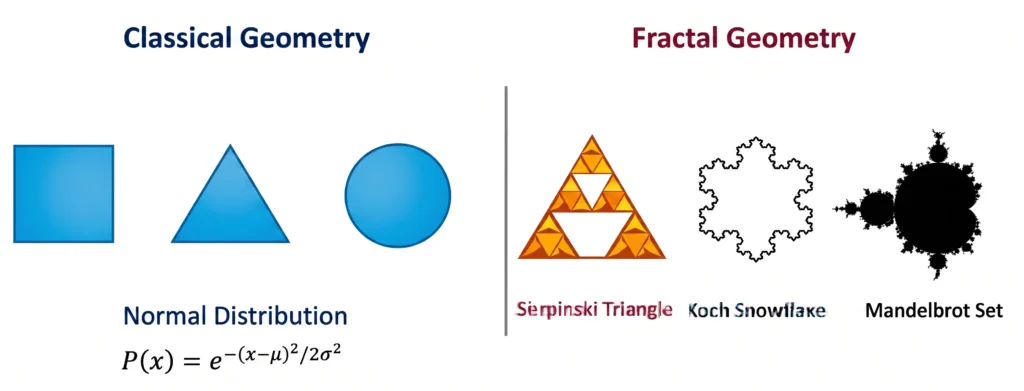
In this visual, classical geometric shapes and fractal motif-repeating geometries are located side by side:
- On the left, the classical square, triangle, and circle are seen as single-scale, fixed-form shapes.
- On the right, the fractal Sierpinski Triangle, Koch Snowflake, and Mandelbrot Set are shown as motif-repeating, multi-scale structures.
This difference visually and clearly demonstrates that fractal geometry measures present a much more complex, self-replicating, and cross-scale resonant structure than classical geometry.
10- Fractal information theory measures (𝐼𝑓)
Now let’s expand the fractal analysis chain with fractal information theory measures (𝐼𝑓). This is a motif-repeating, multi-scale version of classical information theory (entropy, information, complexity, mutual information).
Classical Information Theory Measures
- Shannon Entropy:
𝐻(𝑋) = −∑i 𝑃( 𝑥i )log 𝑃(𝑥i) - Mutual Information:
𝐼(𝑋; 𝑌) = ∑𝑥, 𝑦 𝑃(𝑥, 𝑦)log( 𝑃(𝑥, 𝑦) / ( 𝑃(𝑥)𝑃(𝑦) ) )
Fractal Information Theory Measures
In its fractal version, probabilities become scale-repeating:
- Fractal Entropy
𝐻𝑓 (𝑋) = − (1/𝑍) ∑n=0∞ (1/𝑏n) ∑i 𝑃(𝑟n𝑥i)log 𝑃(𝑟n𝑥i) - Fractal Mutual Information
𝐼𝑓 (𝑋; 𝑌) = (1/𝑍) ∑n=0∞ (1/𝑏n) ∑𝑥, 𝑦 𝑃(𝑟n𝑥, 𝑟n𝑦)log( 𝑃(𝑟n𝑥, 𝑟n𝑦) ) / ( 𝑃(𝑟n𝑥)𝑃(𝑟n𝑦) )
Here:
- r : fractal scale ratio
- b : motif base
- Z : normalization constant
Result: Instead of a single information measure, a fractal information spectrum is formed.
Features
- Multi-scale entropy: Measures both micro and macro uncertainties simultaneously.
- Motif resonance: Information does not just exist on a single plane, but repeats along a motif chain.
- New definition of complexity: While classical complexity is single-scale, fractal complexity becomes a motif-repeating chain.
Concretization
Let’s think in terms of music: Classical entropy measures the uncertainty of a melody on a single plane. Fractal entropy, on the other hand, measures the uncertainty chain repeating across octaves of the same melody. Thus, not just a single information measure, but the entire fractal information structure is revealed.
Application
- Physics: Multi-scale entropy and information flow in chaotic systems.
- Quantum: Information measures of spiral-fractal wave functions.
- Biology: Fractal entropy of genetic information and protein folding.
- Economics: Fractal information flow of crisis waves.
- Society: Multi-scale information resonance in behavior models.
- Art/Music: Information-complexity analysis of fractal motifs.
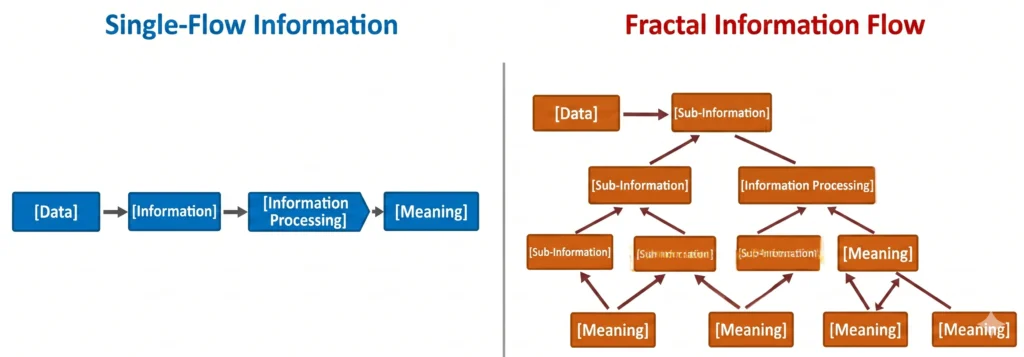
In this visual, classical information flow and fractal information flow are located side by side:
- On the left, single-flow information proceeds in a straight chain — data → information → processing → meaning.
- On the right, fractal information flow branches out and multiplies — each piece of data is split into sub-information, sub-processes, and multiple layers of meaning.
This difference visually and clearly demonstrates that fractal information theory presents a much richer, multi-scale, and self-replicating information structure than the classical linear information model.
11- Fractal thermodynamic measures (𝑇𝑓)
Now let’s expand the fractal analysis chain with fractal thermodynamic measures (𝑇𝑓). This is a motif-repeating, multi-scale version of classical thermodynamics (energy, entropy, temperature, free energy).
Classical Thermodynamic Measures
- Energy:
𝑈 = ∫ 𝐸(𝑥) 𝑑𝑥 - Entropy:
𝑆 = −𝑘∑i 𝑃(𝑥i)log 𝑃(𝑥i) - Free Energy:
𝐹 = 𝑈 − 𝑇𝑆
Fractal Thermodynamic Measures
In its fractal version, all measures become scale-repeating:
- Fractal Energy
𝑈𝑓 = ∑n=0∞ (1/𝑏n) ∫ 𝐸(𝑟n𝑥) 𝑑𝑥 - Fractal Entropy
𝑆𝑓 = −𝑘 ⋅ (1/𝑍) ∑n=0∞ (1/𝑏n) ∑i 𝑃( 𝑟n𝑥i)log 𝑃(𝑟n𝑥i) - Fractal Free Energy
𝐹𝑓 = 𝑈𝑓 − 𝑇𝑓𝑆𝑓 - Fractal Temperature
𝑇𝑓 = ∂𝑈𝑓 / ∂𝑆𝑓
Here:
- r : fractal scale ratio
- b : motif base
- Z : normalization constant
Result: Instead of a single energy/entropy value, a fractal thermodynamic spectrum is formed.
Features
- Multi-scale energy and entropy: Contains both micro and macro contributions simultaneously.
- Motif resonance: Thermodynamics does not just exist on a single plane, but repeats along a motif chain.
- New definition of equilibrium: While classical equilibrium is at a single point, fractal equilibrium is distributed along the motif chain.
Concretization
Let’s think in terms of music: Classical thermodynamics measures the total energy density of a piece. Fractal thermodynamics, on the other hand, measures the energy-entropy chain repeating across octaves of the same piece. Thus, not just a single density, but the entire fractal energy balance is revealed.
Application
- Physics: Multi-scale energy and entropy analysis in chaotic systems.
- Quantum: Thermodynamic measures of spiral-fractal wave functions.
- Biology: Fractal thermodynamics of intracellular energy and metabolism.
- Economics: Fractal energy-entropy balance of crisis waves.
- Art/Music: Energy-dynamic analysis of fractal motifs.
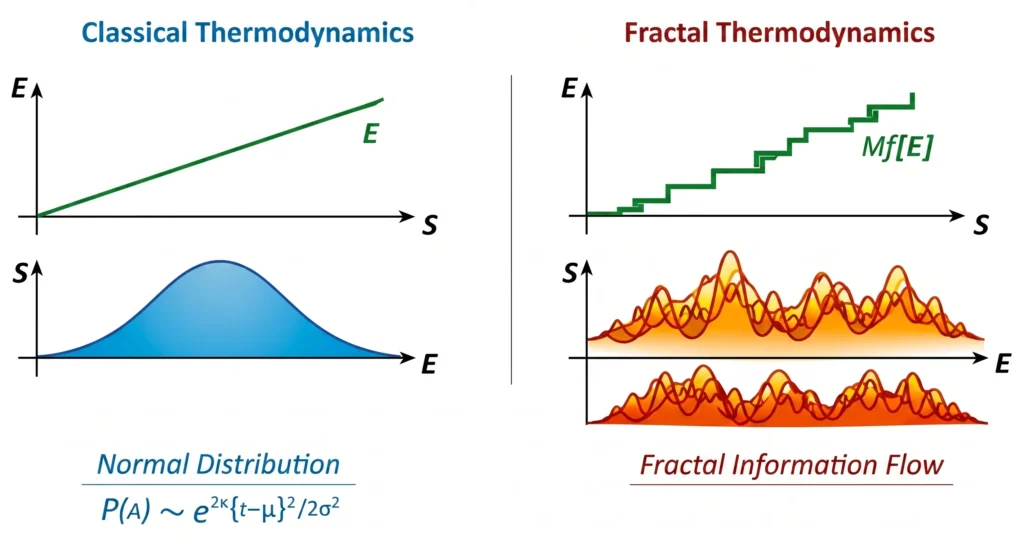
In this visual, classical thermodynamic curves and fractal thermodynamic structures are located side by side:
- On the left, classical energy 𝐸 and entropy 𝑆 curves are smooth and simple — the energy line goes upward, and the entropy curve has a single peak.
- On the right, fractal energy resonances 𝑀𝑓 [𝐸] and fractal entropy waves 𝑀𝑓 [𝑆] are motif-repeating, wavy, and complex — energy resonances are stepped, and entropy waves have a multi-peak structure.
This difference visually and clearly demonstrates that fractal thermodynamics can perform much more complex, multi-scale, and resonant energy-entropy analyses than classical thermodynamics.
12- Fractal mechanical measures (𝑀𝑓)
Now let’s open the fractal analysis chain with fractal mechanical measures (𝑀𝑓). This is a motif-repeating, multi-scale expansion of classical mechanical concepts (force, momentum, energy, flow, wave motion).
Classical Mechanical Measures
- Force:
𝐹 = 𝑚 ⋅ 𝑎 - Momentum:
𝑝 = 𝑚 ⋅ 𝑣 - Energy:
𝐸 = (1/2)𝑚𝑣2
Fractal Mechanical Measures
In its fractal version, all measures become scale-repeating:
- Fractal Force
𝐹𝑓 = ∑n=0∞ (1/𝑏n)𝑚(𝑟n) ⋅ 𝑎(𝑟n𝑡) - Fractal Momentum
𝑝𝑓 = ∑n=0∞ (1/𝑏n)𝑚(𝑟n) ⋅ 𝑣(𝑟n𝑡) - Fractal Energy
𝐸𝑓 = ∑n=0∞ (1/𝑏n)(1/2)𝑚(𝑟n) ⋅ 𝑣(𝑟n𝑡)2 - Fractal Wave Function
𝜓𝑓 (𝑥, 𝑡) = ∑n=0∞ (1/𝑏n)𝜓(𝑟n𝑥, 𝑟n𝑡)
Here:
- r : fractal scale ratio
- b : motif base
- Each term represents the mechanical behavior of the system at different scales.
Result: Instead of a single force/momentum/energy, a fractal mechanical spectrum is formed.
Features
- Multi-scale dynamics: Resolves both micro and macro motions simultaneously.
- Motif resonance: Mechanics does not just exist on a single plane, but repeats along a motif chain.
- New definition of equilibrium: While classical equilibrium is at a single point, fractal equilibrium is distributed along the motif chain.
Concretization
Let’s think in terms of music: Classical mechanics defines a single vibration of a stringed instrument. Fractal mechanics, on the other hand, defines the resonance chain repeating across octaves of the same vibration. Thus, not just a single vibration, but the entire fractal vibration structure is revealed.
Application
- Physics: Fractal dynamics of earthquake waves, turbulence, and chaotic flows.
- Engineering: Multi-scale force and energy calculations in material strength and fluid mechanics.
- Quantum: New particle interactions with spiral-fractal wave functions.
- Biology: Fractal dynamics of intracellular mechanical processes.
- Art/Music: Analysis of fractal vibration and resonance motifs.
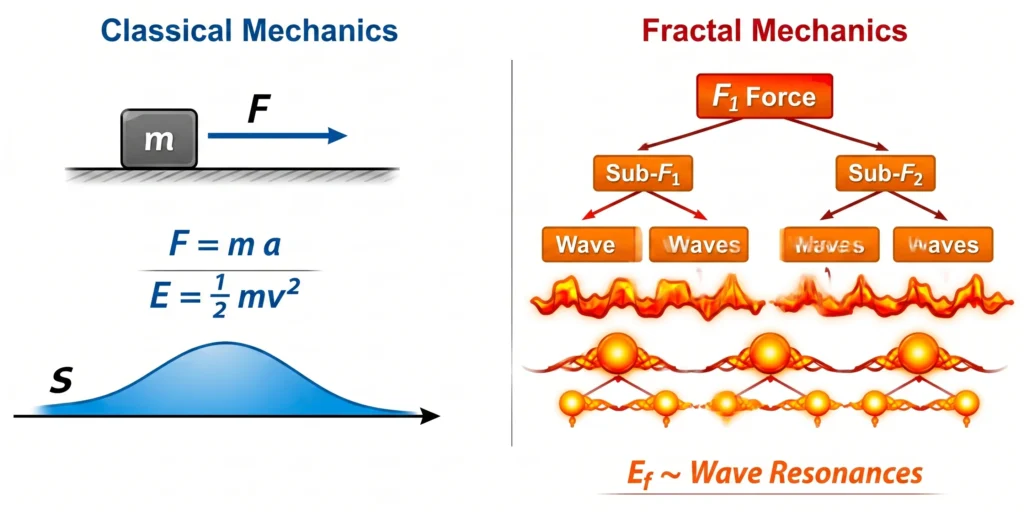
In this visual, classical mechanical systems and fractal mechanical structures are located side by side:
- On the left, classical mechanics shows a straightforward, single-scale force-motion relationship — constant mass 𝑚, unidirectional acceleration 𝑎, and linear energy transfer 𝐹 = 𝑚 ⋅ 𝑎, 𝐸 = (1/2)𝑚𝑣2.
- On the right, fractal mechanics operates with multi-scale wave-resonance chains — force and motion branch out, showing the motif-repeating flow of energy in the form of wave resonances.
This difference visually and clearly demonstrates that in fractal mechanics, energy is transferred not only linearly but through cross-scale resonance.
13- Fractal electromagnetic measures (𝐸𝑀𝑓)
Now let’s open the fractal analysis chain with fractal electromagnetic measures (𝐸𝑀𝑓). This is a motif-repeating, multi-scale expansion of classical electromagnetic theory (electric field, magnetic field, Maxwell’s equations, wave motion).
Classical Electromagnetic Measures
- Electric field:
𝐸➔ = −∇𝑉 - Magnetic field:
𝐵➔ = ∇ × 𝐴➔ - Maxwell’s equations:
∇ ⋅ 𝐸➔ = 𝜌/𝜖0, ∇ ⋅ 𝐵➔ = 0, ∇ × 𝐸➔ = − ∂𝐵➔ / ∂𝑡, ∇ × 𝐵➔ = 𝜇0 𝐽➔ + 𝜇0𝜖0 (∂𝐸➔ / ∂𝑡)
Fractal Electromagnetic Measures
In its fractal version, fields and equations become scale-repeating:
- Fractal Electric Field
𝐸𝑓➔ (𝑥, 𝑡) = ∑n=0∞ (1/𝑏n) 𝐸➔ (𝑟n𝑥, 𝑟n𝑡) - Fractal Magnetic Field
𝐵𝑓➔ (𝑥, 𝑡) = ∑n=0∞ (1/𝑏n) 𝐵➔ (𝑟n𝑥, 𝑟n𝑡) - Fractal Maxwell’s Equations
∇ ⋅ 𝐸𝑓➔ = 𝜌𝑓/𝜖0, ∇ ⋅ 𝐵𝑓➔ = 0, ∇ × 𝐸𝑓➔ = −∂𝐵𝑓➔ / ∂𝑡, ∇ × 𝐵𝑓➔ = 𝜇0 𝐽𝑓➔ + 𝜇0𝜖0 (∂𝐸𝑓➔ / ∂𝑡)
Here:
- r : fractal scale ratio
- b : motif base
- 𝜌𝑓 , 𝐽𝑓 : fractal charge and current density
Result: Instead of a single field, a fractal electromagnetic spectrum is formed.
Features
- Multi-scale fields: Contains both micro and macro electric and magnetic fields simultaneously.
- Motif resonance: Fields do not just exist on a single plane, but repeat along a motif chain.
- New definition of a wave: While the classical electromagnetic wave is at a single frequency, the fractal wave becomes a motif-repeating chain.
Concretization
Let’s think in terms of music: A classical electromagnetic wave carries a single-frequency vibration. A fractal electromagnetic wave, on the other hand, carries the resonance chain repeating across octaves of the same vibration. Thus, not just a single wave, but the entire fractal wave structure is revealed.
Application
- Physics: Analysis of multi-scale electromagnetic waves (plasma, cosmic rays).
- Engineering: Use of fractal resonance in antenna design.
- Quantum: New particle interactions with spiral-fractal electromagnetic fields.
- Biology: Fractal dynamics of intracellular electromagnetic processes.
- Art/Music: Visual and auditory resonance analysis of fractal wave motifs.
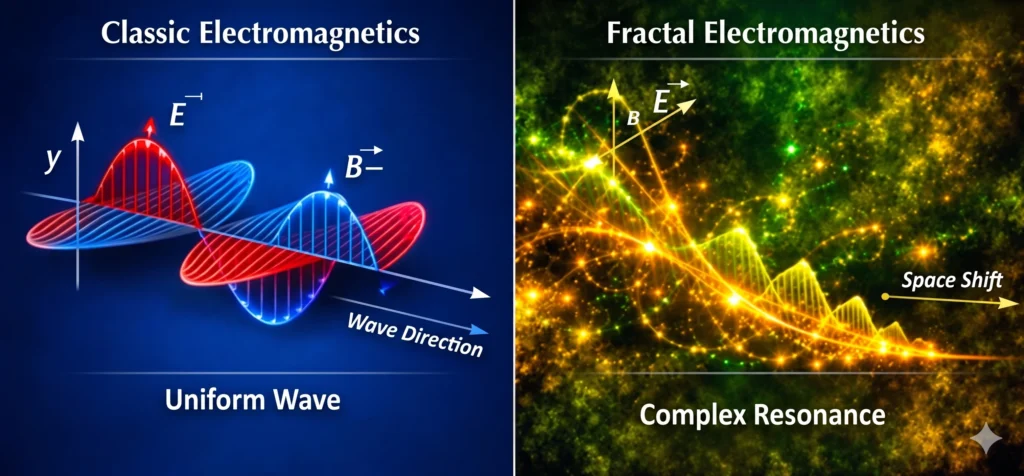
In this visual, the classical electromagnetic wave and the fractal electromagnetic field are shown side by side:
- Classical Electromagnetic (left): Smooth, sinusoidal waves. Electric field (E→) and magnetic field (B→) progress perpendicular to each other with constant amplitude. The wave direction is unidirectional, and energy flow is linear.
- Fractal Electromagnetic (right): Branched, multi-scale wave structure. Field lines connect to form motif-repeating resonance networks. Energy is no longer unidirectional, but in circulation across scales.
This comparison shows that while classical electromagnetics explains nature with single-frequency plane waves, fractal electromagnetics captures the complex, multi-scale energy resonances in nature.
14- Fractal gravitation measures (𝐺𝑣𝑓)
Now let’s open the fractal analysis chain with fractal gravitation measures (𝐺𝑣𝑓). This is a motif-repeating, multi-scale expansion of classical theories of gravity (Newton, Einstein, space-time geometry).
Classical Gravitation Measures
- Newton:
𝐹 = 𝐺 ( 𝑚1𝑚2 ) / 𝑟2 - Einstein (General Relativity):
𝐺𝜇𝑣 = ( 8𝜋𝐺 / 𝑐4 ) / 𝑇𝜇𝑣
Here, 𝐺𝜇𝑣 defines the space-time geometry, and 𝑇𝜇𝑣 defines the energy-momentum tensor.
Fractal Gravitation Measures
In its fractal version, the field and equations become scale-repeating:
- Fractal Newtonian Force
𝐹𝑓 = ∑n=0∞ (1/𝑏n) 𝐺 ( ( 𝑚1(𝑟n) 𝑚2(𝑟n) ) / ( 𝑟n𝑑 )2 - Fractal Einstein Equations
𝐺𝜇𝑣𝑓 = ( 8𝜋𝐺 / 𝑐4 ) / 𝑇𝜇𝑣𝑓
𝐺𝜇𝑣𝑓 = ∑n=0∞ (1/𝑏n)𝐺𝜇𝑣 (𝑟n𝑥, 𝑟n𝑡), 𝑇𝜇𝑣𝑓 = ∑n=0∞ (1/𝑏n)𝑇𝜇𝑣 (𝑟n𝑥, 𝑟n𝑡)
Here:
- r : fractal scale ratio
- b : motif base
Result: Instead of a single gravitational field, a fractal gravitation spectrum is formed.
Features
- Multi-scale gravitation: Both micro (atomic) and macro (cosmic) gravity are calculated simultaneously.
- Motif resonance: Gravity does not just exist on a single plane, but repeats along a motif chain.
- New definition of space-time: While classical space-time is a single geometry, fractal space-time is a motif-repeating chain of manifolds.
Concretization
Let’s think in terms of art: Classical gravitation defines the weight of a sculpture at a single point. Fractal gravitation, on the other hand, defines the motif-repeating weight chain of the same sculpture. Thus, not just a single mass, but the entire fractal gravitational structure is revealed.
Application
- Cosmology: Fractal gravitational distribution of galaxy clusters.
- Quantum: Micro-scale spiral-fractal gravitational fields.
- Engineering: Gravitational resistance of multi-scale structures.
- Biology: Fractal modeling of intracellular gravitational effects.
- Art/Philosophy: Reinterpretation of space-time with fractal motifs.
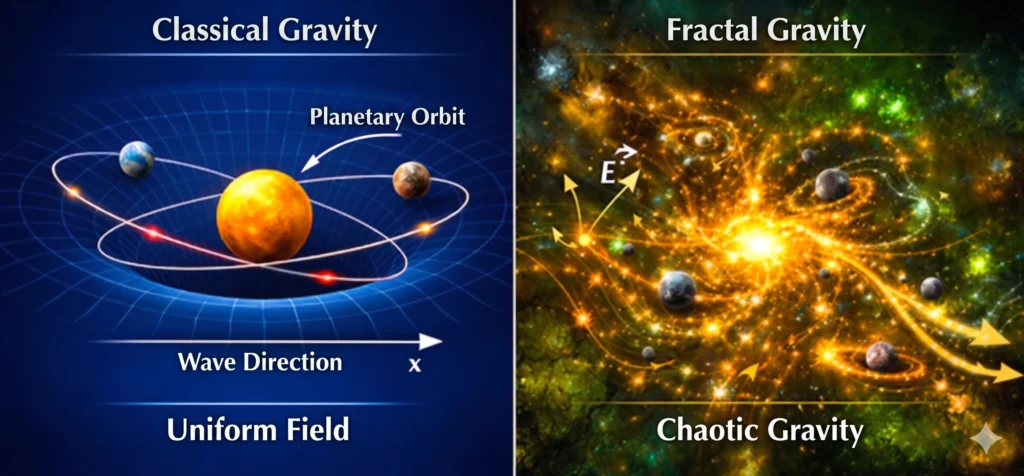
Here is the side-by-side visualization of classical gravitation and fractal gravitation:
- Classical Gravitation (left): A smooth space-time well according to Newton’s law of gravity. Mass attraction is single-centered, planets revolve in fixed orbits, and the field is symmetrical.
- Fractal Gravitation (right): The fabric of space-time is no longer smooth; it is multi-scale, wavy, and resonant. Mass attraction branches out at micro- and macro-scales, creating fractal gravitational networks. Energy flow is not unidirectional, but multi-directional and dynamic.
This comparison shows that while classical gravitation sees the universe as a single “well,” fractal gravitation treats the universe as an interactive weave across scales.
15- Fractal quantum measures (𝑄𝑓)
Now let’s open the fractal analysis chain with fractal quantum measures (𝑄𝑓). This is a motif-repeating, multi-scale expansion of classical quantum mechanics (wave function, probability density, energy levels, field theories).
Classical Quantum Measures
- Wave function:
𝜓(𝑥, 𝑡) - Probability density:
𝑃(𝑥, 𝑡) =∣ 𝜓(𝑥, 𝑡) ∣2 - Schrödinger equation:
𝑖ℏ (∂/∂𝑡) 𝜓(𝑥, 𝑡) = 𝐻𝜓(𝑥, 𝑡)
Fractal Quantum Measures
In its fractal version, all measures become scale-repeating:
- Fractal Wave Function
𝜓𝑓 (𝑥, 𝑡) = ∑n=0∞ (1/𝑏n)𝜓(𝑟n𝑥, 𝑟n𝑡) - Fractal Probability Density
𝑃𝑓(𝑥, 𝑡) =∣ 𝜓𝑓 (𝑥, 𝑡) ∣2 - Fractal Schrödinger Equation
𝑖ℏ (∂/∂𝑡)𝜓𝑓 (𝑥, 𝑡) = 𝐻𝑓 𝜓𝑓 (𝑥, 𝑡)
𝐻𝑓 = ∑n=0∞ (1/𝑏n)𝐻(𝑟n𝑥, 𝑟n𝑡)
Here:
- r : fractal scale ratio
- b : motif base
Result: Instead of a single wave function, a fractal quantum spectrum is formed.
Features
- Multi-scale quantum behavior: Contains both micro and macro wave functions simultaneously.
- Motif resonance: Quantum states do not just exist on a single plane, but repeat along a motif chain.
- New definition of energy levels: While classical energy levels are fixed, fractal energy levels become a motif-repeating chain.
Concretization
Let’s think in terms of music: Classical quantum measures define a single note wave. Fractal quantum measures, on the other hand, define the quantum resonance chain repeating across octaves of the same note. Thus, not just a single wave, but the entire fractal wave structure is revealed.
Application
- Physics: Multi-scale wave functions in quantum field theories.
- Cosmology: Modeling the fractal quantum structure of the universe.
- Engineering: Fractal quantum effects in nano-scale systems.
- Biology: Fractal quantum dynamics of protein folding and genetic processes.
- Art/Music: Aesthetic resonance analysis of fractal quantum motifs.
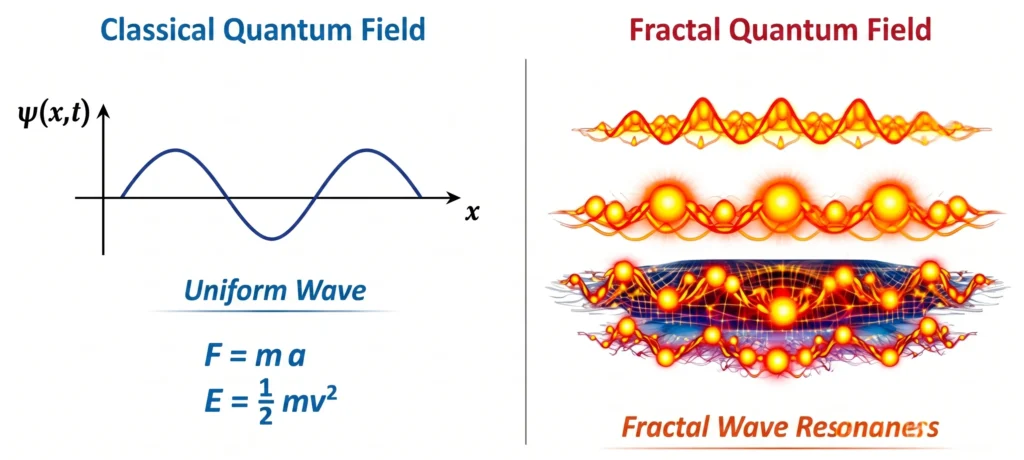
In this visual, the classical quantum field and the fractal quantum field are located side by side:
- On the left, the classical quantum field is shown as a single-frequency, smooth wave — 𝜓(𝑥, 𝑡) draws a simple, linear oscillation.
- On the right, the fractal quantum field is full of multi-scale wave-field resonances — motif-repeating, multi-frequency, complex wave structures connect to each other to form energy-information resonance.
This difference visually and clearly demonstrates that fractal quantum fields present a much deeper, multi-scale, and resonant structure than classical quantum fields.
16- Fractal cosmology measures (𝐶𝑓)
Now let’s open the fractal analysis chain with fractal cosmology measures (𝐶𝑓). This is a motif-repeating, multi-scale expansion of classical cosmology (expansion of the universe, cosmic waves, galaxy distributions, space-time geometry).
Classical Cosmology Measures
- Friedmann Equations (expansion of the universe):
(𝑎̇/𝑎)2 = (8𝜋𝐺/3)𝜌 − (𝑘/𝑎2) + (Λ/3) - Cosmic Wave Function:
𝜓(𝑥, 𝑡) (quantum cosmology approach) - Galaxy Distribution:
Classically considered homogeneous and isotropic (ΛCDM model).
Fractal Cosmology Measures
In its fractal version, all measures become scale-repeating:
- Fractal Friedmann Equations
(𝑎̇𝑓/𝑎𝑓)2 = ∑n=0∞ (1/𝑏n) ( (8𝜋𝐺/3) 𝜌 (𝑟n) − (𝑘 / (𝑎(𝑟n)2)) + (Λ/3) ) - Fractal Cosmic Wave Function
𝜓𝑓 (𝑥, 𝑡) = ∑n=0∞ (1/𝑏n)𝜓(𝑟n𝑥, 𝑟n𝑡) - Fractal Galaxy Distribution
𝜌𝑓 (𝑥) = ∑n=0∞ (1/𝑏n)𝜌(𝑟n𝑥)
Here:
- r : fractal scale ratio
- b : motif base
- 𝑎𝑓 : fractal scale factor
Result: Instead of a single universe model, a fractal universe spectrum is formed.
Features
- Multi-scale expansion: Contains both micro (quantum) and macro (cosmic) expansion simultaneously.
- Motif resonance: The universe does not just exist on a single plane, but repeats along a motif chain.
- New definition of cosmic structure: Instead of classical homogeneity, fractal homogeneity—that is, a motif-repeating galaxy distribution.
Concretization
Let’s think in terms of art: Classical cosmology sees the universe as a single expanding painting. Fractal cosmology, on the other hand, sees the same universe as a motif-repeating chain of paintings. Thus, not just a single expansion, but the entire fractal expansion structure is revealed.
Application
- Cosmology: Fractal distribution of galaxy clusters, multi-scale expansion of the universe.
- Quantum: Fractal wave functions in quantum cosmology.
- Physics: Fractal dynamics of black holes and cosmic waves.
- Philosophy: Ontological interpretation of the motif-repeating structure of the universe.
- Art: Visual and auditory representations of cosmic fractal motifs.
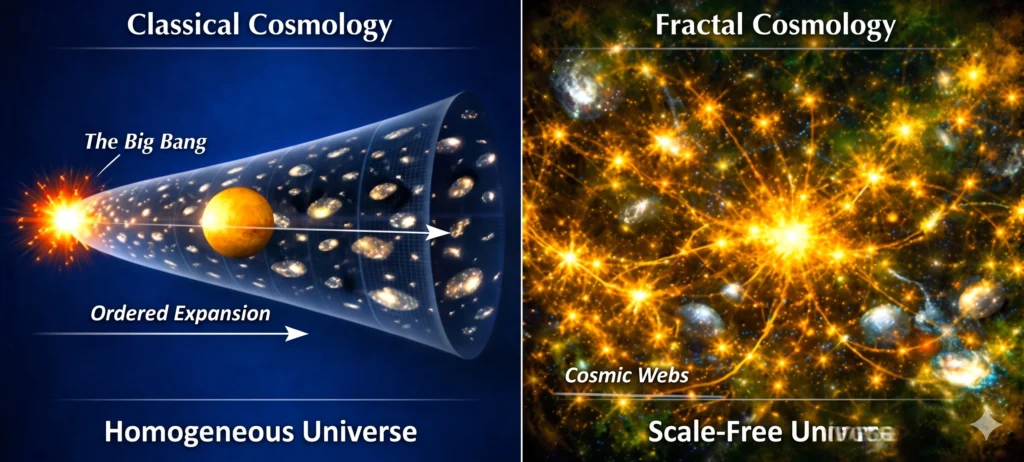
Ready! Here is the side-by-side visualization of classical cosmology and fractal cosmology:
- Classical Cosmology (left): A smooth, homogeneous expansion after the Big Bang. Galaxies are distributed at equal intervals, and the structure of the universe is static and uniform.
- Fractal Cosmology (right): The structure of the universe is no longer homogeneous; it is multi-scale, dynamic, and self-similar. Galaxies connect to each other in the form of cosmic webs and filaments — an inter-scale pattern emerges.
This comparison shows that while classical cosmology explains the universe as a uniform expansion, fractal cosmology treats the universe as an inter-scale fabric of energy-information.