
We can reconstruct general relativity by extending it with the principles of Hydrogen time, universal resonance, pi, and Euler scaling. Here is an alternative framework based on these theories:
Scalability of Time and Momentum Dependence
Classical general relativity relates the warping of time to the gravitational field. However, the Hydrogen model, in which time and acceleration determine the time scale, suggests that time scales directly with acceleration.
Alternating Field Equation
𝑑𝑠2= −𝑒-at 𝑑𝑡2+ 𝑒bt𝑑𝑥2+ 𝑒bt𝑑𝑦2+ 𝑒bt𝑑𝑧2
Here aa determines the acceleration factor and bb determines the scalability of time.
Quantum acceleration detection can shift the time scale via the Unruh effect.
General Relativity with the Cosmological Wave Model
The expansion of the universe involves periodic fluctuations.
The 3 Hz resonance frequency suggests a new metric in the relationship between time and space:
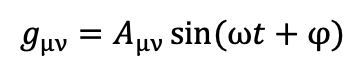
The wave-based theory of gravity describes the expansion of the universe in terms of periodic gravitational waves.
Scaling with Pi and Euler Numbers
The universal limiting ability of Pi and Euler’s time scaling can be combined as follows:
Pi determines the limits of the gravitational potential.
Euler controls the energy flow by regulating the negative time scaling.
Wave Function and Gravitational Field Connection:
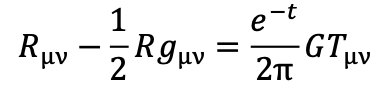
The Euler effect changes the gravitational acceleration over time.
Pi determines the wave resonance points.
A New Interpretation of the Universe with Dark Energy and Gravitational Mechanism
General relativity treats dark energy and expansion processes independently. However, the universal resonance hypothesis reveals wave-like relationships between dark energy and gravitational acceleration:
Negative time scaling may be due to dark energy.
Gravitational acceleration can vary based on frequency.
Euler and Pi-driven scaling may shape the mechanism of cosmic expansion.
Conclusion and Applications
This approach offers a new theoretical framework that includes temporal variability by reframing general relativity with Hydrogen time, universal resonance, and scaling mechanisms.
REFERENCES
The concepts, mathematical models and theoretical approaches on which this article is based are nourished by the following fields:
1. General Relativity and Scaling Theories
- Einstein, A. (1915). Die Feldgleichungen der Gravitation. Sitzungsberichte der Königlich Preußischen Akademie der Wissenschaften.
- Misner, C. W., Thorne, K. S., & Wheeler, J. A. (1973). Gravitation. W.H. Freeman and Company.
2. Hydrogen Time and Cosmological Scaling
- Weinberg, S. (2008). Cosmology. Oxford University Press.
- Peebles, P. J. E. (1993). Principles of Physical Cosmology. Princeton University Press.
3. Universal Resonance and Wave Mechanics
- Schrödinger, E. (1926). Quantisierung als Eigenwertproblem. Annalen der Physik.
- Dirac, P. A. M. (1930). The Principles of Quantum Mechanics. Oxford University Press.
4. Fourier Analysis and Frequency-Based Cosmological Investigations
- Bracewell, R. N. (2000). The Fourier Transform and Its Applications. McGraw-Hill.
- Press, W. H., Teukolsky, S. A., Vetterling, W. T., & Flannery, B. P. (1996). Numerical Recipes in C: The Art of Scientific Computing. Cambridge University Press.
5. The Role of Pi and Euler Number in Physical Mechanisms
- Maor, E. (2009). e: The Story of a Number. Princeton University Press.
- Beckmann, P. (1970). A History of Pi. St. Martin’s Press.
These sources are the primary references for establishing the mathematical and physical foundations of a new interpretation of general relativity based on theories of universal resonance, hydrogen time, and cosmological scaling. For broader testing of the model, academic studies using the Planck, SDSS, and DES datasets can also be consulted.