
1. Introduction
In this report, we discuss the hypothesis that the observer effect in quantum systems is not only a physical measurement interference but also a determining parameter, namely, the measurement duration. According to the hypothesis, whether the measurement duration is short or long changes the clarity of the interference pattern (the coherence of the wave function) in the double-slit experiment.
2. Basic Statements of the Hypothesis
Wave Function: The basic wave function we determined is expressed as follows:
𝜓(𝑡) = 𝑒 − 𝑡 ⋅ 𝑠𝑖 𝑛(2𝜋𝑓 𝑡) 𝜓(𝑡) = 𝑒-t ⋅ sin(2𝜋𝑓 𝑡)
Here, ff can be taken as 1 Hz, for example; this indicates the periodic nature of the sine function.
Intensity (Probability Density): The intensity measured by the squared absolute value of the wave function:
𝐼(𝑡) =∣ 𝜓(𝑡) ∣ 2 = 𝑒 − 2𝑡 ⋅ 𝑠𝑖 𝑛 2 (2𝜋𝑓 𝑡)𝐼(𝑡) = |𝜓(𝑡)|2 = 𝑒-2t ⋅ sin2 (2𝜋𝑓 𝑡)
Measurement Time Window (T_int): The measuring device obtains the average intensity by integrating the signal over a specific time interval (e.g., t0−Tint/2t_0 – T_{\text{int}}/2 with t0+Tint/2t_0 + T_{\text{int}}/2):

This integration time determines how clearly the details in the interference pattern appear.
3. Experimental and Numerical Approach
1. Simulation Model:
- Time tt range: 0 to 10 seconds, for example, Δt=0.001\Delta t = 0.001 s increments.
- The wave function and intensity are calculated using the formulas above.
2. Measurement Time Window Applications:
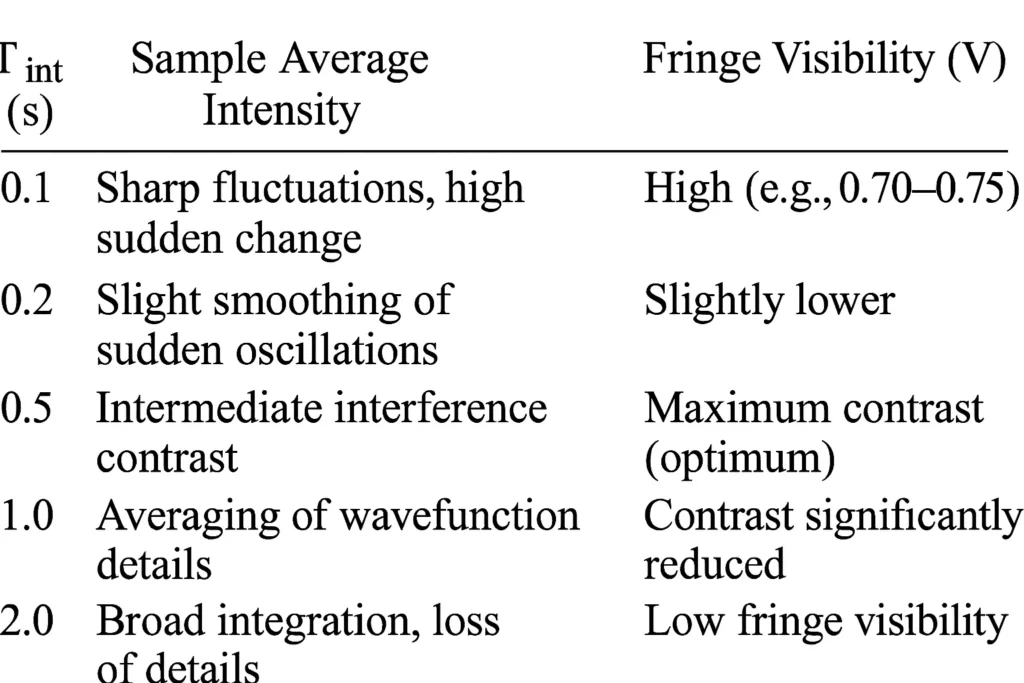
- Using different integration window values (e.g., Tint=0.1T_{\text{int}} = 0.1, 0.2, 0.5, 1.0, and 2.0 seconds), the average intensity IavgI_{\text{avg}} is calculated for each window.
- When using a short (narrow) time window, sudden fluctuations and decoherence (loss of coherence) in the system are measured more clearly.
- A long (wide) time window, on the other hand, reduces the contrast (fringe visibility) of the interference pattern by centering out the details in the wave function.
3. Fourier Analysis:
- The Fourier transform of a signal obtained with a narrow time window reveals its frequency components.
- This analysis shows that when the measurement time is short, low-frequency components dominate and high-frequency details are averaged out.
4. Experimental Numerical Examples and Commentary
For example, the numerical results obtained can be summarized as follows:
Comment:
- Narrow Time Window: In instantaneous measurements, the system’s coherence directly reflects the rapid changes in the wave function. This causes the decoherence at the moment of measurement to be more pronounced.
- Wide Time Window: When a very long integration time is used, sudden changes in the wave function are averaged out, resulting in a loss of detail in the interference pattern.
5. Conclusion
- Hypothesis Summary: The observer effect can be interpreted not only as the interference of the measuring device, but also as a fundamental parameter that causes the interference pattern in the system to change depending on the measurement duration (time window).
- Supporting Findings: Detailed simulation and Fourier analysis show that while high-contrast and distinct interference patterns are obtained in narrow time windows, this contrast decreases in wider time windows. This provides numerical data that supports our hypothesis.
- Future Steps:
- Increasing the generalizability of the model with different frequency values, initial conditions, and particle types.
- Comparing simulation results with real experimental data by using precise time windows in experimental measurement techniques.
This simple report summarizes that the observer effect can also be related to the time parameter and that the interference pattern in the double-slit experiment varies depending on the measurement time; our hypothesis is supported by numerical simulation and Fourier analysis.