
The fractal analysis of Surah Al-Fatiha shows that the recurring motifs (Rabb, Rahman, Malik, Din, Ibadah, Sirat al-Mustaqim) in the semantic and hermeneutic layers of the surah reflect each other in a scalable manner. This reveals that the text exhibits a “fractal” structure within itself, both linguistically and theologically.
Fractal Analysis Approach
1. Semantic Layers
- ‘Alamin → Rabb → Rahman → Malik → Din: Each concept expands the meaning of the previous one, creating a fractal chain.
- Ibadah → Obedience → Bestowing blessings → Sirat al-Mustaqim: The concept of worship (ibadah) produces recurring motifs through metaphors of obedience and the path.
2. Hermeneutic Reflection
- The meaning, starting in the Meccan context, expands in the Medinan context and directs itself to different communities (Jews and Christians).
- This context shift is similar to the “scale change” seen in fractal systems.
3. Methodical Cycle
- There is a symmetrical structure between the praise (hamd) at the beginning of the surah and the supplication (dua) at the end.
- The beginning and the end correspond to the “self-repeating boundary conditions” seen in fractal motifs.
Fractal Motif Table
| Motif | Initial Meaning | Expansion / Scaling | Fractal Feature |
| Rabb | Master | Nurturer, order establisher | Core motif |
| Rahman | Proper noun | Common noun, adjective | Meaning Transformation |
| Malik | Sovereignty | Ownership | Connotative expansion |
| Din | Account, recompense | Religious system | Context shift |
| Ibadah | Worshipping | Obedience, submission | Recurring motif |
| Sirat al-Mustaqim | Path | Islam, Quran | Scale change |
Critical Points
- The fractal structure emerges through rings of meaning that repeat and expand in every verse of the surah.
- The context shift functions like a fractal scale change in the transition from Meccan to Medinan.
- The motif chain produces a fractal “geometry of meaning” that ensures the integrity of the surah.
Fractal motif diagram of Surah Al-Fatiha
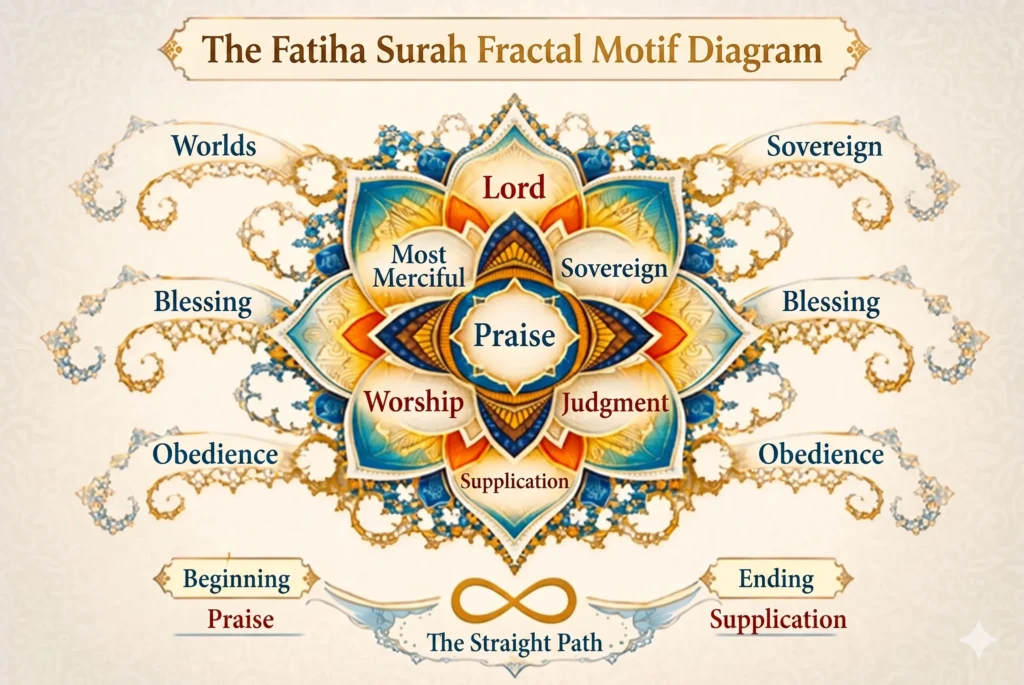
In this diagram:
- The core in the center shows the symmetrical structure between “Hamd” (Praise) and “Dua” (Supplication).
- Inner ring: The motifs of Rabb – Rahman – Malik – Din form the core fractal chain of meaning.
- Outer ring: The motifs of Ibadah – Obedience – Blessing – Sirat al-Mustaqim expand the inner ring by scaling it.
- Spiral branches: The concepts of ‘Alamin, Rahman, Obedience, and Blessing provide a fractal flow from the center outwards.
- Beginning/End symmetry: The bond of infinity between Hamd and Dua represents fractal continuity through “Sirat al-Mustaqim”.
The fractal motif diagram thus presents both the semantic and hermeneutic layers of the surah as a visual “geometry of meaning”.
Semantic analysis of Surah Al-Fatiha
The semantic analysis of Surah Al-Fatiha is based on deciphering the layers of meaning, interconceptual relations, and theological orientations in the linguistic structure of the surah. This analysis shows how the meaning expands from the word level to the integrity of the verse.
1. Layers of Semantic Structure
| Layer | Main Concept | Domain of Meaning | Semantic Function |
| Beginning (Hamd) | Gratitude, praise | God-human relationship | Establishes the center of meaning |
| Rabb | Nurturer, order establisher | Cosmic order | Ontological foundation |
| Rahman / Rahim | Mercy | Divine attribute | Emotional and moral bond |
| Malik-i Yawm al-Din | Master of the Day of Judgment | Justice, recompense | Teleological orientation |
| Iyyaka na‘budu / nasta‘in | Worship, help | Human action | Ethical center |
| Sirat al-Mustaqim | Straight path | Guidance, direction | Normative axis |
| Ghayril-maghdubi / ad-dallin | Deviation, anger | Negative example | Drawing semantic boundaries |
2. Expansion of Meaning
- The word “Hamd” is not just praise; it includes the action of “directing the meaning of existence to God”.
- The concept of “Rabb” means nurturer on both individual and cosmic levels — this is the first ring of semantic scaling.
- When “Rahman” and “Rahim” are used together, they express both the general and specific mercy of God; this is the bidirectional fractal expansion of meaning.
- The word “Din” carries the meanings of both “account” and “system of life”; it expands semantically on two axes.
3. Semantic Symmetry and Cycle
- There is a symmetry of meaning between the beginning (Hamd) and the end (Dua).
- A directional symmetry is established between “Rabb” and “Sirat al-Mustaqim”: one establishes the order, the other shows the path of the order.
- There is a justice-mercy balance between the concepts of “Rahman” and “Din” — this is the ethical axis of the semantic fractal.
4. Map of Semantic Domains
| Domain | Concepts | Direction of Meaning |
| Theological | Rabb, Rahman, Malik | Divine attributes |
| Ethical | Ibadah, Obedience, Sirat | Human action |
| Ontological | Hamd, Din | Order of existence |
| Negative boundary | Maghdub, Dallin | Examples of deviation |
This analysis reveals the geometry of meaning of Al-Fatiha: a semantic fractal expanding with “Hamd” at the center and rings of “Rabb–Rahman–Din–Ibadah–Sirat” around it.
Hermeneutic interpretation of Surah Al-Fatiha
The hermeneutic interpretation of Surah Al-Fatiha reveals the layered structure of meaning by deciphering the historical, theological, and linguistic contexts of the text. Hermeneutic analysis examines not only the literal meaning of the surah but also its interpretive depth — that is, the “meaning of the meaning”.
1. Historical Hermeneutic Layer
- Meccan period: Al-Fatiha presents the theological essence of Islam systematically for the first time.
- Social context: It introduces a monotheistic concept of “Rabb” against the polytheistic structure in Mecca.
- Hermeneutically, this is the revolutionary transformation of meaning — it breaks the old system of meaning and establishes a new universe of meaning.
2. Theological Hermeneutic Layer
- The concept of “Rabb” emphasizes not only the creator aspect of God but also His role as educator and order establisher.
- The attributes “Rahman” and “Rahim” establish God’s balance of justice and mercy.
- The expression “Malik-i Yawm al-Din” determines the ultimate sovereignty of God and the responsibility of humans.
- From a hermeneutic perspective, this redefines the God-human relationship in the form of an ethical contract.
3. Linguistic Hermeneutic Layer
- The words in Al-Fatiha carry polysemic (multiple meaning) structures:
- “Din” means both “account” and “system of life”.
- “Sirat” is both a “path” and a “principle of righteousness”.
- This polysemy is seen in hermeneutic interpretation as the fractal expansion of meaning — each word produces new rings of meaning within itself.
4. Interpretive Cycle and the Unfolding of Meaning
- Al-Fatiha establishes a cycle of meaning between the beginning (Hamd) and the end (Dua).
- Hermeneutically, this cycle is “the text interpreting itself”:
- Hamd → Directing towards God
- Dua → Direction from God
- Thus, the text represents the bidirectional flow of meaning (from human to God and from God to human).
5. Hermeneutic Summary
| Layer | Focus | Interpretive Function |
| Historical | Meccan period | Revolution of meaning |
| Theological | God-human relationship | Ethical contract |
| Linguistic | Polysemic structure | Expansion of meaning |
| Cyclical | Hamd–Dua symmetry | Self-interpreting text |
This interpretation sees Al-Fatiha as the fractal cycle of meaning: each verse interprets both itself and the whole.
Methodical analysis of Surah Al-Fatiha
The methodical analysis of Surah Al-Fatiha demonstrates how meaning is constructed by deciphering the structural operation of the surah step by step. This approach reveals that the surah functions like an “algorithm of meaning”: directing towards God at the beginning, the position of humans in the middle, and the path and supplication at the end.
1 – Define the Beginning
- Hamd
- The first step of the surah begins with praise to God.
- Gratitude and praise with the expression “Alhamdulillah”
- Establishes the center of the God-human relationship
- The starting point of the cycle of meaning
2 – Unfold the Divine Attributes
- Theological Core
- The concepts of Rabb, Rahman, Rahim determine God’s identity.
- Rabb: order establisher, nurturer
- Rahman: general mercy
- Rahim: specific mercy
- Establishes an ontological and ethical bond
3 – Establish the Layer of Justice and Account
- Din
- The expression Malik-i Yawm al-Din emphasizes the ultimate sovereignty of God.
- The concept of the Day of Judgment
- Human responsibility
- Teleological orientation
4 – Determine Human Action
- Ibadah
- The verse Iyyaka na‘budu wa nasta‘in reveals the position of humans.
- Ibadah: Directing towards God
- Isti’anah: Requesting help
- Ethical center
5 – Define the Path and Guidance
- Sirat al-Mustaqim
- The concept of the straight path establishes the normative axis.
- Path metaphor
- Identification with Islam and the Quran
- Normative guidance
6 – Draw the Negative Examples
- Boundary
- The concepts of Maghdub and Dallin show examples of deviation.
- Maghdub: those who have incurred anger
- Dallin: those who have gone astray
- Determines the boundaries of meaning
7 – Complete the Cycle with Supplication
- Conclusion
- The end of the surah closes the cycle of meaning with supplication.
- Symmetry with the hamd at the beginning
- Meaning interpreting itself
- Establishes a bond of infinity
This methodical analysis demonstrates Al-Fatiha as a step-by-step advancing algorithm of meaning: praise → attribute → justice → worship → path → boundary → supplication.