

Fractal potential wells are an extension of classical quantum potential wells with fractal scale dependence; energy surfaces are modulated with wavy, self-similar structures, and the probability distribution of particles is shaped by multi-scale fractal motifs. This approach offers a wide field of application, ranging from atomic transitions at the micro-level to the energy flow around black holes at the macro-level.
Mathematical Definition
Classical potential function: 𝑉(𝑥) (for example, a harmonic oscillator or well potential).
Fractal iteration function:
𝜙(𝑥) = 1 + ∑𝑛=1∞ 𝑐𝑛 sin(𝑏𝑛𝑥)
Fractal potential:
𝑉f (𝑥) = 𝑉(𝑥) ⋅ 𝜙(𝑥)
This formula adds fractal resonance modulation onto the classical potential.
Core Features
- Fractal resonance → The energy surface has wavy and self-similar structures.
- Wave-particle interaction → Probability density is distributed with fractal motifs.
- Self-similar energy structure → The same energy behavior repeats at every scale.
- Definability in the complex plane → Valid in both real and complex spaces.
Application Areas
- Quantum optics → Fractal modulation of light waves in laser interferometers.
- Quantum chemistry → Modeling of molecular bond energies with fractal resonance.
- Astrophysics → Investigation of energy flows around black holes in a fractal structure.
- Nanotechnology → Calculation of atomic-scale energy transitions.
Classical vs. Fractal Potential Wells
| Criterion | Classical Potential Well | Fractal Potential Well |
| Energy surface | Smooth, fixed form | Wavy, self-similar structures |
| Probability distribution | Single-scale | Multi-scale, with fractal motifs |
| Mathematical definition | Classical solution with the Schrödinger equation | Schrödinger + fractal iteration function |
| Application area | Basic quantum models | Quantum optics, chemistry, astrophysics, nanotechnology |
Quantum Fractal Potential Function – Example Solution
Let us add fractal modulation onto a harmonic oscillator potential.
Step 1: Classical Harmonic Oscillator
Classical potential:
𝑉(𝑥) = (1/2) 𝑚𝜔2𝑥2
Where:
- 𝑚 : particle mass
- 𝜔 : angular frequency
Step 2: Fractal Modulation Function
Fractal iteration function:
𝜙(𝑥) = 1 + ∑𝑛=1N 𝑐𝑛 sin(𝑏𝑛𝑥)
- 𝑐𝑛 : fractal amplitude coefficients
- 𝑏𝑛 : fractal frequency coefficients
- N : number of iterations
Step 3: Fractal Potential
Combined form:
𝑉f (𝑥) = 𝑉(𝑥) ⋅ 𝜙(𝑥) = (1/2) 𝑚𝜔2𝑥2 ( 1 + ∑𝑛=1N 𝑐𝑛 sin(𝑏𝑛𝑥) )
This expression adds fractal fluctuations to the classical well.
Step 4: Schrödinger Equation
Time-independent Schrödinger equation:
− (ℏ2/2𝑚)(𝑑2𝜓(𝑥)/𝑑𝑥2) + 𝑉f (𝑥)𝜓(𝑥) = 𝐸𝜓(𝑥)
Where the solution:
- Is given by Hermite polynomials for the classical harmonic oscillator.
- When fractal modulation is added, energy levels are calculated using the perturbation method.
Conclusion – Energy Levels
In the classical case: 𝐸 = ℏ𝜔 (𝑛+1/2)
In the fractal case:
𝐸𝑛( f ) ≈ 𝐸𝑛 + Δ𝐸𝑛
Δ𝐸𝑛 is the correction emerging from the effect of the fractal coefficients (𝑐𝑛, 𝑏𝑛).
Interpretation
- Fractal resonance → Energy levels are modulated with wavy and self-similar structures.
- Wave-particle interaction → Probability density is distributed with fractal motifs.
- Astrophysics application → It can be used in modeling energy flows around black holes.
Fractal Potential Perturbation Calculation
In a quantum system, a fractal potential well is defined by adding small fractal fluctuations onto the classical potential. In this case, energy levels can be calculated using perturbation theory.
Step 1: Base Potential
Classical harmonic oscillator:
𝑉(𝑥) = (1/2) 𝑚𝜔2𝑥2
Step 2: Fractal Perturbation
Fractal contribution:
𝑉 ‘ (𝑥) = (1/2) 𝑚𝜔2𝑥2 ⋅ ∑𝑛=1N 𝑐𝑛 sin(𝑏𝑛𝑥)
Total potential:
𝑉f (𝑥) = 𝑉(𝑥) + 𝑉 ‘ (𝑥)
Step 3: Perturbation Theory
First-order energy correction:
Δ𝐸𝑛(1) = ⟨𝜓𝑛(0) ∣ 𝑉 ‘ (𝑥) ∣ 𝜓𝑛(0)⟩
Where:
- 𝜓𝑛(0) : wave function of the classical harmonic oscillator (via Hermite polynomials).
- 𝑉 ‘ (𝑥) : fractal contribution.
Conclusion
Classical energy levels:
𝐸𝑛(0) = ℏ𝜔 (𝑛+1/2)
Fractal-corrected energy:
𝐸𝑛( f ) ≈ 𝐸𝑛(0) + Δ𝐸𝑛(1)
Depending on the values of the fractal coefficients (𝑐𝑛, 𝑏𝑛), Δ𝐸𝑛(1) generates wavy, self-similar energy levels.
Interpretation
- Fractal resonance → Energy levels are modulated with self-similar fluctuations.
- Quantum optics → Fractal corrections can be observed in laser modulations.
- Astrophysics → Energy flows around black holes can be modeled with fractal perturbation.
Fractal Perturbation Integral Solution
Let us calculate the effect of the fractal potential contribution on energy levels in a quantum system via an integral using perturbation theory.
Step 1: Base Wave Function
Wave function for the harmonic oscillator:
𝜓𝑛(0)(𝑥) = (𝑚𝜔/𝜋ℏ)1/4 (1/(2𝑛!)1/2) 𝐻𝑛 ( 𝑚𝜔/ℏ)1/2𝑥 𝑒 -𝑚𝜔𝑥2/2ℏ
Where 𝐻𝑛 is the Hermite polynomial.
Step 2: Fractal Perturbation Potential
𝑉 ‘ (𝑥) = (1/2) 𝑚𝜔2𝑥2 ⋅ ∑k=1N 𝑐k sin(𝑏k𝑥)
Step 3: First-Order Energy Correction
Δ𝐸𝑛(1) = ∫-∞∞ 𝜓𝑛(0)(𝑥) 𝑉 ‘ (𝑥) 𝜓𝑛(0)(𝑥) 𝑑𝑥
This integral contains sine terms multiplied by Hermite polynomials and the Gaussian function.
Step 4: Solution Approach
Gaussian integral:
∫-∞∞ 𝑒-𝛼𝑥2 sin (𝛽𝑥)𝑑𝑥 = (𝜋/𝛼)1/2 𝑒-𝛽2/4𝛼 ⋅ (𝛽/2𝛼)
When multiplied by Hermite polynomials, different coefficients emerge for each 𝑛.
Result:
Δ𝐸𝑛(1) ∝ ∑k=1N 𝑐k ⋅ 𝐹(𝑛, 𝑏k, 𝑚, 𝜔, ℏ)
Where 𝐹(. . . ) is the special combination of functions resulting from the integral.
Interpretation
- Fractal resonance → Sine terms create self-similar fluctuations in energy levels.
- Perturbation theory → Small fractal contributions shift energy levels in a regular manner.
- Astrophysics application → It can be used in calculating fractal energy flows around black holes.
Graphical Analysis of Fractal Energy Levels
Visual of the Graphical Analysis of Fractal Energy Levels
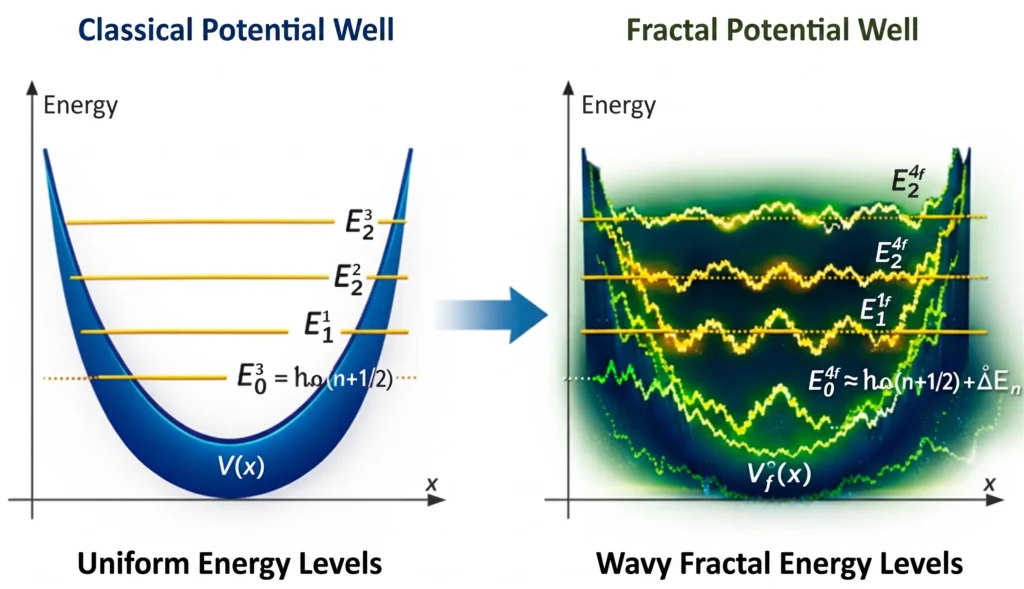
In this analysis:
- On the left, the classical potential well: smooth parabolic energy surfaces and 𝐸𝑛 = ℏ𝜔(𝑛 + 1/2) levels rising at fixed intervals.
- On the right, the fractal potential well: energy surfaces modulated with wavy, self-similar structures. Energy levels are in the form of 𝐸𝑛f ≈ 𝐸𝑛 + Δ𝐸𝑛, meaning they are shifted and have become wavy due to fractal contributions.
- The arrow in between shows the transition from the classical model to the fractal model.
This visual clearly demonstrates how fractal perturbation causes energy levels to fluctuate and modulates them with self-similar structures.