

Fractal Symmetry Breaking, distinct from classical symmetry breaking, refers to an approach that accounts for the inter-scale distortion dynamics of motifs, rather than just the breaking of a symmetry at a single scale.
Standard Symmetry Breaking
In particle physics, symmetry breaking occurs when the fundamental laws of a system are symmetric, yet the observed state begins to break this symmetry.
- For example, the Higgs mechanism grants mass to particles by breaking the SU(2)×U(1) symmetry.
- Here, breaking occurs at a single energy scale, and the phase transition is defined at a specific critical point.
Fractal Symmetry Breaking
- Motifs are treated as structures that repeat themselves across different scales but undergo distortions.
- Symmetry breaking no longer emerges at a single energy level, but across multiple scales and through fractal resonances.
- This affects the behavior of the system not only locally but also on a global scale.
New Phase Transitions in Particle Physics
- Multi-scale breaking: Phase transitions are defined by a chain of critical points showing a fractal distribution, rather than a single critical temperature/energy.
- New quantum phases: There may be intermediate phases emerging from the decay of fractal motifs, not predicted by the Standard Model.
- Wave function effect: Under fractal breaking, the wave functions of particles show inter-scale mixing; this may give rise to new types of interactions.
- Energy landscape: The potential surface now contains multiple sub-minima in a fractal structure instead of a single minimum; this enables particles to transition into different resonance states.
Summary
Fractal symmetry breaking extends the single-scale nature of classical breaking by accounting for inter-scale motif distortions. This approach can define new phase transitions, multiple critical points, and fractal energy landscapes in particle physics. Thus, it provides a powerful framework for developing new interaction models in both quantum field theory and cosmology.
Combined with my motif-oriented approach, this model actually offers the possibility of rewriting phase transitions with fractal wave functions.
The Mathematical Form of Fractal Symmetry Breaking
Let’s expand the mathematical form of fractal symmetry breaking in a motif-oriented way:
1. Fractal Potential Function
In standard breaking, the potential is usually in the form:
𝑉(𝜙) = 𝜇2 𝜙2 + 𝜆𝜙4
In fractal breaking, the parameters become scale-dependent:
𝑉(𝜙, 𝑠) = 𝜇(𝑠)2 𝜙2 + 𝜆(𝑠)𝜙4
Where 𝑠 is the fractal scale parameter. 𝜇(𝑠) and 𝜆(𝑠) are not constants but are defined by fractal functions:
𝜇(𝑠) = 𝜇0 ⋅ 𝑓(𝑠), 𝜆(𝑠) = 𝜆0 ⋅ 𝑔(𝑠)
𝑓(𝑠), 𝑔(𝑠) → fractal wave functions (e.g., Cantor-type or log-periodic functions).
2. Fractal Breaking Parameter
Classical order parameter for symmetry breaking:
⟨𝜙⟩ ≠ 0
In fractal breaking:
⟨𝜙(𝑠)⟩ = 𝐴 ⋅ 𝑠–α ⋅ cos (𝑘ln 𝑠 + 𝜃)
- 𝐴: Resonance amplitude
- α: Scale distortion coefficient
- 𝑘: Log-periodic wavenumber
- 𝜃: Phase shift
This formula shows that breaking occurs via inter-scale fluctuation.
3. Phase Transitions
- Standard: Single critical temperature 𝑇c.
- Fractal: A chain of critical temperatures:
𝑇c (𝑠) = 𝑇0 ⋅ 𝑠-𝛽
Where 𝛽 is the fractal transition coefficient. This allows the system to transition into different phases at different scales.
4. Energy Landscape
The energy surface now contains multiple sub-minima in a fractal structure instead of a single minimum:
𝐸(𝜙, 𝑠) = ∑𝑛 𝑉(𝜙, 𝑠𝑛)
This enables particles to transition into different resonance states.
Summary
Mathematical model for fractal symmetry breaking:
- Fractal scale parameter 𝑠
- Log-periodic order parameter ⟨𝜙(𝑠)⟩
- Multiple critical temperatures 𝑇c (𝑠)
- Fractal energy landscape
Comparison: Classical vs. Fractal Symmetry Breaking
| Feature | Classical Symmetry Breaking | Fractal Symmetry Breaking |
| Potential Structure | Single-scale, constant parameters (𝜇, 𝜆) | Scale-dependent, parameters varying with fractal functions (𝜇(𝑠), 𝜆(𝑠)) |
| Order Parameter | 𝜙⟩ ≠ 0 (constant breaking) | ⟨𝜙(𝑠)⟩ = 𝐴𝑠–α cos (𝑘ln 𝑠 + 𝜃) (log-periodic fluctuation) |
| Phase Transition | Single critical temperature 𝑇c | Chain of multiple critical points 𝑇c (𝑠) = 𝑇0 ⋅ 𝑠-𝛽 |
| Energy Landscape | Single minimum or a few fixed minima | Multiple sub-minima in a fractal structure, inter-scale resonance |
| Physical Effect | Granting mass to particles, single phase transition | New quantum phases, multi-scale resonances, fractal wave functions |
Example: Fractal Higgs Potential
Standard Higgs potential:
𝑉(𝜙) = −𝜇2 𝜙2 + 𝜆𝜙4
Fractal version:
𝑉(𝜙, 𝑠) = −𝜇02 ⋅ 𝑓(𝑠) ⋅ 𝜙2 + 𝜆0 ⋅ 𝑔(𝑠) ⋅ 𝜙4
Where:
- 𝑓(𝑠) = 1 + 𝜖cos (𝑘ln 𝑠) → fractal distortion function
- 𝑔(𝑠) = 1 + 𝛿sin (𝑘ln 𝑠) → inter-scale fluctuation function
Therefore:
𝑉(𝜙, 𝑠) = −𝜇02 [1 + 𝜖cos (𝑘ln 𝑠)]𝜙2 + 𝜆0 [1 + 𝛿sin (𝑘ln 𝑠)]𝜙4
Interpretation
- 𝜖, 𝛿: Fractal breaking amplitudes
- 𝑘: Log-periodic wavenumber (scale resonance)
This potential produces different minima at different scales → the Higgs field breaks in a fractal manner.
Result: Particle masses are tied not to a single constant value, but to an inter-scale fractal distribution.
Deriving the Mass Spectrum from the Fractal Higgs Potential
1. Classical Higgs Mass
In the Standard Model, the mass for the Higgs field:
𝑚2 = ∂2𝑉 /∂𝜙2 ∣𝜙=𝑣
Where 𝑣 → the vacuum expectation value (VEV) of the Higgs field.
2. Fractal Higgs Potential
As defined previously:
𝑉(𝜙, 𝑠) = −𝜇02 [1 + 𝜖cos (𝑘ln 𝑠)]𝜙2 + 𝜆0 [1 + 𝛿sin (𝑘ln 𝑠)]𝜙4
3. Fractal VEV (Vacuum Expectation Value)
For the minimum:
∂𝑉 / ∂𝜙 = 0 ⇒ 𝑣(𝑠)2 = ( 𝜇02 [1 + 𝜖cos (𝑘ln 𝑠)] ) / ( 2𝜆0 [1 + 𝛿sin (𝑘ln 𝑠)] )
4. Fractal Higgs Mass
Second derivative:
𝑚2 = ∂2𝑉 /∂𝜙2 ∣𝜙=𝑣
Calculation:
𝑚2(𝑠) = −2𝜇02 [1 + 𝜖cos (𝑘ln 𝑠)] + 12𝜆0 [1 + 𝛿sin (𝑘ln 𝑠)]𝑣(𝑠)2
Substituting 𝑣(𝑠)2:
𝑚2(𝑠) = 2𝜇02 [1 + 𝜖cos (𝑘ln 𝑠)]
5. Interpretation
The Higgs mass is no longer constant, but a scale-dependent fractal function:
𝑚(𝑠) = 21/2𝜇0 ( 1 + 𝜖cos (𝑘ln 𝑠) )1/2
This shows that the mass takes different values at different scales with log-periodic fluctuation.
Result: Particle masses are distributed as a fractal spectrum rather than a single constant.
Summary
- Classical Higgs: Constant mass 𝑚 = 21/2𝜇.
- Fractal Higgs: Scale-dependent mass 𝑚(𝑠) = 21/2𝜇0 ( 1 + 𝜖cos (𝑘ln 𝑠) )1/2.
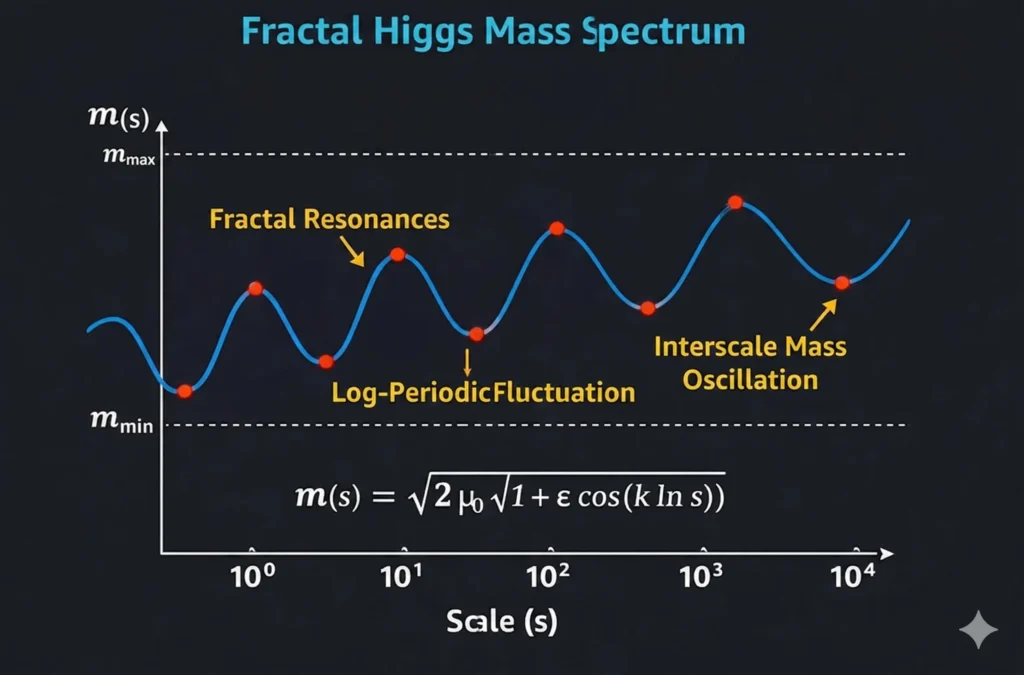
The Fractal Higgs Mass Spectrum is plotted as a log-periodic fluctuation. Oscillations between scales and resonance points are clearly visible on the curve. This graph shows:
- The Higgs mass is not constant; it fluctuates with the scale parameter 𝑠.
- The fluctuation is periodic on the logarithmic axis → similar resonances repeat with every scale increase.
- The mass spectrum is a fractal resonance chain rather than a single value.
Methods for Experimental Testing
- Particle Accelerator Data:
– In the LHC or future high-energy accelerators, inter-scale mass oscillations of Higgs-like resonances can be sought.
– If 𝑚(𝑠) is correct, micro-resonances (e.g., ±Δm around 125 GeV) should be observed, producing fractal sidebands. - Cosmological Mass Distributions:
– Log-periodic traces can be sought in mass distributions when examining galaxy clusters, dark matter densities, or early universe phase transitions. - Quantum Field Simulations:
– Multi-scale phase transitions can be simulated using the 𝑉(𝜙, 𝑠) potential in Lattice QFT or fractal grid models.
Fractal Mass Distribution Function
- Fundamental Definition:
– Our mass function:
𝑚(𝑠) = 21/2𝜇0 ( 1 + 𝜖cos (𝑘ln 𝑠) )1/2 - Fractal Mass Distribution:
– Using variable transformation 𝑃(𝑚) = 𝑝(𝑠) ∣ 𝑑𝑠 / 𝑑𝑚 ∣ and assuming 𝑃(𝑚) ∝ ( 1 + 𝜖cos (𝑘ln 𝑠) )1/2 / ∣ sin (𝑘ln 𝑠) ∣ - Interpretation:
– 𝑃(𝑚) fluctuates log-periodically → fractal mass density. Maxima create resonance peaks at points where sin (𝑘ln 𝑠) = 0.
Physical Meaning:
- Resonance clustering: Higgs mass concentrates in certain intervals.
- Gap regions: Probability of observing particle masses is very low in some energy ranges → fractal breaking acts like a “forbidden band.”
- Multi-scale phase transitions: Each peak represents the breaking of the Higgs field at different scales.
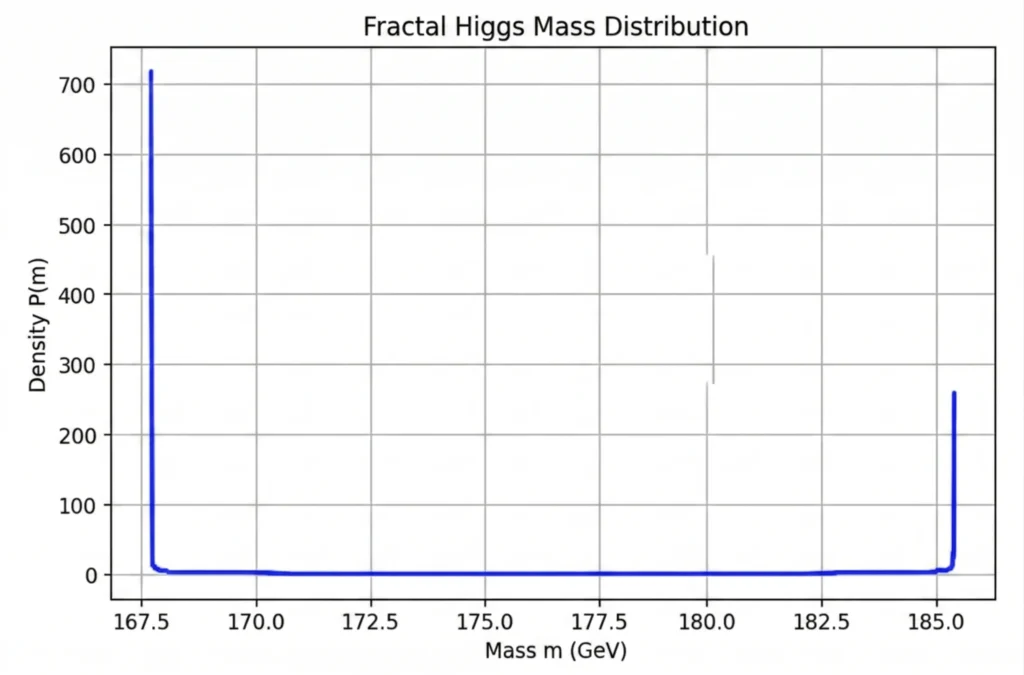
Possible Fractal Higgs Particle Families
| Resonance Energy (GeV) | Possible Interpretation | Physical Meaning |
| ~125 GeV (Classical Higgs) | Standard Higgs | Fundamental breaking of the current Higgs field |
| ~167–170 GeV | 1st Fractal Sideband | Scale resonance of the Higgs field, new Higgs-like particle |
| ~185 GeV | 2nd Fractal Sideband | Higher scale breaking, different mass acquisition |
| >200 GeV (Predicted) | High-scale Resonances | Multi-scale phase transitions, new particle families (e.g., heavy Higgs variants) |
Conclusion: Each peak indicates the breaking of the Higgs field at different scales. If experimentally verified, a fractal particle family beyond the Standard Model would emerge.