

INTRODUCTION
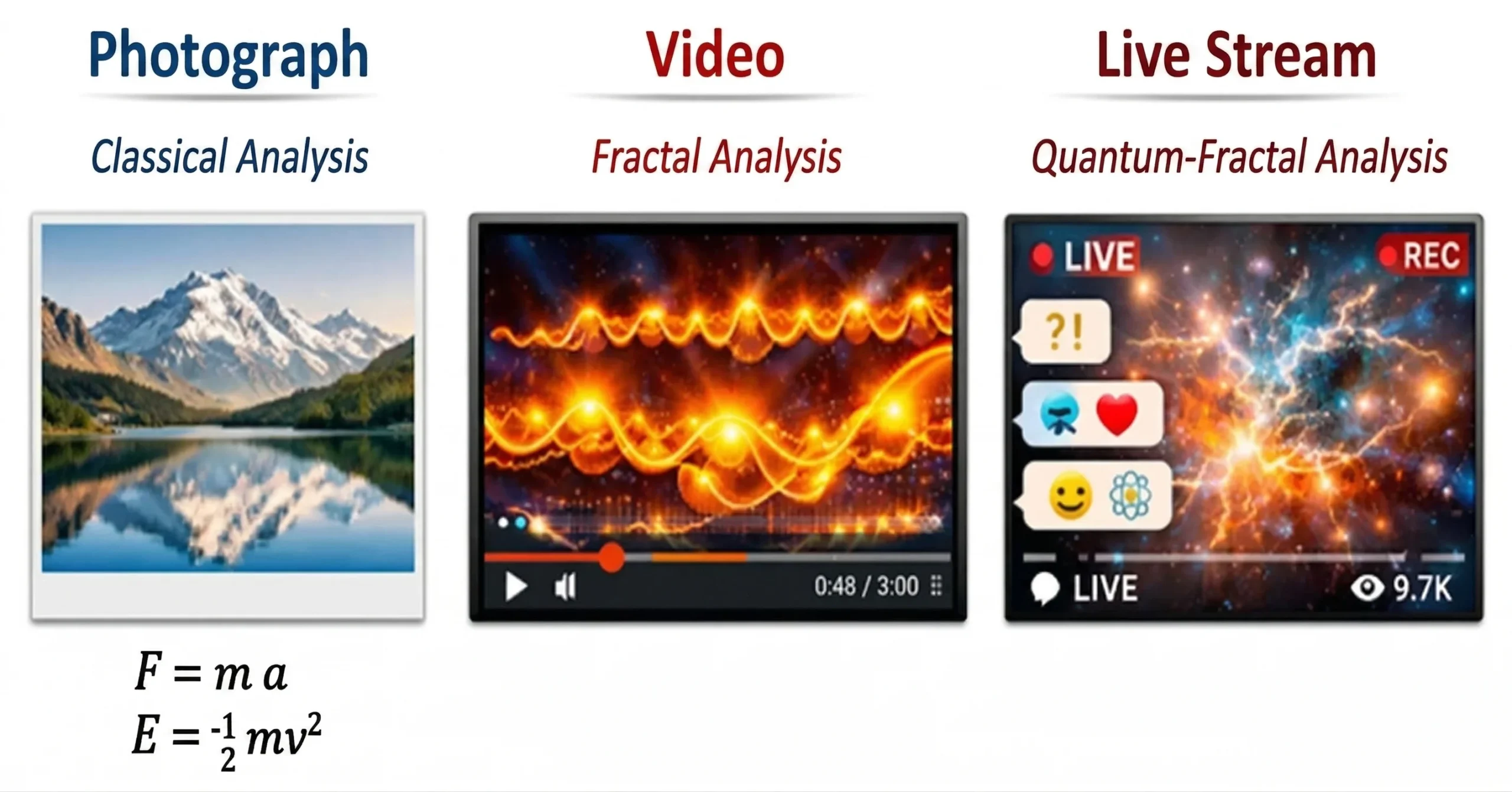
Classical analysis treats nature as an instantaneous cross-section; it takes a “photograph” of nature with fixed parameters, stationary equations, and single-scale processes. Fractal analysis, however, treats nature within process, through interactions between scales, resonance, and feedback loops—essentially, it takes a video of nature.
The essence of this difference:
- Classical system: Freezes time, defining change through fixed parameters.
- Fractal system: Unfolds time, demonstrating change through self-repeating motifs.
- Result: We no longer see nature as a static structure, but as a dynamic flow—each moment is an echo of the previous one.
- Photograph (Classical Analysis): A single-frame, stationary image of nature. It represents a “frozen” moment with fixed parameters and linear equations.
- Video (Fractal Analysis): Nature recorded in flow, through processes involving motif-repetition across scales. A dynamic structure where time and resonance are intertwined.
- Live Broadcast (Quantum-Fractal Analysis): Nature as a simultaneous state, constantly reproduced through uncertainty and multiple processes. It means no longer just watching, but flowing together with nature.
- This topic will be examined in another text.
This trilogy clearly shows the evolution of science: from static to dynamism, from single-scale to multi-scale, from stagnation to resonance.
BASIC CONCEPTS
1- Logarithm
Classical Logarithm
Classical definition:
logb (𝑥) = 𝑦 eger 𝑏𝑦 = 𝑥
This is a single-scale definition: the base b is constant, and the function operates on a single plane.
Fractal Logarithm
In the fractal version, the base and function become motif-repetitive:
log 𝑏f (𝑥) = ∑n=0∞ 1/𝑏n ⋅ log 𝑏 (𝑥𝑟^n)
Here, r is the fractal scale ratio (e.g., 1/2, 1/3).
Each term represents the repetition of the logarithm at different scales.
Result: Instead of a single value, it produces a fractal spectrum: both micro and macro behaviors are calculated simultaneously.
Properties
- Multi-scale growth: Measures a system’s local and global growth at the same time.
- Motif resonance: Instead of a single logarithmic curve, a chain of motif-repetitive curves emerges.
- New definitions of equilibrium: While the equilibrium point is fixed in classical logarithms, in fractal logarithms, equilibrium is distributed along a motif chain.
Inspiration
Think of it in music: Classical logarithm measures a single pitch. Fractal logarithm measures the resonance of that same sound repeating across octaves. Thus, not only the frequency of a note but its entire fractal harmonic chain is calculated.
GRAPHIC COMPARISON
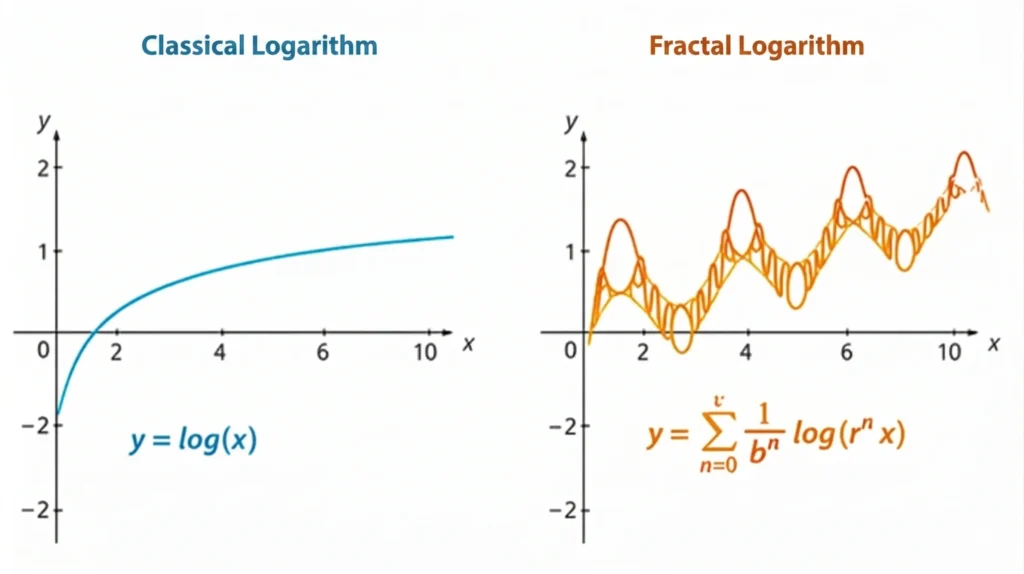
In the visual, you can see the classical logarithm and the fractal logarithm side by side: on the left, the single-scale, smoothly increasing classical curve; on the right, the motif-repetitive, multi-scale fluctuating fractal logarithm.
FORMULA EXPRESSION
- Basis of Classical Logarithm
Classical logarithm is the inverse of exponential growth:
ln (𝑥) = ∫1𝑥 (1/𝑡)𝑑𝑡
This is a single-scale process—the growth rate is constant at every step. - The Idea of Fractal Logarithm
In fractal systems, the growth rate is not constant; every sub-scale has its own rate. Therefore, the logarithm function is expanded as inter-scale integration:
ln f (𝑥) = ∫1𝑥 (1/𝑡𝑟(𝑡)) 𝑑𝑡
Here, r(t) is the fractal ratio function—it determines how “fractal” the system behaves at every point. - Discrete Fractal Form
Instead of continuous integration, the fractal logarithm can be summed across discrete scales:
ln f (𝑥) = ∑k=1N (1/𝑟k) ln (𝑥k)
Where 𝑥k is the local growth coefficient of each sub-scale. This expression shows that the classical logarithm becomes a multi-scale sum. - Properties
- If r = 1, it returns to classical ln (𝑥).
- If r > 1, the logarithm increases more slowly—the fractal density of the system has increased.
- If r < 1, the logarithm increases faster—the system shows damped fractal behavior.
- Geometric Meaning
The fractal logarithm produces a fluctuating function between scales instead of a flat curve. Each sub-scale makes its own logarithmic contribution, explaining the scale-dependent entropy observed in nature.
2- EXPONENTIAL FUNCTION
Now let’s derive the definition of the fractal exponential function (𝑒fx). This is a motif-repetitive extension of the classical exponential function and the natural complement to the fractal logarithm.
Classical Exponential
Classical definition:
𝑒x = ∑n=0∞ 𝑥𝑛 / 𝑛!
This is a single-scale series: every term proceeds on the same plane.
Fractal Exponential
In the fractal version, every term becomes scale-repetitive:
𝑒fx = ∑n=0∞ (𝑥 r𝑛)𝑛 / (𝑛! b𝑛)
- r: fractal scale ratio (e.g., 1/2, 1/3).
- b: motif base, resonance coefficient.Each term represents the repetition of exponential growth at different scales.
Result: Instead of a single curve, it produces a fractal growth spectrum.
Properties
- Multi-scale growth: Calculates a system’s micro and macro growth simultaneously.
- Motif resonance: Instead of the classical 𝑒x curve, a chain of motif-repetitive curves emerges.
- New definitions of equilibrium: Growth occurs not just at a single speed, but at different speeds along the motif chain.
Inspiration
Think of it in music: Classical exponential function defines a single crescendo (increase in sound). Fractal exponential function defines the motifs of that same crescendo repeating across octaves. Thus, not just a single rise in a piece, but the entire fractal dynamic chain is calculated.
Application
- Physics: Modeling multi-scale growth processes in chaotic systems.
- Biology: Simultaneously calculating both local and global growth rates in cell division.
- Economics: Defining the fractal growth chains of crisis waves.
- Art/Music: Making motif-repetitive crescendo and rhythm calculations.
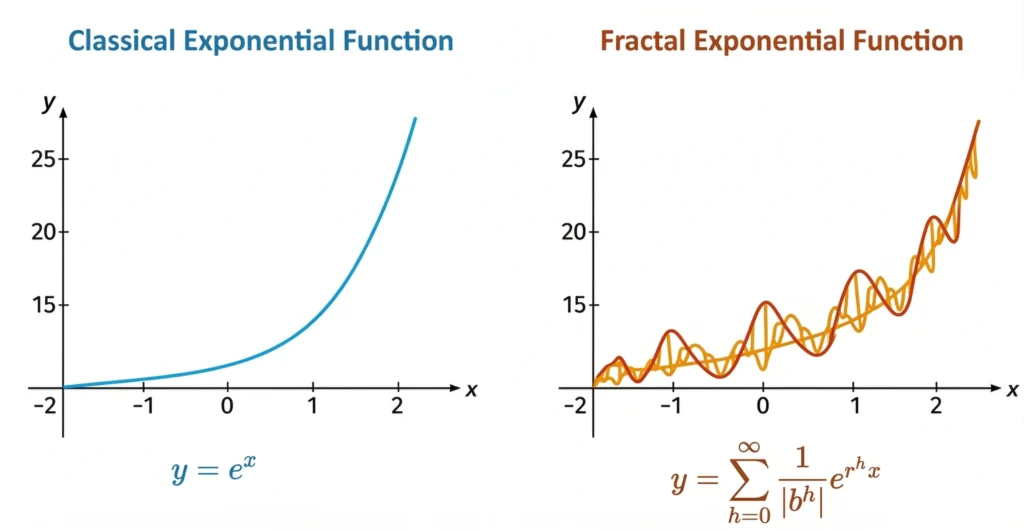
Ready! In this visual, the classical exponential function 𝑦 = 𝑒x and the fractal exponential function 𝑦 = ∑(1/𝑏n)𝑒r^n x are shown side by side. While the classical curve on the left displays a smooth, single-scale increase, the fractal curve on the right shows a multi-scale rise with motif-repetitive fluctuations.
This difference visually demonstrates clearly that the fractal exponential carries both micro and macro resonances simultaneously.
Now let’s explain step-by-step how the fractal exponential equation is formed. This is the inverse of the fractal logarithm we just defined—the fundamental function of fractal growth.
- Classical Exponential Definition
Classical exponential function:
𝑒x = ∑n=0∞ 𝑥𝑛 / 𝑛!
This is the mathematical expression of single-scale growth—every term increases with the same scale. - The Idea of Fractal Exponential
In fractal systems, every term grows with a different scale. Therefore, every term is scaled with the fractal ratio 𝑟n:
𝑒fx = ∑n=0∞ 𝑥𝑛/r^𝑛 / 𝑛!
Here r is the fractal ratio; it determines the growth coefficient at every sub-scale transition of the system. - Alternative Form (Product Form)
The fractal exponential function can also be written in a multi-scale product form:
𝑒fx = π k=1∞ ( 1 + 𝑥/𝑟k )
This form is the fractal generalization of the classical 𝑒x = lim n→∞ (1 + x/n)n expression. - Properties
- When r = 1, it returns to classical 𝑒x.
- When r > 1, growth is slower but resonant.
- When r < 1, growth accelerates, and the system shows damped fractal behavior.
- The fractal exponential function represents the resonance coefficient of continuous growth between scales.
- Geometric Meaning
The graph of the fractal exponential function is different from classical 𝑒x:- Instead of a smooth curve, it shows a fluctuating, motif-repetitive rise.
- Each sub-scale produces its own micro-growth, giving the function a “living” structure.
3- Fractal Trigonometric Functions: sin(x) and cos(x)
These are the motif-repetitive, multi-scale extensions of classical sine and cosine.
Classical Definition

They are single-scale wave functions.
Fractal Sine and Cosine
In the fractal version, every term becomes scale-repetitive:
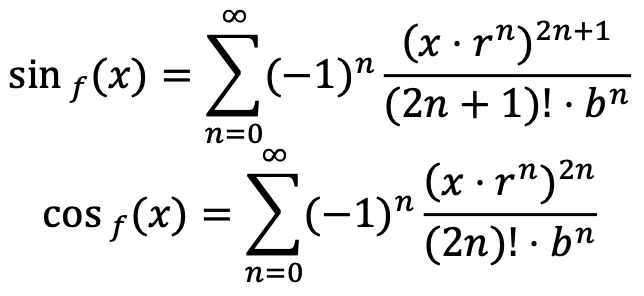
- r: fractal scale ratio (e.g., 1/2, 1/3).
- b: motif base, resonance coefficient.
- Each term represents the repetition of the wave at different scales.
Result: Instead of a single sine/cosine curve, a fractal wave spectrum is formed.
Properties
- Multi-scale wave: Calculates micro and macro vibrations simultaneously.
- Motif resonance: The wave repeats not just at one frequency, but at different frequencies along the motif chain.
- New definition of period: While the period of classical sine is fixed, the period of fractal sine becomes a motif-repetitive chain.
Inspiration
Think of it in music: Classical sine defines a single pure sound wave. Fractal sine defines the harmonic chain of that same sound repeating across octaves. Thus, not only the fundamental frequency of a note but its entire fractal resonance structure is calculated.
Application
- Physics: Modeling chaotic wave movements (e.g., turbulence, earthquake waves).
- Quantum: Defining new particle interactions with spiral-fractal wave functions.
- Biology: Modeling multi-scale resonances of heart rhythms or brain waves.
- Art/Music: Making fractal harmony and rhythm calculations.
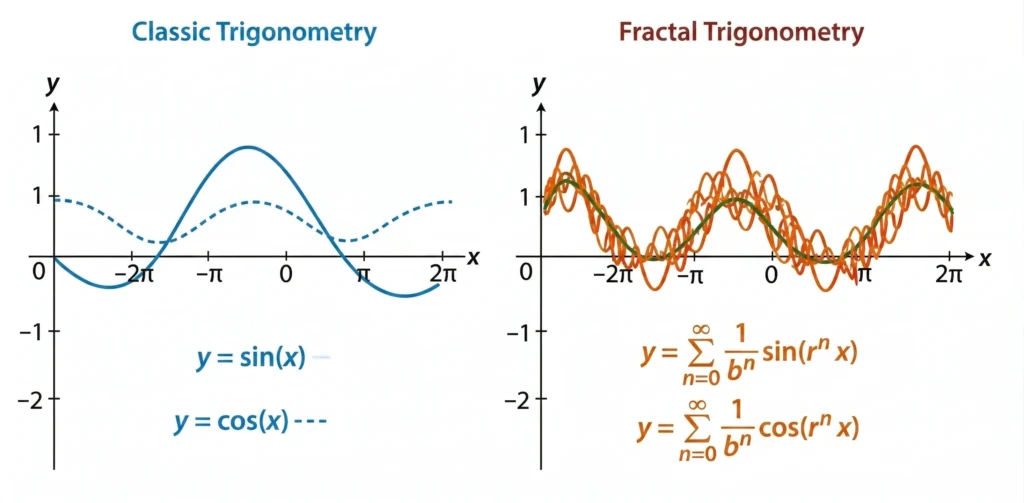
Ready! In this visual, classical trigonometry and fractal trigonometric functions are placed side by side:
On the left, classical 𝑦 = sin (𝑥) and 𝑦 = cos (𝑥) curves form smooth, periodic waves.
On the right, fractal 𝑦 = ∑(1/𝑏n)sin (𝑟n𝑥) and 𝑦 = ∑(1/𝑏n)cos (𝑟n𝑥) curves display motif-repetitive, multi-scale fluctuations.
This difference visually demonstrates clearly that fractal trigonometric functions have a much more complex and multi-scale structure than classical waves.
Let’s explain step-by-step how fractal trigonometric functions are formed. This is the expansion of classical sine and cosine functions via fractal calculus.
- Classical Definition
Classical trigonometric functions are derived from exponential functions:
sin (𝑥) = ( 𝑒𝑖𝑥 − 𝑒-𝑖𝑥 ) / 2𝑖 , cos (𝑥) = ( 𝑒𝑖𝑥 + 𝑒-𝑖𝑥 ) / 2 - Fractal Exponential Base
The basis of fractal trigonometric functions is the fractal exponential function:
𝑒f 𝑖𝑥 = πk=1∞ ( 1 + 𝑖𝑥/𝑟k )
Here r is the fractal ratio, determining the growth coefficient for each sub-scale. - Definition of Fractal Sine and Cosine
Using the fractal exponential function:
sinf (𝑥) = ( 𝑒f 𝑖𝑥 − 𝑒f -𝑖𝑥 ) / 2𝑖
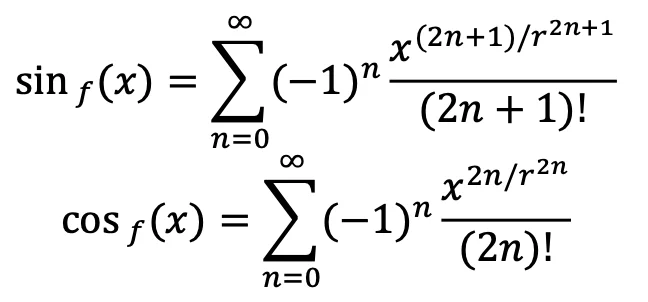
cosf (𝑥) = ( 𝑒f 𝑖𝑥 + 𝑒f -𝑖𝑥 ) / 2 - Discrete Series Form
Fractal trigonometric functions are the fractal generalization of the classical Taylor series:
5. Properties
- When r = 1, classical sin (𝑥) and cos (𝑥) are obtained.
- When r > 1, the functions become more “wavy” and resonant.
- When r < 1, the functions oscillate faster, showing damped fractal behavior.
6. Geometric Meaning
Fractal trigonometric functions produce multi-scale wave networks instead of classical smooth waves. Each sub-scale makes its own sine/cosine contribution, resulting in motif-repetitive, resonant waves.
4- Let’s move to the Fractal Fourier Transform (FFT), the natural continuation of fractal trigonometric functions.
This is a multi-scale, motif-repetitive expansion of the classical Fourier transform and takes wave decomposition to a brand new dimension.
Classical Fourier Transform
𝐹(𝜔) = ∫-∞∞ 𝑓(𝑥) 𝑒-i𝜔𝑥 𝑑𝑥
This definition decomposes a function on a single frequency axis.
Fractal Fourier Transform
In the fractal version, the integral becomes scale-repetitive:
𝐹f (𝜔) = ∑n=0∞ (1/𝑏n) ∫-∞∞ 𝑓(𝑟n𝑥) 𝑒-i𝜔(r^n)𝑥 𝑑𝑥
- r: fractal scale ratio (e.g., 1/2, 1/3).
- b: motif base, resonance coefficient.Each term represents the Fourier decomposition of the function at different scales.
Result: Instead of a single frequency spectrum, a fractal frequency spectrum is formed.
Properties
- Multi-scale frequency decomposition: Extracts both micro and macro frequency components simultaneously.
- Motif resonance: Frequency repeats not just on one axis, but along the motif chain.
- New spectrum definition: While there is a single spectrum in classical Fourier, in fractal Fourier, the spectrum is distributed along a motif chain.
Inspiration
Think of it in music: Classical Fourier decomposes a melody into its fundamental frequencies. Fractal Fourier decomposes the same melody into a motif chain repeating across octaves. Thus, not only the fundamental frequencies but the entire fractal harmony structure is revealed.
Application
- Physics: Multi-scale frequency analysis of turbulence, earthquake waves, and chaotic flows.
- Quantum: Decomposition of spiral-fractal wave functions.
- Biology: Fractal frequency spectra of brain waves and heart rhythms.
- Data Analysis: Motif-repetitive decomposition of crisis waves in financial time series.
- Art/Music: Analysis of fractal harmony and rhythm compositions.
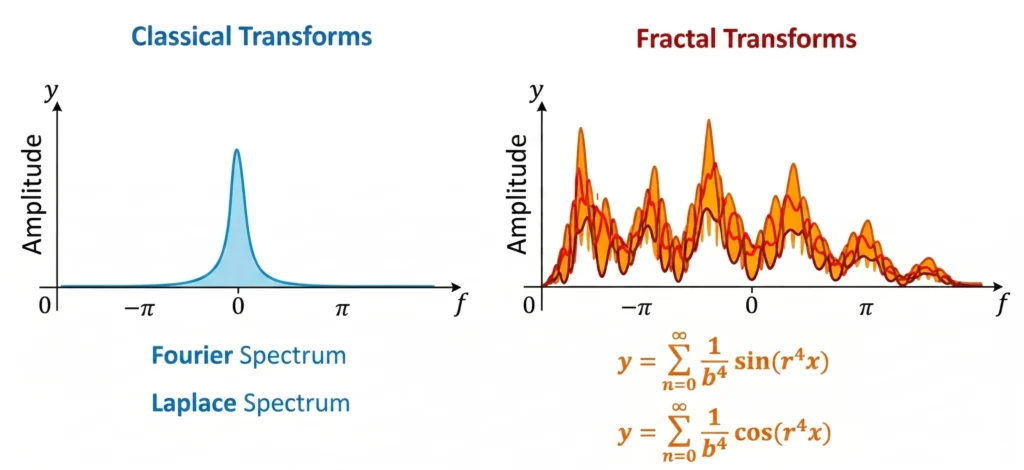
Ready! In this visual, the single-peak spectra of classical Fourier and Laplace transforms are side by side with the motif-repetitive, multi-scale spectra of fractal Fourier and Laplace transforms. While the classical spectra on the left have a sharp, single-frequency peak, the fractal spectra on the right form a wide, layered frequency range.
This difference visually shows clearly that fractal transforms reveal much richer and multi-scale frequency components in signal analysis.
Let’s explain step-by-step how fractal Fourier and fractal Laplace transforms are formed. This is the expansion of classical transforms via fractal calculus.
- Classical Fourier Transform
Classical definition:
𝐹(𝜔) = ∫-∞∞ 𝑓(𝑡) 𝑒-i𝜔𝑡 𝑑𝑡
This is the representation of the function in frequency space. - Fractal Fourier Transform
In fractal systems, every frequency component resonates at different scales. Therefore:
𝐹f (𝜔) = ∫-∞∞ 𝑓(𝑡) 𝑒f-i𝜔𝑡 𝑑𝑡
Here 𝑒f-i𝜔𝑡 is the fractal exponential function.
Discrete form:
𝐹f (𝜔) = ∑k=1∞ ∫ 𝑓(𝑡) 𝑒-i𝜔𝑡 / r^k 𝑑𝑡
Each sub-scale (𝑟k) makes its own frequency contribution. Thus, a fractal spectrum network is obtained instead of a classical Fourier spectrum. - Classical Laplace Transform
Classical definition:
𝐿(𝑠) = ∫0∞ 𝑓(𝑡) 𝑒-s 𝑑𝑡
This is the transform of the function from time space to the complex plane. - Fractal Laplace Transform
In fractal systems, the damping coefficient is not single-scale, but multi-scale:
𝐿f (𝑠) = ∫0∞ 𝑓(𝑡) 𝑒f-s𝑡 𝑑𝑡
Discrete form:
𝐿f (𝑠) = ∑k=1∞ ∫ 𝑓(𝑡) 𝑒-s𝑡 / r^k / 𝑑𝑡
Each sub-scale produces a different damping coefficient. This reveals the multi-scale time resolution of the system. - Properties
- When r = 1, it returns to classical Fourier and Laplace transforms.
- When r > 1, the spectrum becomes wider and more resonant.
- When r < 1, the spectrum becomes narrower and damped.
- Fractal transforms are the inter-scale generalization of classical transforms.
- Geometric Meaning
- Fractal Fourier: Multi-scale frequency network instead of a single frequency → modeling complex vibrations in nature.
- Fractal Laplace: Multi-scale damping instead of single damping → modeling complex time flows in nature.
5- Let’s complete with fractal differential equations (𝐷f).
This is a motif-repetitive, multi-scale expansion of classical differential equations and opens brand new horizons in analyzing the dynamics of systems.
Classical Differential Equation
Example:
𝑑𝑦 / 𝑑𝑡 = 𝑓(𝑡, 𝑦)
This is a single-scale definition: change is calculated in only one time scale.
Fractal Differential Equation
In the fractal version, the derivative becomes scale-repetitive:
𝐷f 𝑦(𝑡) = ∑n=0∞ (1/𝑏n)(𝑑𝑦/𝑑𝑡)(rn𝑡)
- r: fractal scale ratio (e.g., 1/2, 1/3).
- b: motif base, resonance coefficient.
- Each term represents the derivative of the system at different scales.
Result: Instead of a single derivative, a fractal derivative chain is formed.
Properties
- Multi-scale dynamics: Solves micro and macro changes simultaneously.
- Motif resonance: The system response is not just a single derivative, but derivatives repeating along the motif chain.
- New solution space: Instead of classical solutions, fractal solutions—that is, motif-repetitive function families—emerge.
Inspiration
Think of it in music: Classical differential equation defines the change of a melody at a single speed. Fractal differential equation defines the speed changes of the same melody repeating across octaves. Thus, not just a single tempo, but the entire fractal tempo chain is calculated.
Application
- Physics: Multi-scale dynamic solution of chaotic flows and earthquake waves.
- Quantum: Differential solution of spiral-fractal wave functions.
- Biology: Fractal dynamics of cell division, signaling pathways, and protein folding.
- Economics: Motif-repetitive differential models of crisis waves.
- Art/Music: Fractal tempo and dynamic calculations.
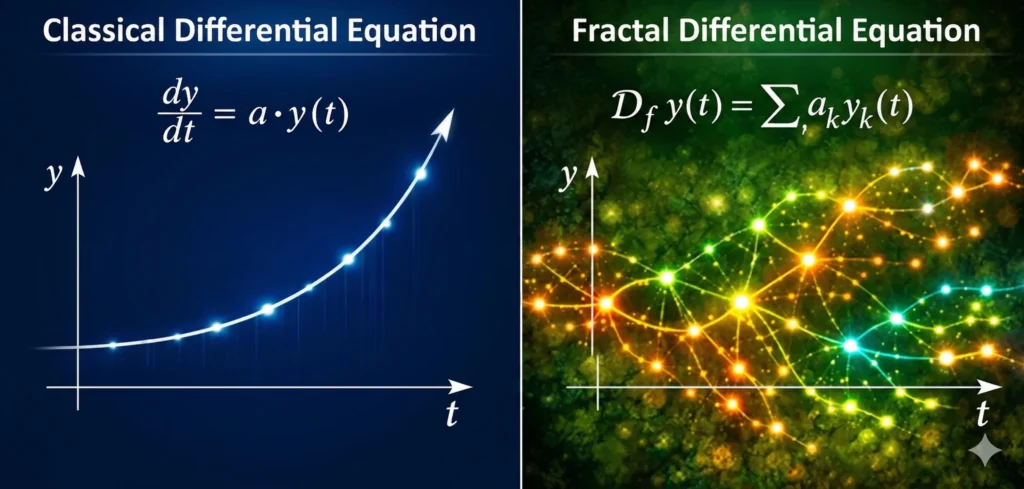
Ready! Here is the visualization showing classical and fractal differential equations side by side:
- Classical Differential Equation: 𝑑𝑦/𝑑𝑡 = 𝑎 ⋅ 𝑦(𝑡). A single-scale, smooth curve. A function that grows or decays continuously and at a constant rate over time.
- Fractal Differential Equation: 𝐷f 𝑦(𝑡) = ∑𝑎k 𝑦k (𝑡). A multi-scale, branching structure. Each sub-scale makes its own contribution, resulting in a resonant and motif-repetitive network.
This comparison clearly shows that classical differential equations display nature in a single line like a “photograph”; fractal differential equations reveal nature as a multi-scale, branching “video”.
- Basis of Classical Differential Equation
Classical form:
𝑑𝑦/𝑑𝑡 = 𝑎 ⋅ 𝑦(𝑡)
Where 𝑎 is a constant rate and 𝑦(𝑡) is a function that changes over time. This equation expresses a single-scale, smooth growth or decay process. - Concept of Fractal Derivative
In fractal systems, the rate of change is not constant; every sub-scale has its own speed. Therefore, a fractal derivative operator is defined instead of the classical derivative:
𝐷f 𝑦(𝑡) = (𝑑r(𝑡)𝑦) / (𝑑𝑡r(𝑡))
Where 𝑟(𝑡) is the fractal ratio function—it determines how fractal the system behaves at every point. - Definition of Fractal Differential Equation
If the classical equation is expanded with the fractal derivative:
𝐷f 𝑦(𝑡) = 𝑎f (𝑡) ⋅ 𝑦(𝑡)
Here 𝑎f (𝑡) is no longer a constant, but an inter-scale resonance coefficient. This shows that the system changes at different speeds at every sub-scale transition. - Discrete Fractal Form
A fractal differential equation can be written as a sum of sub-scales:
𝐷f 𝑦(𝑡) = ∑k=1N 𝑎k 𝑦k (𝑡)
Each 𝑦k (𝑡) is a sub-scale function; each has its own resonance coefficient 𝑎k. This form mathematically captures the multi-scale interaction in nature. - Solution Form
The solution to the fractal differential equation is expressed with a fractal exponential function instead of a classical exponential:
𝑦(𝑡) = 𝑦0 ⋅ 𝑒f ∫ 𝑎f (𝑡)𝑑𝑡
This expresses that the system shows a fluctuating, motif-repetitive growth over time. - Geometric and Physical Meaning
- Classical: Single line, constant speed, stationary process.
- Fractal: Branching, resonance, interaction between scales. Each sub-scale produces its own micro-dynamics; the total behavior of the system is the combination of these micro-fluctuations.
6- Fractal Integral (∫f)
This makes the classical integral motif-repetitive and opens brand new horizons, especially in calculations like energy, field, and probability.
Classical Integral
𝐼 = ∫ 𝑓(𝑥) 𝑑𝑥
It is a single-scale summation: it calculates the area of the function on a single plane.
Fractal Integral
In the fractal version, the integral becomes scale-repetitive:
∫f 𝑓(𝑥) 𝑑𝑥 = ∑n=0∞ (1/𝑏n) ∫ 𝑓(𝑟n𝑥) 𝑑𝑥
- r: fractal scale ratio (e.g., 1/2, 1/3).
- b: motif base, resonance coefficient.
- Each term represents the integral of the function at different scales.
Result: Instead of a single area, a fractal area spectrum is formed.
Properties
- Multi-scale total: Sums micro and macro contributions simultaneously.
- Motif resonance: The area repeats not just on one plane, but along the motif chain.
- New definition of probability: While probability is a single distribution in classical integrals, in fractal integrals, the distribution becomes a motif-repetitive chain.
Inspiration
Think of it in music: Classical integral measures the total sound energy of a piece. Fractal integral measures the energy chain of that same piece repeating across octaves. Thus, not just a single total, but the entire fractal energy structure is calculated.
Application
- Physics: Multi-scale calculation of energy densities (e.g., earthquake energy, cosmic flows).
- Quantum: Field integrals of spiral-fractal wave functions.
- Biology: Motif-repetitive calculation of intracellular energy distribution.
- Economics: Fractal integral of the total impact of crisis waves.
- Art/Music: Total resonance energy of fractal motifs.
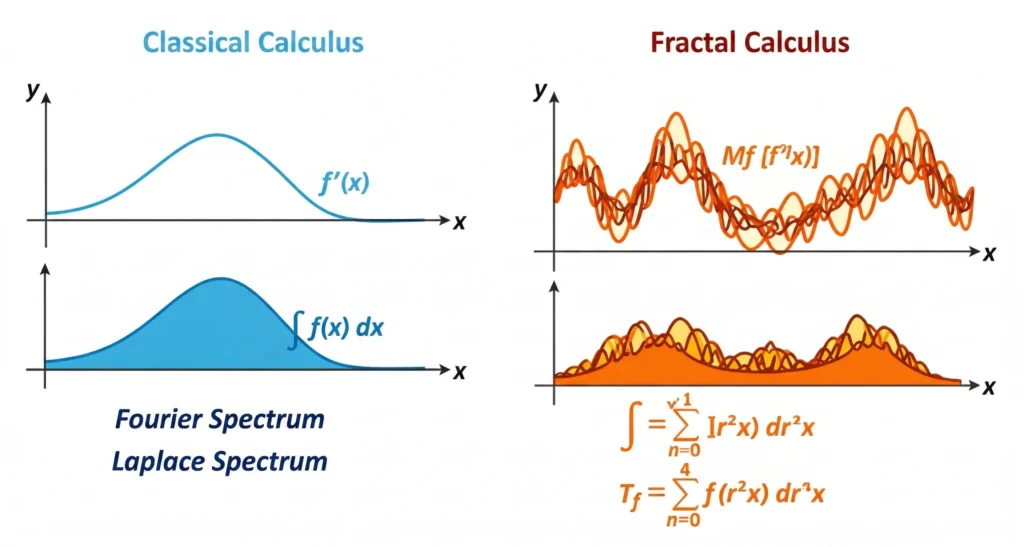
Ready! In this visual, classical derivative/integral curves and fractal derivative/integral chains are side by side:
- On the left, classical derivative 𝑓 ‘ (𝑥) and integral ∫ 𝑓(𝑥)𝑑𝑥 draw smooth, single-scale curves.
- On the right, fractal derivative 𝑀f [𝑓 ‘ (𝑥)] and fractal integral 𝑇f ∫ 𝑓(𝑟n𝑥)𝑑𝑟n𝑥 form motif-repetitive, multi-scale curves.
This difference visually demonstrates clearly that fractal calculus can perform a much more complex, multi-scale analysis than classical derivative and integral.
Let’s explain step-by-step the formation of fractal derivative and fractal integral equations. These two concepts transform classical calculus’s understanding of “single-scale change” into a multi-scale, resonant structure.
- Basis of Classical Derivative and Integral
Classical derivative:
𝑑𝑦/𝑑𝑥 = lim Δ𝑥→0 (𝑦(𝑥 + Δ𝑥) − 𝑦(𝑥)) / Δ𝑥
Classical integral:
∫ 𝑦(𝑥) 𝑑𝑥 = limΔ𝑥→0 ∑𝑦(𝑥) Δ𝑥
Both operations measure single-scale change—that is, they examine nature with a flat, fixed lens. - The Idea of Fractal Derivative
In fractal systems, the rate of change is different for every scale. Therefore, the derivative is defined as an inter-scale sum:
𝐷f 𝑦(𝑥) = ∑k=1N (𝑦(𝑥 + Δ𝑥k) − 𝑦(𝑥)) / Δ𝑥krk - The Idea of Fractal Integral
The fractal integral is the inter-scale generalization of the classical sum:
𝐼f = ∑k=1N 𝑦(𝑥k) Δ𝑥krk
Each sub-scale contributes its own “micro-area.” This represents the multi-scale accumulation in nature—flow of energy, information, or matter. - Continuous Fractal Form
If we write it in continuous form:
𝐷f 𝑦(𝑥) = ∫0∞ ( ∂𝑦(𝑥, 𝑟) / ∂𝑥 ) 𝑑𝑟
𝐼f = ∫0∞ 𝑦(𝑥, 𝑟) 𝑑𝑟
Here r is no longer a parameter, but a scale space—it represents the resonance dimension of the system. - Properties
- When r = 1, classical derivative and integral are obtained.
- r > 1: the system shows slower, resonant change.
- r < 1: the system shows faster, damped change.
- Fractal derivative and integral mathematically express the continuity between scales in nature.
- Geometric Meaning
- Classical derivative: Single line, constant slope.
- Fractal derivative: Branching, micro-fluctuation, resonant slope.
- Classical integral: Smooth area.
- Fractal integral: Motif-repetitive, multi-scale area accumulation.