

The following system modularly describes the physical and mathematical components of the eye model for contrast-enhanced pattern stimulation under photopic PERG conditions: optical transfer, phototransduction chemistry, membrane currents, synaptic transmission, and ganglion firing.
Optical input and retinal illumination
- Pattern stimulus:
𝐼(𝐱, 𝑡) = 𝐼0[1 + 𝐶 ⋅ 𝑠(𝐱, 𝑓s) ⋅ sin , (2𝜋𝑓t𝑡)]
Here, 𝐼o is the photopic mean light intensity, 𝐶 is the contrast, 𝑠(𝐱, 𝑓s) is the spatial frequency filter (e.g., 1.6 cpd), and 𝑓t is the temporal frequency (e.g., 4 Hz).
- Pupil-lens optical transmission:
𝐸ret(𝐱, 𝑡) = 𝜂opt ⋅ 𝐴pupil ⋅ 𝐼(𝐱, 𝑡) ⋅ 𝑇λ
Here, 𝜂opt is optical efficiency, 𝐴pupil is pupil area, and 𝑇λ is wavelength transmission coefficient.
Phototransduction chemistry and current gates
- Opsin–G protein–PDE cascade (activity modification):
𝑑𝑅∗ / 𝑑𝑡 = 𝛼R𝐸ret− 𝛽R𝑅∗, 𝑑𝐺∗ / 𝑑𝑡 = 𝛼G𝑅∗ − 𝛽G𝐺∗, 𝑑PDE / 𝑑𝑡 = 𝛼P𝐺∗ − 𝛽PPDE
- cGMP pool and Ca²⁺ feedback:
𝑑[cGMP] / 𝑑𝑡 = 𝑘syn (1 + 𝛾Ca(Ca‾ − [Ca2+]) − 𝑘hydPDE [cGMP]
- CNG door opening probability and current:
𝑝CNG = [cGMP]n / [𝐾nCNG + [cGMP]n] , 𝐼CNG = 𝑔CNG 𝑝CNG(𝑉m − 𝐸CNG)
- Photoreceptor membrane equation (rod/cone):
𝐶m𝑑𝑉m / 𝑑𝑡 = −(𝐼CNG + 𝐼leak + 𝐼HC + 𝐼Ca + 𝐼K)
Here, 𝐼leak = 𝑔leak(𝑉m − 𝐸leak), horizontal cell feedback can be modeled with the 𝐼HC inclusion term dependent on the environmental mean.
- Internal Ca²⁺ dynamics:
𝑑[Ca2+] / 𝑑𝑡 = 𝐼Ca,in / 𝑧𝐹𝑉cell − 𝑘upt[Ca2+] + 𝑘rel𝑆store
and for SR depots
𝑑𝑆store / 𝑑𝑡 = = 𝑘fill[Ca2+] − 𝑘rel𝑆store
Bipolar synaptic transmission and postsynaptic potentials
- ON pathway (metabotropic, reversed sign):
𝐼syn,ON = 𝑔ON 𝜎 , ([Glu]0 − Δ[Glu](𝑉m)) (𝑉BP− 𝐸ON)
Here, 𝜎(⋅) represents sigmoidal transfer, and Δ[Glu] represents glutamate decrease due to photoreceptor output.
- OFF path (ionotropic, same sign):
𝐼syn,OFF = 𝑔OFF 𝜎 , (Δ[Glu](𝑉m)) (𝑉BP− 𝐸OFF)
- Bipolar membrane equation:
𝐶BP𝑑𝑉BP / 𝑑𝑡 = −(𝐼syn,ON + 𝐼syn,OFF + 𝐼leak,BP), 𝐼leak,BP = 𝑔leak,BP(𝑉BP− 𝐸leak,BP)
Ganglion cell: firing pattern and output
- Simple LIF (discharge condition):
𝐶RGC𝑑𝑉RGC / 𝑑𝑡 = −𝑔L(𝑉RGC− 𝐸L) + 𝐼syn,BP(𝑡) , if 𝑉RGC ≥ 𝑉th ⇒ spike, 𝑉RGC → 𝑉reset, 𝑡 → 𝑡 + 𝑡ref
- HH-derivative (optional channel detail):
𝐶RGC𝑑𝑉RGC / 𝑑𝑡 = −(𝑔Na𝑚3ℎ(𝑉RGC − 𝐸Na) + 𝑔K𝑛4(𝑉RGC− 𝐸K) + 𝑔L(𝑉RGC− 𝐸L)) + 𝐼syn,BP
gate variables:
𝑑𝑥 / 𝑑𝑡 = 𝛼x(𝑉RGC) (1 − 𝑥) − 𝛽x(𝑉RGC) 𝑥, 𝑥 ∈ {𝑚, ℎ, 𝑛}
- Ignition rate and PERG components:
𝑓RGC(𝑡) = Σk𝛿(𝑡 − 𝑡k) ⇒ PERG(𝑡) = ℱ(𝑓RGC(𝑡))
≈ 𝑎 𝑁35(𝑡) + 𝑏 𝑃50(𝑡) + 𝑐 𝑁95(𝑡)
Here, ℱ(⋅) represents the linear–weak linear functional representing the recording/optical nerve–electrode response; 𝑎, 𝑏, 𝑐 are the component weights.
Phase and time calibration under PERG conditions.
- Temporal period alignment (4 Hz):
𝑇 = 1 / 𝑓t = 250 ms, 𝑡k ∈ {35,50,95} (ms, in-loop reference)
- Phase lock error function (for component timings):
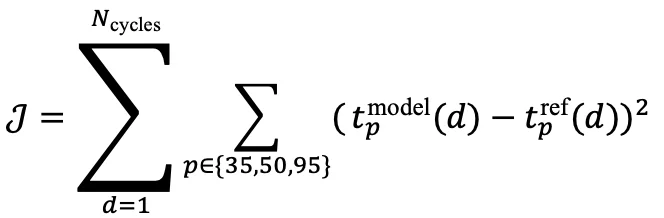
Parameter calibration, 𝜃 = {𝛾Ca, 𝑘syn, 𝑘hyd, 𝑔ON, 𝑉th, 𝑡ref}
𝜃∗ = arg min𝜃 𝒥
- Amplitude normalization and adaptation metric:
𝐴pnorm = 𝐴p / maxd 𝐴p(𝑑) , 𝜅adapt = 𝐴p(𝑑1) − 𝐴p(𝑑N) / 𝐴p(𝑑1)
Here, 𝑝 ∈ {𝑃50, 𝑁95}, 𝑑1 is the first loop, and 𝑑N is the last loop.
Parameter-output sensitivity summary
- Optical-chemical bond:
∂𝑁35 / ∂𝑘hyd > 0, ∂𝑃50 / ∂𝑔ON < 0 (Phase positive peak earlier)
- Synaptic-neural connection:
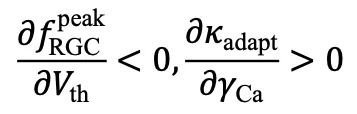
This formulation establishes a complete chain, starting from optical energy transfer and extending to second messenger dynamics, membrane currents, and synaptic-neural output. The phase-locked error function and sensitivity derivatives provide a practical optimization framework for calibrating time-phase coherence and amplitude-adaptation relationships under photopic PERG conditions.