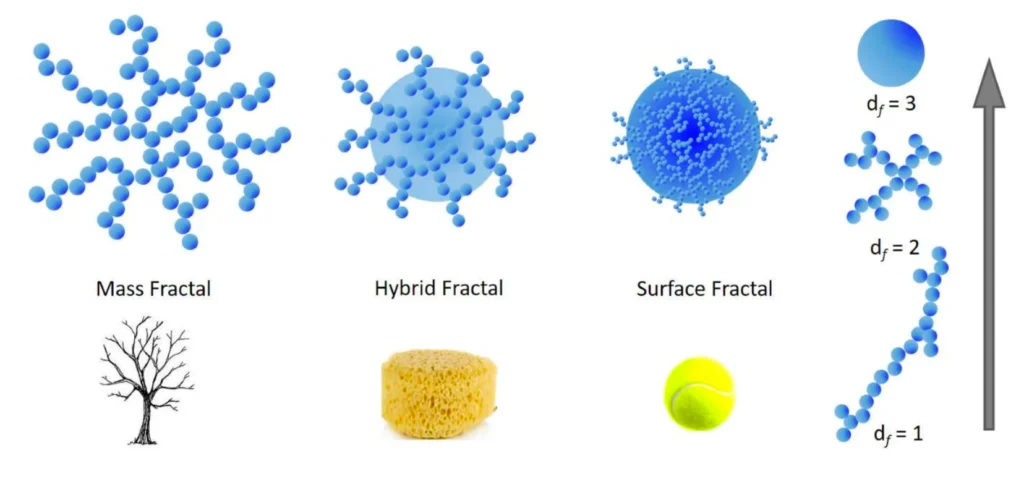
Quantum fractal chemistry is a field based on modeling molecular structures and reactions by bridging fractal geometry and quantum mechanics. This approach aims to explain both the multiscale nature of chemical processes and the self-similar behaviors of quantum wave functions.
Core Topics
- Fractal Wave Functions: Defining molecular orbitals using fractal harmonics.
𝜓fr (𝑟) = ∑n 𝑎n ⋅ 𝑓(𝑟)𝐷𝑓
- Fractal Potential Energy Functions: Scaling intermolecular interactions with the fractal dimension.
𝑉fr (𝑟) = 𝑉0 ⋅ 𝑟𝐷𝑓 – d
- Fractal Reaction Kinetics: Explaining quantum chemical reaction rates through fractal integral equations.
- Fractal Energy Transfer: Modeling electron and photon movements via self-similar spiral flows.
- Fractal Biochemistry: Analyzing quantum fractal motifs within DNA and protein structures.
Application Areas
| Area | Description | Example |
| Molecular modeling | Explaining orbitals through fractal wave functions | Quantum chemistry simulations |
| Nanochemistry | Modeling nanoparticles via fractal energy transfer | Gold nanoparticle synthesis |
| Biochemistry | Analyzing DNA and protein foldings using fractal motifs | Fractal globule DNA model |
| Astrochemistry | Fractal energy distribution of cosmic molecules | Intragalactic molecular clouds |
Visual Motifs
- Fractal Wave Function Diagram: The self-similar structure of orbitals
- Fractal Potential Energy Map: Fractal scaling of intermolecular interactions
- Fractal DNA Spiral Model: The quantum fractal structure of the genetic code
This lecture notes package encompasses both the theoretical and applied dimensions of quantum fractal chemistry.
Fractal Wave Functions
Fractal wave functions are defined as quantum wave functions extended with self-similar structures. This approach aims to explain the probability distributions of particles using fractal motifs instead of classical Gaussian or sine functions.
Key Concepts
- Fractal Gaussian function: Extending the wave function via Cantor-type or Koch-type fractal modulation.
- Fractal Fourier transform: Analyzing wave functions through their self-similar frequency components.
- Fractal dimension effect: The amplitude and probability density of the wave function are scaled by the fractal dimension.
- Fractal entropy: Calculating the information content of the wave function using fractal logarithms.
Mathematical Formulation
Fractal-modulated wave function
𝜓fr (𝑥) = 𝜓0 (𝑥) ⋅ 𝑓(𝑥)𝐷𝑓
Where:
- 𝜓0 (𝑥) : classical wave function
- 𝑓(𝑥) : fractal modulation function
- 𝐷𝑓 : fractal dimension
Cantor-Gaussian example
𝜓CG (𝑥) = 𝑒-𝑥2 ⋅ 𝐶(𝑥)𝐷𝑓
- 𝐶(𝑥) : Cantor function, which imparts self-similarity to the wave function.
Application Areas
| Area | Description | Example |
| Quantum chemistry | Modeling molecular orbitals with fractal wave functions | Electron distribution |
| Astrophysics | Explaining cosmic wave functions through fractal resonances | Black hole environments |
| Biochemistry | Analyzing DNA and protein vibrations with fractal wave functions | Protein folding |
| Nanotechnology | Fractal modulation of quantum wave functions in nanoparticles | Gold nanoparticles |
Visual Motifs
- Fractal Gaussian Wave Graph: A classical Gaussian function extended by fractal modulation
- Fractal Fourier Spectrum: Self-similar frequency components
- Fractal Cantor Wave Diagram: A wave function modulated by the Cantor function
Fractal Potential Energy Functions
Fractal potential energy functions describe how intermolecular interactions and molecular bonds scale with the fractal dimension, diverging from classical potential energy models. This approach is utilized to model energy distribution more realistically in quantum chemistry and nanochemical systems.
Key Concepts
- Fractal scaling: Potential energy functions change depending on the fractal dimension of the system.
- Fractal dimension effect: Energy distribution is defined by the Hausdorff dimension instead of a classical 2D/3D framework.
- Multiscale interaction: Intermolecular bonds exhibit self-similar motifs across different scales.
- Fractal resonance: Energy levels align and harmonize with fractal harmonics.
Mathematical Formulation
Fractal potential energy function
𝑉fr (𝑟) = 𝑉0 ⋅ 𝑟𝐷𝑓 – d
Where:
- 𝑉0 : initial potential energy
- 𝑟 : interatomic distance
- 𝐷𝑓 : fractal dimension
- d : classical dimension of the system (e.g., 2 or 3)
Fractal harmonic oscillator
𝑉fr (𝑥) = (1/2) 𝑘𝑥2 ⋅ 𝑓(𝑥)𝐷𝑓
- An extension of the classical harmonic oscillator via fractal modulation.
Application Areas
| Area | Description | Example |
| Quantum chemistry | Modeling molecular orbitals with fractal potential functions | Electron distribution |
| Nanochemistry | Fractal scaling of bond energies in nanoparticles | Gold nanoparticle synthesis |
| Astrophysics | Explaining the energy distribution of cosmic molecules via fractal potentials | Molecular clouds |
| Biochemistry | Fractal energy motifs of DNA and protein bonds | Protein folding |
Visual Motifs
- Fractal Potential Energy Curve: Distance-dependent self-similar energy distribution between atoms
- Fractal Harmonic Oscillator Diagram: A fractal-modulated vibration model
- Fractal Resonance Map: Self-similar alignment of energy levels
Fractal Reaction Kinetics
Fractal reaction kinetics is an extended model that links the rate and energy distribution of chemical reactions to the fractal geometry of the medium. While classical kinetic equations explain linear behavior, fractal kinetics encompasses multiscale and self-similar processes.
Core Equations
Fractal rate equation
𝑅(𝑡) = 𝑘 ⋅ [𝐴] n / 𝐷𝑓
- 𝑅(𝑡) : reaction rate
- 𝑘 : rate constant
- [𝐴] : reactant concentration
- n : reaction order
- 𝐷𝑓 : fractal dimension
Fractal entropy equation
𝑆𝑓 = 𝑘B ⋅ ln (Ω𝐷𝑓)
- The distribution of microstates scales with the fractal dimension.
Fractal energy transfer
𝐸(𝑡) = ∫0𝑡 𝜙(𝜏)𝐷𝑓 𝑑𝜏
- Energy flow is modeled hierarchically using self-similar functions.
Properties
- Multiscale behavior: Reaction rates scale differently across different dimensions.
- Chaotic dynamics: Reactions in fractal media display non-linear behaviors.
- Surface effect: The fractal dimension determines reaction kinetics on heterogeneous surfaces.
Application Areas
| Area | Description | Example |
| Crystal growth | Surface morphology scales with the fractal dimension | Carbon crystals |
| Polymerization | Chain branching rate explained by fractal kinetics | Polyethylene production |
| Biochemistry | Enzyme–substrate interactions modeled via fractal motifs | Protein folding |
| Nanochemistry | Nanoparticle reactivity calculated through fractal energy transfer | Gold nanoparticle synthesis |
Visual Motifs
- Fractal Reaction Map: Fractal integral form of energy flows
- Fractal Polymer Diagram: Fractal topology of branched chains
- Fractal Enzyme Motif: Self-similar structure of enzyme–substrate binding sites
Fractal Energy Transfer
Fractal energy transfer is a model explaining that energy does not propagate in a unidirectional and constant manner, but rather proceeds in multiscale spiral flows with self-similar motifs. This approach extends classical thermodynamics and kinetic equations using fractal derivatives.
Core Equations
Fractal energy density
𝐸fr (𝑟) = 𝐸0 ⋅ 𝑟𝐷𝑓 – 𝑑
- 𝐸0 : initial energy density
- 𝐷𝑓 : fractal dimension
- 𝑑 : system dimension (e.g., 2D or 3D)
Fractal energy flow
Φfr (𝑟, 𝑡) = (𝑑𝛼 / 𝑑𝑡𝛼) (𝐸fr (𝑟) ⋅ 𝑀(𝑟, 𝑡))
- Energy flow evolves over time via the fractal derivative (𝛼).
Fractal transfer integral
𝐸(𝑡) = ∫0𝑡 𝜙(𝜏)𝐷𝑓 𝑑𝜏
- Energy is transported via multilayered fractal functions.
Properties
- Multiscale flow: Energy is carried in spiral motifs across different scales.
- Resonance links: Energy loops at different scales harmonize with each other.
- Conservation: The total energy of the sub-motifs equals that of the core.
- Entropy connection: Energy transfer can be directly linked to information theory.
Application Areas
| Area | Description | Example |
| Quantum physics | Explaining electron orbits through fractal energy loops | Atomic energy levels |
| Astrophysics | Spiral energy flow around black holes | Accretion disks |
| Biophysics | Intracellular energy transfer via fractal motifs | Mitochondrial energy flow |
| Cosmology | Fractal energy distribution of galaxy formations | Spiral galaxies |
Visual Motifs
- Fractal Energy Rings: Outward spiral flow from the core
- Fractal Transfer Diagram: Multiscale energy integral
- Fractal Resonance Map: Inter-ring energy alignment
Fractal Biochemistry
Fractal biochemistry aims to explain DNA, protein, enzyme, and metabolic networks in living systems through self-similar, multiscale, and fractal motifs. This approach demonstrates that biochemical processes operate via multilayered energy and information transfer, distinguishing them from classical linear models.
Key Concepts
- Fractal DNA structure → Modeling the double helix using spiral fractal functions.
- Fractal protein folding → The transformation of amino acid chains into three-dimensional structures with self-similar motifs.
- Fractal enzyme kinetics → Explaining enzyme–substrate interactions via fractal rate equations.
- Fractal metabolism → Modeling intracellular energy flows using fractal integral functions.
Mathematical Models
DNA spiral fractal
𝐷(𝑟, 𝜃) = 𝑟 ⋅ 𝑒i𝜃
Protein folding function
𝑃(𝑛) = 𝑘 ⋅ 𝑛𝐷𝑓
( 𝑛: number of amino acids, 𝐷𝑓: fractal dimension)
Fractal enzyme kinetics
𝑅(𝑡) = 𝑘 ⋅ [𝑆] 𝑛 / 𝐷𝑓
The substrate concentration scales with the fractal dimension.
Application Areas
| Area | Description | Example |
| Genetic code analysis | Measuring fractal motifs in DNA sequences | Epigenetic fractal blocks |
| Protein engineering | Utilizing folding motifs in biotechnology | Enzyme design |
| Metabolic networks | Fractal analysis of intracellular energy transfer | Mitochondrial energy flow |
| Nanobiotechnology | Implementing fractal biopolymers in nanostructures | DNA origami |
Visual Motifs
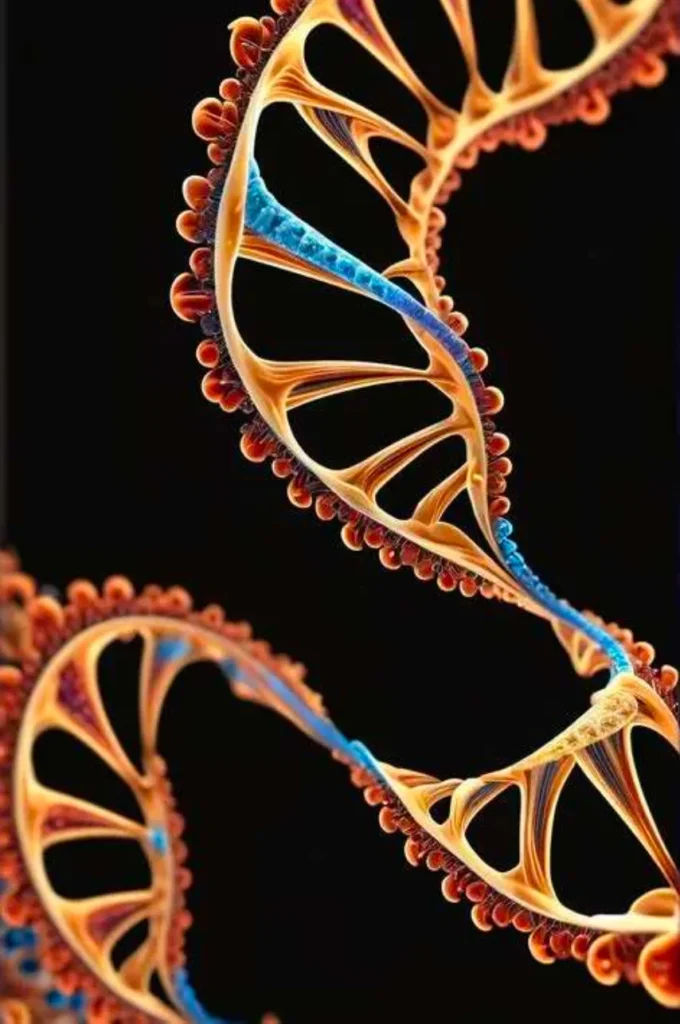
- Fractal DNA Spiral Diagram → The self-similar structure of the double helix
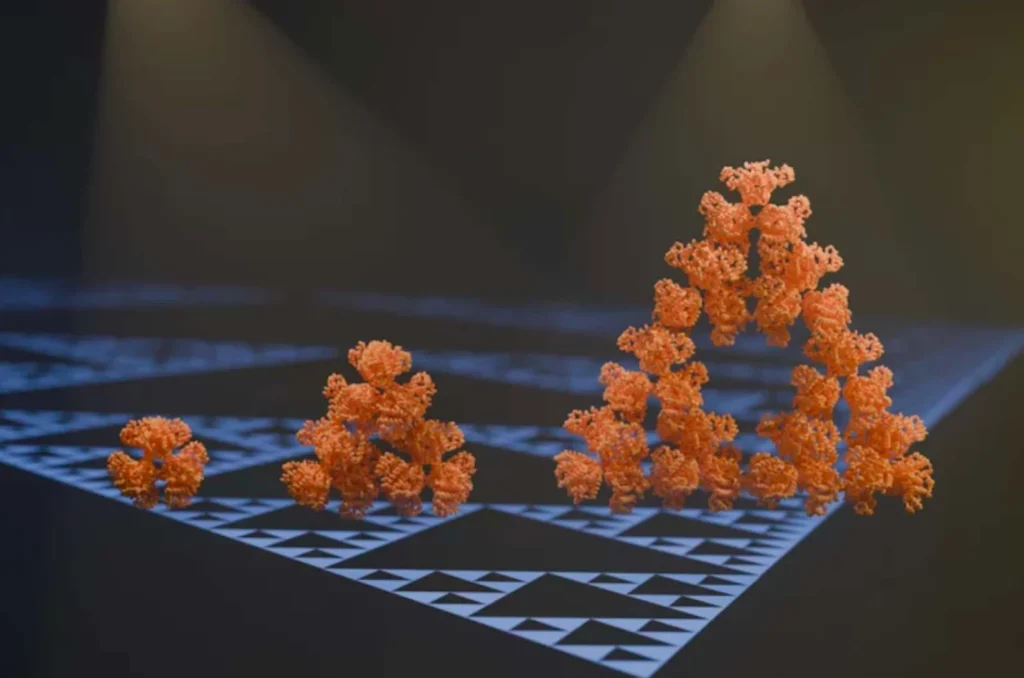
- Fractal Protein Folding Map → Fractal transformation of amino acid chains
- Fractal Metabolic Network Diagram → Fractal model of intracellular energy flows
Fractal DNA Spiral Diagram
Fractal Protein Folding Map
Fractal Metabolic Network Diagram