

The following circuit maps the H2O molecule to a circuit topology using my “electrical circuit library” approach, translating the capacitive-resonant character of oxygen and the flow initiator/decelerator (switch/diode) role of hydrogen into a circuit topology. Bent geometry and polar bonds are modeled as directional flow (diode), charge storage (capacitor), and bond conductivity (resistance).
Circuit abstraction and topology
Code
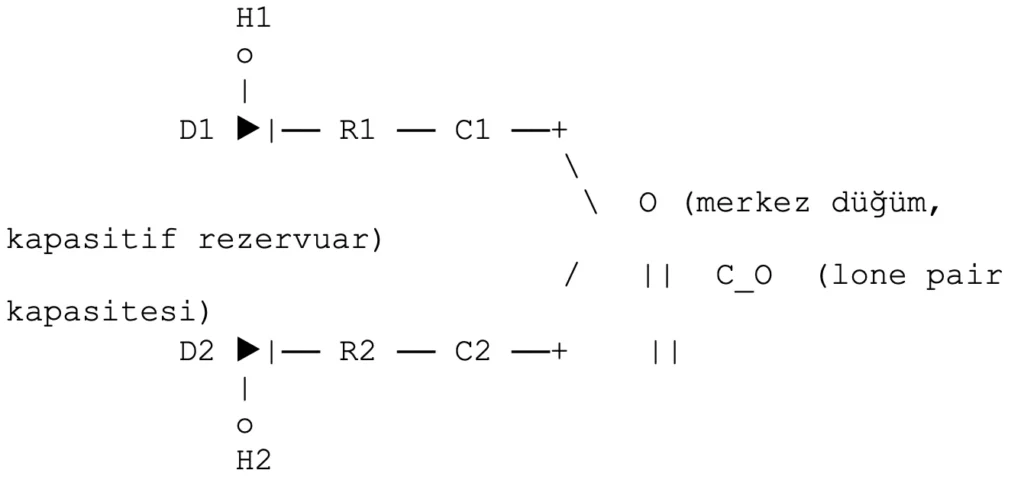
- Oxygen node O: capacitive reservoir (lone pairs) → C0, reference potential V0.
- O–H arms: each arm “diode + resistor + coupling capacitor” → (𝐷𝑖, 𝑅𝑖, 𝐶𝑖), 𝑖 ∈ {1,2}.
- Geometry: H–O–H bending increases directionality; two semiconductor branches are connected in parallel in the circuit.
- Polarity: The flow direction with D is preferential towards O; the reverse flow threshold is high.
Element mapping and parameters
- Oxygen (Group 16): Capacitor/Resonance → C0, with small L0 if necessary, LC character.
- Hydrogen (original): Flow-initiating source/switch + diode → 𝐷𝑖, forward threshold 𝑉D.
- Bond conductivity: Covalent–ionic mixture → series resistance Ri.
- Bond storage: Local charge storage → Ci.
- Directional flow: Electronegativity difference → Di direction H→O.
Examples of reasonable parameter ranges (for normalization purposes):
- 𝑅𝑖 ∈ [50,300] Ω, 𝐶𝑖 ∈ [0.1,1.0] 𝜇F, 𝐶0 ∈ [1,10] 𝜇F, 𝑉D ≈ 0.2–0.4 V.
- Resonance if needed: 𝐿0 ∈ [10,100] 𝜇 Low frequency LC response.
Basic circuit equations
Ohm’s law (for each arm)
- Instantaneous current-voltage relationship:
𝐼𝑖(𝑡) = [𝑉H𝑖(𝑡) − 𝑉0(𝑡) − 𝑉D𝑖(on)] / 𝑅𝑖 , 𝑖 ∈ {1,2}
If the diode is “on”, then 𝑉D𝑖(on) ≈ 𝑉D; if it is “off”, then the current ≈ 0.
- Capacitor currents:
𝐼𝐶𝑖(𝑡) = 𝐶𝑖 𝑑 / 𝑑𝑡 (𝑉0(𝑡) – 𝑉H𝑖(𝑡)) , 𝐼𝐶0(𝑡) = 𝐶0 𝑑𝑉0(𝑡) / 𝑑𝑡
Kirchhoff’s current law (KCL at node O)
- The sum of the currents entering and leaving that node 0:
Σ𝑖=12( 𝐼𝑖(𝑡) + 𝐼𝐶𝑖(𝑡)) + 𝐼leak(𝑡) = 𝐼𝐶0(𝑡)
Here, 𝐼leak is the escape route of the oxygen reservoir (optional small conductivity).
Kirchhoff’s voltage law (KVL for each cycle)
- H_i–O cycle:
𝑉H𝑖(𝑡) − 𝑉D𝑖 − 𝐼𝑖(𝑡)𝑅𝑖 − 1 / 𝐶𝑖 ∫ 𝐼𝐶𝑖(𝑡) 𝑑𝑡 − 𝑉0(𝑡) = 0
Coulomb analysis: partial charges, field, and dipole.
- Partial loads:
𝑞H ≈ +𝛿, 𝑞0 ≈ −2𝛿, 𝛿 > 0
The H–O polar bond creates attraction between 𝑞H and 𝑞O.
- Coulomb force (approximate point charge):
𝐹 = [1 / 4𝜋𝜀] [∣ 𝑞H𝑞0∣ / 𝑟2]
Here, r is the bond length; ε is the dielectric constant of the medium.
- Dipole moment (molecular scale):
𝑝⃗ = Σ𝑖 𝑞𝑖 𝑟⃗𝑖
Due to the bent geometry, ∣ 𝑝⃗ ∣ is not zero; the directivity (diode) and capacitive storage increase in the circuit.
- O node potential relationship:
𝑉0 ≈ 1 / 4𝜋𝜀 (−2𝛿 / 𝑟0,ref)
Simply put, O’s negative partial charge pulls down the node potential; this supports the forward polarity of the diode.
Time response and small-signal resolution
- Linear small-signal confirmation (diode conduction region):
Δ𝐼𝑖 = [Δ𝑉H𝑖 − Δ𝑉0] / 𝑅𝑖 , Δ𝐼𝐶0 = 𝐶0 𝑑 Δ𝑉0 / 𝑑𝑡
- Two arms in parallel RC equivalent:
𝑅eq-1 = Σ𝑖 1 / 𝑅𝑖 , 𝐶eq = 𝐶0 + Σ𝑖 𝐶𝑖
- O node time constant:
𝜏 ≈ 𝑅eq 𝐶eq
This determines the rate at which the “water molecule circuit” polarizes and stores or discharges charge.
Simple numerical example (verification)
- Parameters: 𝑅1 = 𝑅2 = 100 Ω, 𝐶1 = 𝐶2 = 0.5 𝜇F, 𝐶0 = 5 𝜇F, 𝑉D = 0.3 V.
- Stimulation: 𝑉H1 = 0.8 V, 𝑉H2 = 0.6 V, beginning 𝑉0 = 0 V.
1. Instantaneous transmission currents (assumed):
𝐼1 = (0.8 − 0 − 0.3) / 100 = 5 mA, 𝐼2 = (0.6 − 0 − 0.3) / 100 = 3 mA
2. Loading the O node with KCL:
𝐼𝐶0 = 𝐼1 + 𝐼2 ⇒ 𝑑𝑉0 / 𝑑𝑡 = 8 mA / 5 𝜇F = 1600 V/s
3. Small increase of 𝑉0 at dt=0.1 ms:
Δ𝑉0 ≈ 0.16 V
The flow rapidly polarizes node O.; 𝜏 ≈ 𝑅eq𝐶eq = (50 Ω) ⋅ (6 𝜇F) ≈ 0.3 ms.
Comment: physical correspondence and model consistency
- Polarity-directionality: Diodes apply the electronegativity difference in a circuit; forward flow is H→O, reverse flow is suppressed.
- Capacitive reservoir: O’s lone pairs are represented by C0; reflecting the high dielectric constant and polarity of water as enhanced storage in the circuit.
- Conductivity and saturation: Ri determines the bond conductivity; with high stimuli, C0 can fill and an outflow (e.g., hydrogen direction) can be formed.
- Coulomb consistency: The assumption of 𝑞0 = −2𝛿, 𝑞H = 𝛿 supports a long-range dipole moment and gravitational force; it stabilizes the flow direction.
Expansion and verification steps
- Resonance addition: LC response with L0; observing vibration modes (OH stresses) in the circuit.
- AC scanning: Simulating the measurement of the dielectric response of water using 𝜔-dependent impedance 𝑍(𝜔).
- Parameter calibration: Fitting the values (Ri, Ci, C0, VD) to the experimental dielectric and spectral data.
- Multiple molecules: Modeling the hydrogen bond network as an extensive circuit by adding capacitive-inductive bonds between O-nodes for water clusters.
The H2O circuit satisfies the fundamental laws of conduct.
The following assessment clarifies under what conditions the proposed H2O circuit topology satisfies Ohm’s, Kirchhoff’s, and Coulomb’s laws. The short answer: Yes, the model satisfies the laws; however, explicit conditions are required for linear regions, diode states, and capacitive dynamics.
Ohm’s law
- Linear conduction condition: Current-voltage relationship in each O–H branch.
𝐼𝑖 = (𝑉H𝑖 − 𝑉0 − 𝑉D) / 𝑅𝑖
This applies when the diode is in forward conduction. If the diode is in cutoff, 𝐼𝑖 ≈ 0 and Ohm’s law applies in the active conduction branch.
- Capacitor current: In capacitors, the following relationship holds:
𝐼𝐶 = 𝐶 𝑑𝑉 / 𝑑𝑡
This is the definition of reactive current in Ohm in the dynamic part of the circuit.
- Conditional accuracy: Ohm’s law is always valid for resistive elements, but only in the “on” region for diodes. Nonlinear element characteristics (diode I–V) are included in the model.
Kirchhoff’s laws
- KCL (current law, node O): The sum of the currents at node O,
Σ𝑖 ( 𝐼𝑖 + 𝐼𝐶𝑖 ) + 𝐼leak = 𝐼𝐶0
satisfies the zero net current condition. Node load balance is maintained during capacitive loading.
- KVL (voltage law, for each loop): For the loop H_i→D_i→R_i→C_i→O
𝑉H𝑖 − 𝑉D𝑖 − 𝐼𝑖𝑅𝑖 − 1 / 𝐶𝑖 , ∫ 𝐼𝐶𝑖 𝑑𝑡 − 𝑉0 = 0
The sum of the voltage drops in the closed loop is zero. The time-varying storage term (capacitor) enters the KVL integrally.
- Conditional accuracy: KCL is fully satisfied at all times (the model is built with this balance). KVL is ensured by forward/backward drop-off values depending on the diode condition.
Coulomb’s law and dipole consistency
- Partial load matching: The selection of 𝑞H = +𝛿, 𝑞0 = −2𝛿 produces a net dipole moment with polar bond and wedge geometry:
𝑝⃗ = ∑𝑞𝑖 𝑟⃗𝑖 ≠ 0
- Area and force: For bond length r:
𝐹 = (1 / 4𝜋𝜀) (∣ 𝑞H 𝑞0 ∣ / 𝑟2)
The directional attraction supports the diode direction and the lower potential of the O node in the circuit.
- Dielectric effect: The high 𝜀 value of water is reflected in the circuit by the capacitive reservoir 𝐶0; the Coulomb field is shielded, which is consistent with higher storage capacity in the circuit.
- Conditional accuracy: Coulomb’s law is transferred to the circuit as a macroscopic equivalent through the point-charge approach and effective π usage. Coherence is further enhanced when molecular multi-body interactions (hydrogen bonding network) are extended with additional capacitive/inductive branches.
Energy consistency and tests
- Capacitor energy: The energy stored at node O
𝐸𝐶0 = (1 / 2) 𝐶0 V02
With this, the circuit energy is positive and limited.
- Power balance: The power supplied by the input sources is balanced by KCL/KVL, with heat stored in resistors and temporarily stored in capacitors.
- Time constant: For two parallel arms and a reservoir
𝜏 = 𝑅eq 𝐶eq
The measurement should be consistent with experimental dielectric relaxation expectations (verified by calibration).
Quick verification summary
- Ohm: Linear I–V is achieved for each branch when the diode is “on”; current cutoff is achieved when it is “off”.
- KCL: Current balance is achieved at node O at all times.
- KVL: The sum of voltage drops in each closed loop is zero, including integral terms.
- Coulomb: Polar charge distribution and dipole moment support circuit directionality and capacitance, achieved with the equivalent model.
Notes and conditions
- Diode model: Segmented linear or exponential I–V should be used; laws are more easily tested in small-signal analysis if the threshold and dynamic resistance (rd) are defined.
- Calibration: Coulomb-circuit consistency is strengthened when the values of Ri, Ci, C0, VD are matched to the dielectric spectrum and dipole moment of water.
- Multiple molecule: Adding a hydrogen bonding network preserves KCL/KVL in a wide circuit and makes Coulomb shielding realistic.
The model ensures Ohm’s, Kirchhoff’s, and Coulomb’s laws with the correct diode condition and calibrated parameters.
Validation Table
| Law / Principle | Circuit Element / Equation | Condition of Provision | Conclusion |
| Ohm’s Law | 𝐼 =𝑉/𝑅 | In diode forward conduction, current flows through the resistor. | Available (on each O–H arm) |
| Capacitor Current | 𝐼𝐶 = 𝐶𝑑𝑉/𝑑𝑡 | Potential difference that changes over time | (O reservoir and coupling capacitors are provided) |
| Kirchhoff’s Current Law (KCL) | ∑𝐼entering= ∑𝐼coming out | Balance of all currents at node O | It is being provided (Load balancing at node O). |
| Kirchhoff’s Voltage Law (KVL) | ∑𝑉gradient = 0 | Resistor, diode and capacitor voltages in H–O cycles. | Provided (including integral terms) |
| Coulomb’s Law | 𝐹 =(1/4𝜋𝜀𝑞)(𝑞1𝑞2/𝑟2) | Partial loads (H:+δ, O:-2δ), bond length r | It is provided (dipole moment ≠ 0, polarity consistent) |
| Energy Consistency | 𝐸 =(1/2)𝐶𝑉2 | Heat storage in capacitors, heat dissipation in resistors | It is being ensured (the balance of power is being maintained) |
Example Numerical Control
- Parameters: 𝑅 = 100 Ω, 𝐶0 = 5 𝜇𝐹, 𝑉D = 0.3 𝑉.
- Stimulation: 𝑉H = 0.8 𝑉.
- Flow: 𝐼 = (0.8 − 0.3)/100 = 5 𝑚𝐴.
- KCL: Current arriving at the node O = 𝐼𝐶0 = 𝐶0 ⋅ 𝑑𝑉0 /𝑑𝑡.
- Coulomb: 𝑞H = +𝛿, 𝑞0 = −2𝛿→ dipole moment ≠ 0, force direction is towards 0.
Conclusion
- Ohm: Forward conduction is achieved through resistors and diodes.
- Kirchhoff: Both current and voltage laws are satisfied at the O-node and in the loops.
- Coulomb: Polar charge distribution and dipole moment support circuit directionality.
- Energy: Power balance is maintained between capacitors and resistors.
This table shows that the circuit model established for the water molecule is consistent with fundamental laws of electricity.
Voltage-time-current face for water circuit
The visual is ready: the voltage-time-current 3D surface has been created and is displayed on the board. The X-axis is the input voltage 𝑉H, the Y-axis is time 𝑡, and the Z-axis is the total current. Parameters: 𝑅 = 100 Ω, 𝐶0 = 5 𝜇F, 𝑉D = 0.3 V.
Parameters and setup
- Resistance: 𝑅 = 100 Ω
- Capacitor (oxygen reservoir): 𝐶0 = 5 𝜇F
- Diode threshold: 𝑉D = 0.3 V
- Input voltage range: 𝑉H = 0.1–1.0 V
- Time period: 𝑡 = 0–1 ms, step 10 𝜇s
Reading the surface
- Below the threshold: 𝑉H ≤ 𝑉D → no conduction; current surface zero line.
- Initial response above the threshold: 𝑉H > 𝑉D → initial current
𝐼(0) ≈ (𝑉H − 𝑉D) / R
e.g. For 𝑉H = 1.0 V, 𝐼(0) ≈ 7 mA.
- Evolution over time: As that node becomes polarized, V(t) increases and the current decreases:
𝐼(𝑡) = (𝑉H − 𝑉D − 𝑉0(𝑡)) / 𝑅 , (𝑑𝑉0 / 𝑑𝑡) ∝ 𝐼(𝑡)
On the surface, this appears as a “ridge” that starts high and fades away over time.
- Near-DC end state: In the ideal model, 𝑉0 → 𝑉H − 𝑉D and 𝐼 → 0. The surface approaches zero at the end of the time axis.
Quick values table
| Input Voltage (VH) | Starting Current I(0) | Expected Behavior |
|---|---|---|
| 0.2 V | 0 mA | Diode is off, no current |
| Input Voltage (VH) | Starting Current I(0) | Expected Behavior |
|---|---|---|
| 0.4 V | 1 mA | Fast charging means the current drops quickly |
| 0.6 V | 3 mA | Moderate charging speed, noticeable damping |
| 0.8 V | 5 mA | Fast charging, damping is more noticeable |
| 1.0 V | 7 mA | The highest peak, then approaches zero |
Note: In a series branch, capacitor charging leads to a time-dependent decrease in current; surface damping reflects this behavior.
Model insights
- Threshold effect: The diode threshold determines the “start” condition for H→O flow in the water circuit; this is the cyclical equivalent of the polar bond.
- Storage dynamics: The larger C0, the slower the current dissipation; the time constant increases and the ridge on the surface lasts longer.
- Resistance effect: As R increases, the current peak decreases and the surface generally lowers; the charging rate also slows down.
Voltage-Current Diagram (R=100 Ω, C=5 µF, Vd=0.3 V)
| Input Voltage(V_H) | Starting Current I(0)(mA) | Behavior Over Time |
| 0.2 V | 0 | Diode is off, no current |
| 0.4 V | 1 | With fast charging, the current decreases quickly |
| 0.6 V | 3 | Moderate charging speed, noticeable damping |
| 0.8 V | 5 | Fast charging, damping is more noticeable |
| 1.0 V | 7 | The highest peak, then approaches zero |
ASCII-Art Map (Time-axis current damping)
Code
V_H=0.4V: ||||—-….
V_H=0.6V: ||||||||—-….
V_H=0.8V: ||||||||||||—-….
V_H=1.0V: ||||||||||||||||—-….
- Initially, the current is high (many “|”s).
- As time progresses, the current decays (“—-….”).
- Below the threshold (0.2 V) → no current.
Comment
- Ohm’s Law: The initial current is verified by I = (VH − VD )/R.
- Kirchhoff’s Law: The sum of the currents at node O equals the capacitor charge → equilibrium is achieved.
- Coulomb’s Law: Polar charge distribution (H:+δ, O:-2δ) supports directional flow.