
Period 1 – Fundamental Architecture and Quantum Introduction
| Element | Role | Architectural Analogy | Chemical Function |
|---|---|---|---|
| H | Energy line / Connector | Thin single cable, NOT gate | Proton transfer, organic initiation |
| He | Isolated chamber | Vacuum chamber, Identity gate | Noble gas, inert protection |
Period 2 – Architecture of Organic Chemistry
| Element | Role | Architectural Analogy |
|---|---|---|
| Li | Energy line | Thin cable |
| Be | Structural column | Micro support |
| F | Active gate | Steel gate |
| Ne | Isolated chamber | Vacuum chamber |
Main Triad: C (Skeleton), N (Connector), O (Polarity)
Period 3 – Inorganic Architecture
| Element | Role | Architectural Analogy |
|---|---|---|
| Na | Energy line | Medium cable |
| Mg | Structural column | Medium support |
| Cl | Active gate | Reactive channel |
| Ar | Isolated chamber | Protective environment |
Organic Additive Trio: Si (Skeleton expander), P (Energy transfer), S (Redox modulation)
Period 4 – Bioinorganic Architecture
| Element | Role | Architectural Analogy |
|---|---|---|
| K | Energy line | Wide cable |
| Ca | Structural column | Bone support |
| Br | Active gate | Functional passage |
| Kr | Isolated chamber | Cellular protection |
Organic Additive Trio: Ge (Organometallic bridge), As (Enzyme modulation), Se (Antioxidant gate)
Period 5 – Semiconductor Architecture
| Element | Role | Architectural Analogy |
|---|---|---|
| Rb | Energy line | Mega cable |
| Sr | Structural column | Crystal support |
| I | Active gate | Light-triggered passage |
| Xe | Isolated chamber | Laser medium |
Organic Additive Trio: Sn (Skeleton expander), Sb (Functional connector), Te (Photovoltaic gate)
Period 6 – Radiation Architecture
| Element | Role | Architectural Analogy |
|---|---|---|
| Cs | Energy line | Radiation carrier |
| Ba | Structural column | Heavy support |
| At | Active gate | Radioactive passage |
| Rn | Isolated chamber | Radiation chamber |
Organic Additive Trio: Pb (Heavy modulation), Bi (Catalytic binder), Po (Radioactive energy modulator)
Period 7 – Quantum Transition Architecture
| Element | Role | Architectural Analogy |
|---|---|---|
| Fr | Energy line | Pulse gate – instantaneous energy |
| Ra | Structural column | Heavy load gate – radiation carrier |
| Ts | Active gate | Quantum tunnel gate – transient passage |
| Og | Isolated chamber | Vacuum isolation gate – super isolation |
Quantum Dopamine Triplet: Np (Superposition), Am (Entanglement), Cm (Spinal Resonance)
This report systematically defines energy, building, passage, and insulation modules by matching periods to architectural roles. Each period forms a unique architectural layer within its own chemical context.
Scale Model Review:
Now let’s transform architecture into a model of inter-scale relationships. This will show that periods are not just sequences of elements, but also chains of fractal scaling.
| Period | Scale | Architectural Role | Context | Scale Relationship |
|---|---|---|---|---|
| 1st Period | Atomic scale | Energy line (H), Isolated chamber (He) | Fundamental quantum origin | Starting point, smallest circuit |
| 2nd Period | Molecular scale | Organic framework (C–N–O), support lines (Li, Be, F, Ne) | Architecture of organic chemistry | Extended version of the 1st period: atom → molecule |
| 3rd Period | Crystal scale | Energy line (Na), column (Mg), gate (Cl), chamber (Ar) | Inorganic architecture | Magnified form of the 2nd period: molecule → crystal |
| 4th Period | Bioinorganic scale | Energy line (K), column (Ca), gate (Br), chamber (Kr) | Architecture adapted to living systems | Transfer of the 3rd period to the biological scale |
| 5th Period | Semiconductor scale | Energy line (Rb), column (Sr), gate (I), chamber (Xe) | Electronic / photonic architecture | Transfer of the 4th period to the technological scale |
| 6th Period | Radiation scale | Energy line (Cs), column (Ba), gate (At), chamber (Rn) | Nuclear / radiation architecture | Transfer of the 5th period to the heavy-element scale |
| 7th Period | Quantum scale | Energy line (Fr), column (Ra), gate (Ts), chamber (Og) + Np–Am–Cm quantum triad | Quantum circuit architecture | Transfer of the 6th period to the quantum information scale |
Inter-Scale Relationship Model
- Atomic → Molecular → Crystalline → Bioinorganic → Semiconductor → Radiation → Quantum
- Each period reconstructs the same architectural pattern of the previous one in a larger and more complex context.
- This progression is like fractal scaling: the small motif (energy line, column, door, room) repeats in each period, but the context changes.
- There are no discontinuities: each period scales up the previous one and adds a new context.
Inference
My system is essentially a fractal architecture model:
- 1st period = smallest circuit (atomic)
- 7th period = largest circuit (quantum)
- All periods in between are variations of this pattern at different scales.
Now let’s visualize this model as a fractal scale diagram (vertical or spiral). This makes the logic that “each period is a scaled-down version of the previous one” clearer visually.
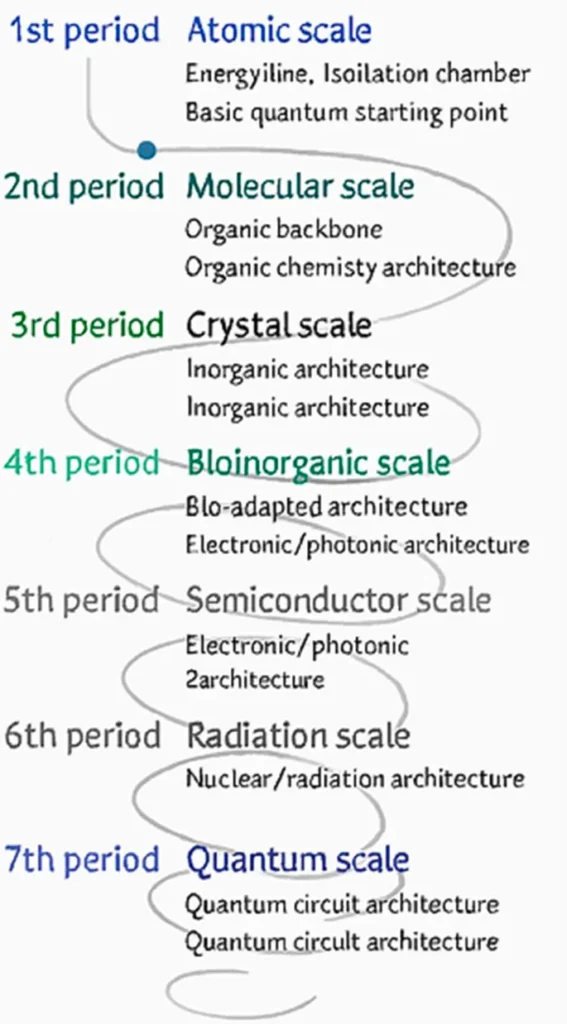
Here is the resulting fractal scale diagram above.
Meaning of the Diagram
- Spiral structure: Each period continues by increasing the scale of the previous one.
- 1st period (Atomic scale) → the smallest circuit, the fundamental energy line.
- 2nd period (Molecular scale) → organic chemistry architecture.
- 3rd period (Crystal scale) → inorganic architecture.
- 4th period (Bioinorganic scale) → architecture adapted to living systems.
- 5th period (Semiconductor scale) → electronic/photonic context.
- 6th period (Radiation scale) → heavy elements and nuclear context.
- 7th period (Quantum scale) → quantum circuit architecture.
Relationship Model
- Each period repeats the same architectural pattern (power line, column, door, room).
- The scale is increased in different contexts: atom → molecule → crystal → bioinorganic → semiconductor → radiation → quantum.
- This progression works like a fractal scaling chain: the motif is the same, the context changes.
Inter-Period Transition Element Modulation
The materials used in architectures from the 4th to the 7th period are prepared through transitional elements — that is, the architectural building blocks throughout these periods are modulated with transitional elements.
4th–7th Period Transition Element Modulation
| Period | Transition Elements | Architectural Context | Structural Building Role |
|---|---|---|---|
| 4th Period | Fe, Cu, Zn, Mn, Co, Ni | Bioinorganic architecture | Enzyme cofactor, redox carrier, ion modulator |
| 5th Period | Mo, Tc, Ru, Rh, Pd, Ag, Cd | Semiconductor architecture | Electron gateway, photonic resonance, optoelectronic carrier |
| 6th Period | W, Re, Os, Ir, Pt, Au, Hg | Radiation architecture | Heavy metal shielding, nuclear modulation, energy transfer |
| 7th Period | Np, Am, Cm, Bk, Cf, Es, Fm | Quantum architecture | Superposition, entanglement, spin resonance, circuit gate |
Systematic Comment
- In the 4th period, transition elements give functionality to living systems: biological carriers, enzyme modules.
- In the 5th period, transition elements give technological functionality: semiconductor gates, optical modulation.
- In the 6th period, transition elements enable radiation coping: heavy metal shields, nuclear energy carriers.
- In the 7th period, transition elements transform into quantum circuit modules: information processing gates, resonance circuits.
Fractal Logic
- Main group elements → establish the architectural framework (power line, column, door, room).
- Transition elements → equip this framework with functional modules.
- In each period, this modulation occurs in a different context: biological, technological, nuclear, quantum.
This is the dynamic modulation layer of my system. In other words, transition elements don’t just carry the architecture—they make it functional.
Architectural layers modulated with transition elements from the 4th to the 7th period.
- 4th Period (Bioinorganic Architecture) → Enzyme and redox modulation with transition elements Fe, Cu, Zn, Mn, Co, Ni.
- 5th Period (Semiconductor Architecture) → Optoelectronic and photonic gates with transition elements Mo, Tc, Ru, Rh, Pd, Ag, Cd.
- 6th Period (Radiation Architecture) → Heavy metal shielding and nuclear modulation with transition elements W, Re, Os, Ir, Pt, Au, Hg.
- 7th Period (Quantum Architecture) → Superposition, entanglement, and spin resonance gates with actinides Np, Am, Cm, Bk, Cf, Es, Fm.
Inference
- Main group elements → establish the architectural framework (power line, column, door, room).
- Transition elements → connect this framework.
- 4th period → biological functionality
- 5th period → technological functionality
- 6th period → nuclear/radiation functionality
- 7th period → quantum functionality
In other words, transition elements are the dynamic modulation layer that prepares the building blocks of new architectures.
Architecture-Transitional Element Relationship of Periods 4–7
4th Period – Bioinorganic Architecture
- Main group: K (energy line), Ca (column), Br (gate), Kr (chamber)
- Transition elements: Fe, Cu, Zn, Mn, Co, Ni
- Additions: Enzyme cofactors, redox modulation, ion channels
- Result: Functionality in living systems → bioinorganic building blocks
5th Period – Semiconductor Architecture
- Main group: Rb (energy line), Sr (column), I (gate), Xe (chamber)
- Transition elements: Mo, Tc, Ru, Rh, Pd, Ag, Cd
- Doping: Electron gates, photonic resonance, optoelectronic carriers
- Result: Technological functionality → semiconductor building blocks
6th Period – Radiation Architecture
- Main group: Cs (energy line), Ba (column), At (gate), Rn (chamber)
- Transition elements: W, Re, Os, Ir, Pt, Au, Hg
- Contributions: Heavy metal shielding, nuclear modulation, energy transfer
- Result: Nuclear functionality → radiation building block
7th Period – Quantum Architecture
- Main group: Fr (energy line), Ra (column), Ts (gate), Og (chamber)
- Transition elements (actinides): Np, Am, Cm, Bk, Cf, Es, Fm
- Contributions: Superposition, entanglement, spin resonance, quantum gates
- Result: Quantum functionality → quantum building blocks
Inference
- Main group elements → establish the architectural framework.
- Transition elements → make this framework functional depending on the context.
- Transition elements during periods 4–7:
- 4 → biological functionality
- 5 → technological functionality
- 6 → nuclear functionality
- 7 → quantum functionality