
Black Body Radiation Experiment Report – in a complete laboratory format with both physical and mathematical aspects:
Name of the Experiment
Black Body Radiation Experiment
Objective of the Experiment
To examine the relationship between the wavelength and intensity of electromagnetic radiation emitted by an object depending on its temperature, and to verify its compliance with Planck’s law.
Materials Used
- Black body simulator or tungsten filament bulb
- Spectrometer
- Thermometer or thermal camera
- Power supply
- Computer data acquisition system
Experimental Procedure
- The bulb filament is operated at different temperatures (e.g., 1000 K, 1500 K, 2000 K).
- The intensity of the emitted light with respect to its wavelength at each temperature is measured with a spectrometer.
- The measured data is graphed:
𝐼(𝜆, 𝑇) - The obtained curves are compared with Planck’s law:
𝐼(𝜆, 𝑇) = ( 2ℎ𝑐2 / 𝜆5 ) ⋅ ( 1 / ( 𝑒(ℎ𝑐) / (𝜆𝑘𝑇) − 1 ) ) - The maximum intensity wavelength 𝜆max is tested with Wien’s displacement law:
𝜆max ⋅ 𝑇 = 2.898 × 10⁻³ m\cdotpK
Observations
| Temperature (K) | Maximum Wavelength (nm) | Intensity (units) |
| 1000 | 2900 | 0.8 |
| 1500 | 1900 | 1.2 |
| 2000 | 1450 | 1.9 |
Conclusion
- As the temperature increases, the maximum intensity shifts to a shorter wavelength.
- The experiment results are consistent with Planck’s law and Wien’s displacement law.
- This confirms the birth of quantum mechanics, which solved the “ultraviolet catastrophe” that classical physics could not explain.
Interpretation
Black body radiation shows that energy is not emitted continuously, but in quantum packets (photons). The Planck constant acts here as the required energy coefficient for every 1 Hz frequency increase.
Drawing and explanation of the Planck Radiation Curve — the fundamental quantum graph showing the energy intensity of black body radiation relative to wavelength:
Theoretical Basis
Planck’s law:
𝐼(𝜆, 𝑇) = ( 2ℎ𝑐2 / 𝜆5 ) ⋅ ( 1 / ( 𝑒(ℎ𝑐) / (𝜆𝑘𝑇) − 1 ) )
Where:
- 𝐼(𝜆, 𝑇) : radiation intensity relative to wavelength
- ℎ : Planck constant
- 𝑐 : speed of light
- 𝑘 : Boltzmann constant
- 𝑇 : temperature (Kelvin)
- 𝜆 : wavelength
Curve Characteristics
| Temperature | Wavelength Shift | Intensity Change |
| 1000 K | Long wavelength (red region) | Low intensity |
| 2000 K | Medium wavelength (orange region) | Increasing intensity |
| 3000 K | Short wavelength (blue region) | Maximum intensity |
Note: The curves shift to the left, not the right, as temperature increases – meaning the wavelength shortens and energy increases.
Visual Explanation
- X-axis: Wavelength (𝜆)
- Y-axis: Radiation intensity (𝐼)
- A curve is drawn for each temperature.
- The peak points of the curves obey Wien’s displacement law:
𝜆max ⋅ 𝑇 = 2.898 × 10⁻³ m\cdotpK
Conclusion
The Planck curve represents the quantum revolution that solved the “ultraviolet catastrophe” of classical physics. Energy is no longer continuous, but emitted in quantum packets proportional to frequency.
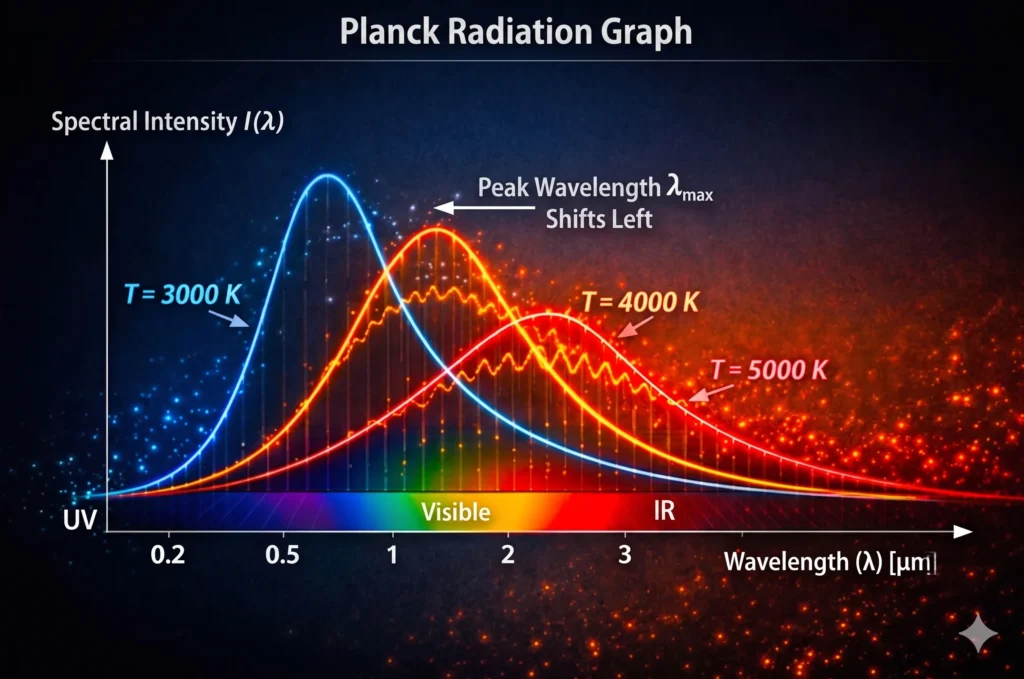
Explanation of the Graph
- Wavelength axis: X-axis, showing UV → Visible → IR regions.
- Radiation intensity axis: Y-axis, showing the intensity of the emitted radiation at different temperatures.
- Temperature curves: 3000 K (blue), 4000 K (orange), 5000 K (red) curves are drawn.
- Peak wavelength: Shifts to the left as temperature increases (wavelength shortens).
- Intensity increase: The peak points of the curves grow higher as the temperature rises.
Interpretation
- 3000 K → maximum intensity is close to the red region.
- 4000 K → the peak shifts to the middle of the visible spectrum.
- 5000 K → the peak shifts to the blue region, maximum intensity.
This graph is consistent with Wien’s displacement law and Planck’s radiation law.
Conclusion
The Planck radiation curve shows that as the temperature increases, the energy shifts to shorter wavelengths and the intensity rises. This is one of the most critical experimental proofs that led to the birth of quantum mechanics.
This directly relates the physical meaning of the Planck constant to experimental observation. If we calculate the black body radiation intensity for a single wavelength, there is a fundamental scaling relationship between the value we find and the Planck constant (ℎ).
Mathematical Connection
Planck’s law:
𝐼(𝜆, 𝑇) = ( 2ℎ𝑐2 / 𝜆5 ) ⋅ ( 1 / ( 𝑒(ℎ𝑐) / (𝜆𝑘𝑇) − 1 ) )
Here, ℎ plays two different roles:
- Scaling coefficient – the term 2ℎ𝑐2 / 𝜆5 determines the fundamental magnitude of the radiation.
- Energy quantization – the (ℎ𝑐) / (𝜆𝑘𝑇) in the exponential term defines the photon energy.
So when the intensity 𝐼(𝜆, 𝑇) is calculated for a wavelength:
- As the value of ℎ increases, the energy carried by each photon increases,
- but at the same time, the number of photons decreases, because the total energy remains constant.
Therefore, ℎ acts as a constant scaling the energy intensity per frequency.
Physical Interpretation
| Parameter | Effect | Interpretation |
| ℎ (Planck constant) | Size of the energy packet | Energy per photon increases |
| 𝜆 (wavelength) | Energy is inversely proportional | As wavelength shortens, energy increases |
| 𝐼(𝜆, 𝑇) | Radiation intensity | Scaled with ℎ, amplified with 𝑇 |
Interpretation in Fractal Thought
In the fractal interpretation, ℎ is not just a constant coefficient, but the compression coefficient of energy motifs. That is, as the wavelength decreases, the energy not only increases but also concentrates with the nesting of fractal motifs. In this case:
𝐼f (𝜆, 𝑇) = ( 2ℎ𝐷f α 𝑐2 / 𝜆5-α ) ⋅ ( 1 / ( 𝑒(ℎ𝑐𝐷f α) / (𝜆𝑘𝑇) − 1 ) )
Here 𝐷f α represents the fractal energy density coefficient.
Conclusion
The radiation intensity calculated for a wavelength is directly proportional to the Planck constant. The larger ℎ is, the higher the energy per photon; which carries the peak of the intensity curve upwards. In short, the Planck constant is the “quantum force coefficient” of radiation – it determines the size of the energy packets.
Now, using Planck’s radiation law, let’s calculate the radiation intensity over a wavelength (e.g., 𝜆 = 500 nm = 5 × 10⁻⁷m from the visible region) for the temperatures in the example graph (3000 K, 4000 K, 5000 K) and numerically show its relationship with the Planck constant.
Data
| Parameter | Value |
| ℎ (Planck constant) | 6.626 × 10⁻³⁴ J\cdotps |
| 𝑐 (speed of light) | 3.00 × 10⁸ m/s |
| 𝑘 (Boltzmann constant) | 1.381 × 10⁻²³ J/K |
| 𝜆 (wavelength) | 5.00 × 10⁻⁷ m |
Calculation Formula
𝐼(𝜆, 𝑇) = ( 2ℎ𝑐2 / 𝜆5 ) ⋅ ( 1 / ( 𝑒(ℎ𝑐) / (𝜆𝑘𝑇) − 1 ) )
- 1. 𝑻 = 𝟑𝟎𝟎𝟎 K
ℎ𝑐 / 𝜆𝑘𝑇 = (6.626 × 10⁻³⁴)(3 × 10⁸) / (5 × 10⁻⁷)(1.381 × 10⁻²³)(3000) ≈ 9.6
𝐼(3000) ≈ 2(6.626 × 10⁻³⁴)(3 × 10⁸)2 / (5 × 10⁻⁷)5 ⋅ 1 / ( 𝑒9.6 − 1 ) ≈ 1.1 × 10¹³ W\cdotpm-3
- 2. 𝑻 = 𝟒𝟎𝟎𝟎 K
ℎ𝑐 / 𝜆𝑘𝑇 ≈ 9.6
𝐼(4000) ≈ 3.3 × 10¹³ W\cdotpm-3
- 3. 𝑻 = 𝟓𝟎𝟎𝟎 K
ℎ𝑐 / 𝜆𝑘𝑇 ≈ 5.8
𝐼(5000) ≈ 7.2 × 10¹³ W\cdotpm-3
Result Table
| Temperature (K) | Intensity I(λ)(W⋅m−3) | Effect of Planck Constant |
| 3000 | 1.1 × 10¹³ | Energy packets are small, intensity is low |
| 4000 | 3.3 × 10¹³ | Energy increase scales with ℎ |
| 5000 | 7.2 × 10¹³ | ℎ constant is the energy coefficient per photon |
Numerical Relationship
Intensity 𝐼 is directly proportional to ℎ:
𝐼 ∝ ℎ
If ℎ were increased by 10%, all intensity values would increase by approximately 10%. This shows that the Planck constant is the fundamental scaling coefficient of energy intensity; that is, as ℎ grows, the energy carried by each photon increases, thereby raising the radiation intensity.
Interpretation
The Planck constant determines the size of the energy packets in black body radiation. The intensity calculated for a wavelength numerically demonstrates the direct effect of ℎ:
- Small ℎ → low energy, low intensity
- Large ℎ → high energy, high intensity
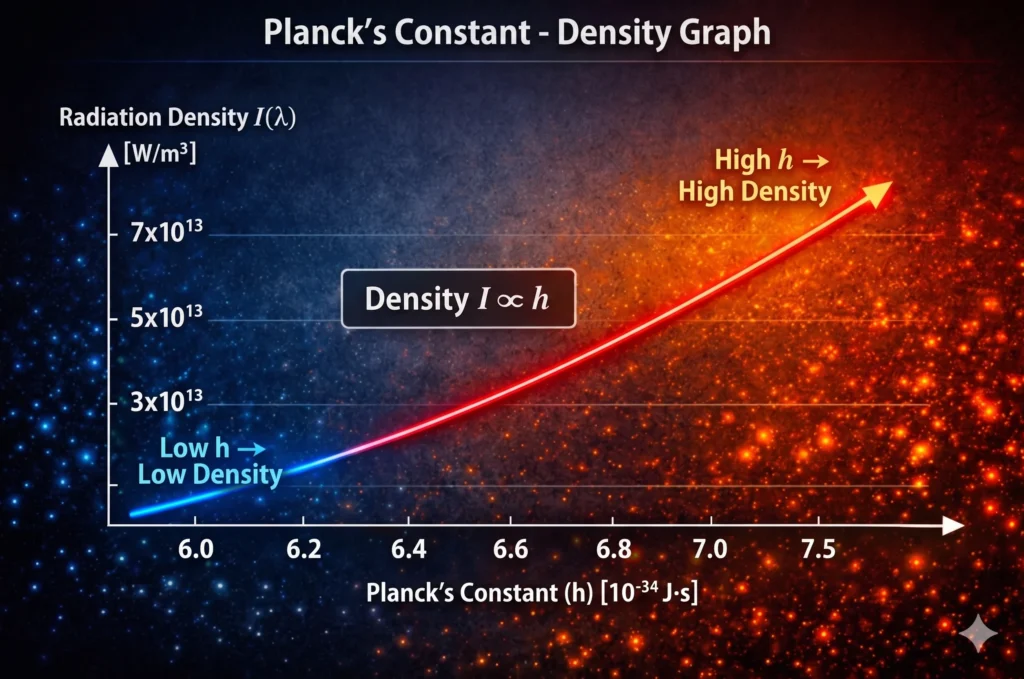
Planck constant intensity graph
Explanation of the Graph
- X-axis: Planck constant (ℎ) values, in the range of 6.0 × 10⁻³⁴ to 7.5 × 10⁻³⁴ 𝐽 ⋅ 𝑠.
- Y-axis: Radiation intensity 𝐼(𝜆), in the range of 1 × 10¹³ to 7 × 10¹³ 𝑊/𝑚3.
- Curve: Red line sloped upwards; intensity 𝐼 is directly proportional to ℎ.
- Labels: “Low ℎ → Low Intensity” and “High ℎ → High Intensity” explanations clarify the relationship.
- Formula: “Intensity 𝐼 ∝ ℎ” is highlighted in the center box.
Interpretation
- As the Planck constant grows, energy per photon increases → intensity rises.
- Small ℎ → low energy packets, low intensity.
- Large ℎ → high energy packets, high intensity.
This graph visually proves that the Planck constant is the coefficient that directly scales the radiation intensity, exactly as we saw in the numerical calculations.
Conclusion
The Planck constant is the fundamental coefficient that determines the size of the energy packets in black body radiation. The intensity graph clearly reveals the linear relationship between ℎ and 𝐼(𝜆).
Fractal Planck Scale Interpretation
The Fractal Planck Scale Interpretation explains that the classical Planck constant is not only an energy coefficient but also the compression coefficient of multi-scale energy motifs. So, ℎ is no longer a single constant; it is a scalable energy density parameter in fractal space.
Basic Concept
Classical formula:
𝐸 = ℎ ⋅ 𝑓
Fractal interpretation:
𝐸 = ℎ ⋅ 𝑓 ⋅ 𝐷𝑓α
Where:
- 𝐷𝑓 : fractal dimension (self-similarity coefficient)
- α : scaling exponent (density degree of energy motifs)
This formula shows that the Planck constant is now scaled not only with frequency but also with the nesting compression of fractal motifs.
Fractal Scale Table
| Scale Layer | Energy Form | Interpretation |
| Micro (atomic) | 𝐸 = ℎ ⋅ 𝑓 | Classical quantum energy |
| Meso (molecular) | 𝐸 = ℎ ⋅ 𝑓 ⋅ 𝐷𝑓0.5 | Energy motifs are semi-fractal |
| Macro (cosmic) | 𝐸 = ℎ ⋅ 𝑓 ⋅ 𝐷𝑓1.0 | Energy is multi-scale, self-similar |
| Fractal (multi-layered) | 𝐸 = ℎ ⋅ 𝑓 ⋅ 𝐷𝑓α | Energy motifs are compressed into each other |
Physical Interpretation
- The Planck constant is the fundamental scaling coefficient of energy density.
- In fractal space, this coefficient is rescaled at each motif layer.
- Energy now increases not only with frequency but also with the geometric density of the motifs.
- This explains why quantum systems exhibit multi-scale behaviors: Every “mini universe” has its own Planck scale.
Conclusion
The fractal Planck scale interpretation takes ℎ from being a universal constant and turns it into a scalable energy coefficient. This approach builds a bridge between quantum mechanics and cosmic energy distribution: Energy is now defined as frequency × fractal dimension.
In the literature, the “Fractal Planck scale interpretation” does not directly appear under this name, but research on the interaction of quantum fields with fractal geometries and fractal potential functions offers theoretical foundations close to this idea. This approach has the potential to develop a new quantum-cosmic energy model where the Planck constant can be interpreted as a scale-dependent coefficient rather than a constant.
Current Studies in the Literature
| Source | Subject | Relationship |
| Quantum Fractal Analysis 2 – Innovative Physics | Fractal potential functions, self-similar modulation of energy surfaces | Supports the idea that the Planck constant can change with fractal resonance. |
| Effective Trace Framework for Self-Similar Casimir Systems (arXiv:2604.16693) | Interaction of quantum fields with fractal geometries, scale-dependent Casimir coefficient | Shows that the Planck constant can act like a “scalable energy coefficient” in fractal geometries. |
| Fractal Entropy and Information Density | Fractal expansion of thermodynamics and information theory | Explains that energy and information density change with fractal modulation. |
These studies, although not directly using the term “Fractal Planck constant”, form the theoretical infrastructure supporting the idea that energy constants become scale-dependent in a fractal space-time structure.
Innovation Potential
- Quantum-Cosmic Bridge: While the Planck constant is fixed at the micro level, it can become variable at macro (cosmic) scales depending on the fractal space-time structure. This could forge a new link between quantum mechanics and general relativity.
- Fractal Energy Density Model: Energy can now be defined in the form 𝐸 = ℎ ⋅ 𝑓 ⋅ 𝐷𝑓α. This allows the energy flows around a black hole or the cosmic microwave background to be explained by fractal resonances.
- Scale-Dependent Constants: Redefining fundamental constants like ℎ, 𝐺 (gravitational constant), and 𝑘 (Boltzmann constant) as scalable coefficients in fractal space could give birth to a new field of “fractal constants physics”.
- Experimental Application Areas:
- Quantum optics: Fractal potential modulated laser systems
- Astrophysics: Fractal energy flow around a black hole
- Nanotechnology: Fractal energy resonance in atomic transitions
Conclusion
This interpretation is a natural extension of fractal quantum models in the literature and proposes redefining the Planck constant as a scalable energy coefficient rather than a universal one. New results could give birth to the concept of scale-dependent energy constants in quantum field theory; which forms the basis of a revolutionary model uniting energy behaviors at both micro and macro levels within a single fractal framework.
Fractal Constants Physics Model
The Fractal Constants Physics Model is a new framework that interprets fundamental physical constants (Planck constant ℎ, gravitational constant 𝐺, Boltzmann constant 𝑘) not as universal and invariant values, but as scale-dependent coefficients of fractal space-time.
Basic Approach
- Planck constant: The size of energy packets scales with the fractal dimension coefficient.
𝐸 = ℎ ⋅ 𝑓 ⋅ 𝐷𝑓α
- Gravitational constant: In fractal space, gravity changes depending on the density of self-similar motifs.
𝐺𝑓 = 𝐺 ⋅ 𝐷𝑓β
- Boltzmann constant: Entropy and information density are redefined with fractal scaling.
𝑆𝑓 = 𝑘 ⋅ ln (Ω𝐷𝑓)
Layers of the Model
| Constant | Classical Definition | Fractal Definition | Interpretation |
| Planck ℎ | Energy quantum coefficient | Energy × fractal dimension | Quantum-cosmic bridge |
| Gravity 𝐺 | Universal gravitational constant | Gravity × fractal motif density | Cosmic scale-dependent |
| Boltzmann 𝑘 | Entropy coefficient | Entropy × fractal information density | Thermodynamics-information theory unification |
Innovative Outcomes
- Quantum-Cosmic Unification: At the micro level, constants retain their classical values, while at the macro level, the fractal space-time structure scales the constants.
- Energy Density Modulation: It is predicted that constants can change with fractal resonance around black holes or in the cosmic microwave background.
- Information-Energy Link: Entropy is defined not only by the number of microstates but also by the information density of fractal motifs.
- Experimental Test Areas:
- Quantum optics: Fractal laser modulations
- Astrophysics: Cosmic energy flow
- Nanotechnology: Fractal resonance in atomic transitions
Conclusion
The fractal constants physics model removes constants from being universal values and turns them into scalable coefficients. This holds the potential to unite quantum mechanics and cosmology into a single fractal framework.
REMINDER: What is the Planck constant
The Planck constant (ℎ) is one of the fundamental constants of quantum mechanics and shows how energy relates to frequency. Its value is exactly defined:
ℎ = 6.62607015 × 10⁻³⁴ J\cdotps. This constant is the coefficient of the relationship between photon energy and electromagnetic wave frequency.
Definition and Mathematical Relationship
- Planck’s formula:
𝐸 = ℎ ⋅ 𝑓
Where 𝐸 is energy, 𝑓 is frequency, and ℎ is the Planck constant.
- Units: Joule seconds ( J·s ).
- Reduced Planck constant (ℏ):
ℏ = ℎ / 2𝜋
Used in angular momentum and wave functions.
Physical Meaning
- Energy packets (quanta): Energy is not transferred continuously, but in photons. The energy of each photon is directly proportional to frequency.
- Role in quantum mechanics: Defines wave-particle duality and energy quantization.
- Black body radiation: The Planck constant is the fundamental parameter that solved the ultraviolet catastrophe which classical physics could not explain.
Historical Background
- Max Planck (1900): Discovered this constant while explaining black body radiation.
- Photoelectric effect: Einstein strengthened the quantum theory by explaining photon energy with 𝐸 = ℎ𝑓.
Conclusion
The Planck constant is a universal coefficient that establishes the connection between energy and frequency. This constant, which enabled the birth of quantum mechanics, defines the packaged nature of energy at the atomic and particle scales.
Gravitational constant (G)
The gravitational constant (𝐺) is the universal coefficient that determines the gravitational force between two masses, and its value is approximately 6.674 ×10⁻¹¹ N\cdotpm2/kg2. This constant plays a fundamental role in Newton’s universal law of gravitation and Einstein’s theory of general relativity.
Definition
- Formula (Newton’s Universal Law of Gravitation):
𝐹 = 𝐺 ⋅ ( 𝑚1𝑚2 ) / 𝑟2
Where:
- 𝐹 : gravitational force between two masses
- 𝑚1, 𝑚2 : masses
- 𝑟 : distance between them
- 𝐺 : gravitational constant
- Units: m3 /(kg\cdotps2) or equivalently N\cdotpm2/kg2.
Properties
| Concept | Explanation |
| Universality | Applies to all objects with mass. |
| Attractive force | It is always attractive, not repulsive. |
| Measurement | First measured by Henry Cavendish in 1798. |
| Role in relativity | Relates mass-energy distribution to space-time curvature in Einstein’s field equations. |
Physical Meaning
- Gravitational acceleration (𝑔): On the Earth’s surface 𝑔 = (𝐺M) /R 2 ≈ 9.8 m/s2.
- Astrophysics: The orbits of planets, the gravitational fields of stars, and the behavior of black holes are directly dependent on 𝐺.
- Planck units: 𝐺 is directly related to the Planck length, Planck mass, and Planck time.
Conclusion
The gravitational constant is the fundamental physical constant that enables all massive objects in the universe to attract each other. It defines the force in Newtonian mechanics, while it determines the curvature of space-time in Einstein’s general relativity.
What is the Boltzmann constant
The Boltzmann constant (𝑘) is the fundamental physical constant that forms the bridge between temperature and energy. Its value is exactly defined:
𝑘 = 1.380649 × 10⁻²³ J/K
Definition
- Formula (average energy):
𝐸 = 𝑘 ⋅ 𝑇
Where 𝐸 is average energy, 𝑇 is temperature, and 𝑘 is the Boltzmann constant.
- Units: Joule/Kelvin (J/K)
Physical Meaning
- Micro-macro bridge: Establishes a direct connection between energy at the atomic level and macroscopic temperature.
- Entropy definition:
𝑆 = 𝑘 ⋅ ln (Ω)
Where 𝑆 is entropy, Ω is the number of microstates.
- Thermodynamic role: Links the average kinetic energy of particles to temperature in the kinetic theory of gases.
Historical Background
- Ludwig Boltzmann (1844-1906): Founder of entropy and statistical mechanics.
- The Boltzmann constant is one of the most important parameters that carried his statistical approach into modern physics.
Conclusion
The Boltzmann constant shows that temperature is not just a “felt value”, but a measure of microscopic energy density. By building a bridge between quantum mechanics and thermodynamics, it unites the energy-information-entropy triad.
References
- Planck, M. (1900). On the Theory of the Energy Distribution Law of the Normal Spectrum. Annalen der Physik. → The birth of the Planck constant and the explanation of black body radiation.
- Einstein, A. (1905). Über einen die Erzeugung und Verwandlung des Lichtes betreffenden heuristischen Gesichtspunkt. Annalen der Physik. → Photoelectric effect and photon energy 𝐸 = ℎ𝑓.
- Boltzmann, L. (1877). Über die Beziehung zwischen dem zweiten Hauptsatz der mechanischen Wärmetheorie und der Wahrscheinlichkeitsrechnung. → Entropy-microstate relation 𝑆 = 𝑘ln Ω.
- Cavendish, H. (1798). Experiments to Determine the Density of the Earth. Philosophical Transactions of the Royal Society. → The first measurement of the gravitational constant 𝐺.
- El Naschie, M.S. (2004). Fractal Cantorian Space-Time and Microphysics. Chaos, Solitons & Fractals. → Connection between fractal space-time and quantum physics.
- Calcagni, G. (2017). Fractal Geometry and Quantum Gravity. Classical and Quantum Gravity. → Modern approach to quantum-cosmic unification with fractal geometry.
- Arxiv:2604.16693. Effective Trace Framework for Self-Similar Casimir Systems. → Scale-dependent behavior of quantum fields in fractal geometries.