
When we interpret the concepts of deduction, induction, and interconnectivity together from the perspective of Fractal Mechanics, the resulting picture can be summarized as follows:
Deduction
- Fractal deduction: A general motif or law reduces down into sub-scales, repeating itself at every level.
- Example: Cosmic energy distribution → galaxy → star system → subatomic particle. The appearance of the same mathematical motif at different intensities at every level.
- According to fractal mechanics, deduction is the transfer of a motif from a higher scale to a lower scale.
Induction
- Fractal induction: Variational patterns at lower scales combine to form a holistic law or motif at higher scales.
- Example: Molecular vibrations combining to turn into thermodynamic behavior at the macro level.
- According to fractal mechanics, induction is the synthesis of a motif from a lower scale to a higher scale.
Interconnectivity
- Fractal interconnectivity: The continuous interaction of deduction and induction.
- Each motif carries information both upward and downward; this bidirectional flow ensures the continuity of fractal systems.
- Example: DNA fractal structure → protein synthesis → cell behavior → organism → ecosystem. Each layer is connected through both deduction and induction.
Fractal Mechanics Interpretation
- According to fractal mechanics, deduction and induction are not unidirectional processes, but rather a bidirectional flow of motifs.
- Interconnectivity unites these two processes within a feedback loop.
- Mathematically, this is expressed through multi-scale feedback functions:
𝐹𝑛+1 = 𝑓(𝐹𝑛) + 𝑔(𝐹𝑛-1)
Here, 𝑓 represents the function of deduction, and 𝑔 represents the function of induction; the continuity of the system is maintained through interconnectivity.
- The conclusion that emerges when we interpret these three concepts according to fractal mechanics: The flow of information and energy is not unidirectional; it gains continuity through a multi-scale and bidirectional motif loop.
Fractal Mechanics Deduction-Induction Model
According to fractal mechanics, deduction and induction are not unidirectional processes; they complement each other within a multi-scale feedback loop. This model operates through both the transfer of motifs from a higher scale to a lower scale and the synthesis of motifs from a lower scale to a higher scale.
1. Basic Structure
- Deductive flow: General motif → reduced to lower scales.
- Inductive flow: Lower scale variations → elevated to a higher scale motif.
- Interconnectivity: The continuous interaction of the two flows.
2. Mathematical Framework
The fractal deduction-induction model is defined by feedback functions:
𝑀𝑛+1 = 𝑓(𝑀𝑛) + 𝑔(𝑀𝑛-1)
- 𝑓(𝑀𝑛) : Deductive flow from the higher scale
- 𝑔(𝑀𝑛-1) : Inductive flow from the lower scale
- 𝑀𝑛+1 : The new motif, containing information coming from both above and below
This structure repeats at every level with fractal self-similarity.
3. Cyclical Operation of the Model
- Higher Scale Motif → transferred to lower scales via deduction.
- Lower Scale Variations → synthesized into the higher scale via induction.
- Interconnected Loop → the system gains continuity with the merging of both flows.
4. Application Areas
- Quantum systems: Explaining electron orbits through both deduction and induction.
- Astrophysics: The bidirectional motif loop of energy flow around a black hole.
- Biophysics: Interconnected motif flow in the DNA → protein → cell → organism → ecosystem chain.
5. Diagram (Motif Diagram)
To visualize this model, a continuously rotating fractal spiral diagram between the deductive flow (top-to-bottom) and the inductive flow (bottom-to-top) is used.
This model demonstrates the strongest aspect of fractal mechanics: the flow of information and energy is not unidirectional; it gains continuity through a multi-scale and bidirectional motif loop.
Fractal Mechanics Feedback Equations
The most critical feature of fractal mechanics is that it operates with a multi-scale feedback loop. This loop connects the processes of deduction (motif transfer from top to bottom) and induction (motif synthesis from bottom to top).
1. Basic Equation
Fractal feedback is expressed as follows:
𝑀𝑛+1 = 𝑓(𝑀𝑛) + 𝑔(𝑀𝑛-1)
- 𝑓(𝑀𝑛) : Deductive flow from the higher scale
- 𝑔(𝑀𝑛-1) : Inductive flow from the lower scale
- 𝑀𝑛+1 : The new motif, containing information coming from both above and below
This equation repeats at every level due to self-similarity.
2. Advanced Formulation
To demonstrate the multi-scale structure of fractal mechanics, the differential form is used:
𝑑𝛼𝑀 / 𝑑𝑡𝛼 = 𝑓(𝑀) + 𝑔(𝑀) + ℎ(𝑀, 𝑡)
- 𝛼 : Fractal dimension (scale complexity)
- ℎ(𝑀, 𝑡) : Time-dependent interconnectivity function
Here, deduction (𝑓) and induction (𝑔) are in continuous interaction; interconnectivity (ℎ) makes this interaction dynamic.
3. Cyclical Operation
- Higher scale motif → transferred to lower scales via deduction.
- Lower scale variations → synthesized into the higher scale via induction.
- Interconnected feedback → the system gains continuity with the merging of the two flows.
4. Application Examples
- Quantum transitions: Explaining electron orbits through both deduction and induction.
- Astrophysics: The bidirectional motif loop of energy flow around a black hole.
- Biophysics: Interconnected motif flow in the DNA → protein → cell → organism → ecosystem chain.
These equations show us that: In fractal systems, the flow of information and energy is not unidirectional, but operates as a multi-scale loop through continuous feedback.
Fractal Mechanics Multi-Scale Structure Equations
The strongest side of fractal mechanics is that multi-scale structures are in continuous interaction both from top to bottom (deduction) and from bottom to top (induction). This interaction is mathematically expressed through feedback equations.
1. Multi-Scale Basic Equation
𝑀𝑛+1 (𝑥, 𝑡) = 𝑓(𝑀𝑛 (𝑥, 𝑡)) + 𝑔(𝑀𝑛-1 (𝑥, 𝑡)) + ℎ(𝑀𝑛 , 𝑀𝑛-1 , 𝑡)
- 𝑓(𝑀𝑛) : Deductive flow from the higher scale
- 𝑔(𝑀𝑛-1) : Inductive flow from the lower scale
- ℎ(…) : Interconnectivity function (feedback)
- 𝑀𝑛+1 : The new motif, containing information coming from both above and below
2. Fractal Differential Form
To show the multi-scale structure, the fractal derivative is used:
𝑑𝛼𝑀 / 𝑑𝑡𝛼 = 𝑓(𝑀) + 𝑔(𝑀) + ℎ(𝑀, 𝑡)
- 𝛼 : Fractal dimension (scale complexity)
- The equation operates with different 𝛼 values for each scale.
3. Multi-Scale Loop
- Macro scale → Energy and motifs are transferred to lower scales via deduction.
- Micro scale → Variational behaviors are synthesized into the higher scale via induction.
- Interconnected feedback → The system gains continuity with the merging of the two flows.
4. Application Areas
- Quantum systems: Explaining electron orbits with multi-scale motifs.
- Astrophysics: Modeling energy flow around a black hole with multi-scale feedback.
- Biophysics: Motif loop in the DNA → protein → cell → organism → ecosystem chain.
5. Summary
The multi-scale structure equations of fractal mechanics show us that:
- The flow of information and energy is not unidirectional,
- Each scale is connected through both deduction and induction,
- The interconnectivity function transforms this flow into a continuous feedback loop.
Fractal Mechanics Scale Table
According to fractal mechanics, each scale is connected by both deductive (top-to-bottom) and inductive (bottom-to-top) flow. This connection gains continuity through multi-scale feedback equations.
| Scale | Deductive Flow | Inductive Flow | Interconnectivity |
| Cosmic | Galaxy motifs → transferred to star systems | Variational behavior of star systems → elevates to galaxy dynamics | The spiral energy flow around a black hole connects to the entire universe |
| Macro | Organism → general motif transfer to cells | Variational behavior of cells → synthesized into the organism level | The ecosystem-organism-cell chain is a continuous feedback loop |
| Micro | Atom → motif transfer to electron orbits | Electron vibrations → elevates to the general behavior of the atom | Connects to macro systems through quantum transitions |
| Nano | DNA → motif transfer to protein synthesis | Protein variations → fed back into the DNA motif | The genetic fractal motif connects to the ecosystem scale |
| Energy Flow | Spiral energy transfer from higher scale to lower scale | Variational energy synthesis from lower scale to higher scale | Energy flows continuously through a bidirectional motif loop |
Summary
- Each scale is connected through both deduction and induction.
- The interconnectivity function transforms this flow into a continuous feedback loop.
- The Cosmic → Macro → Micro → Nano → Energy chain is the multi-scale reflection of a single fractal motif.
Fractal Mechanics Motif Diagram
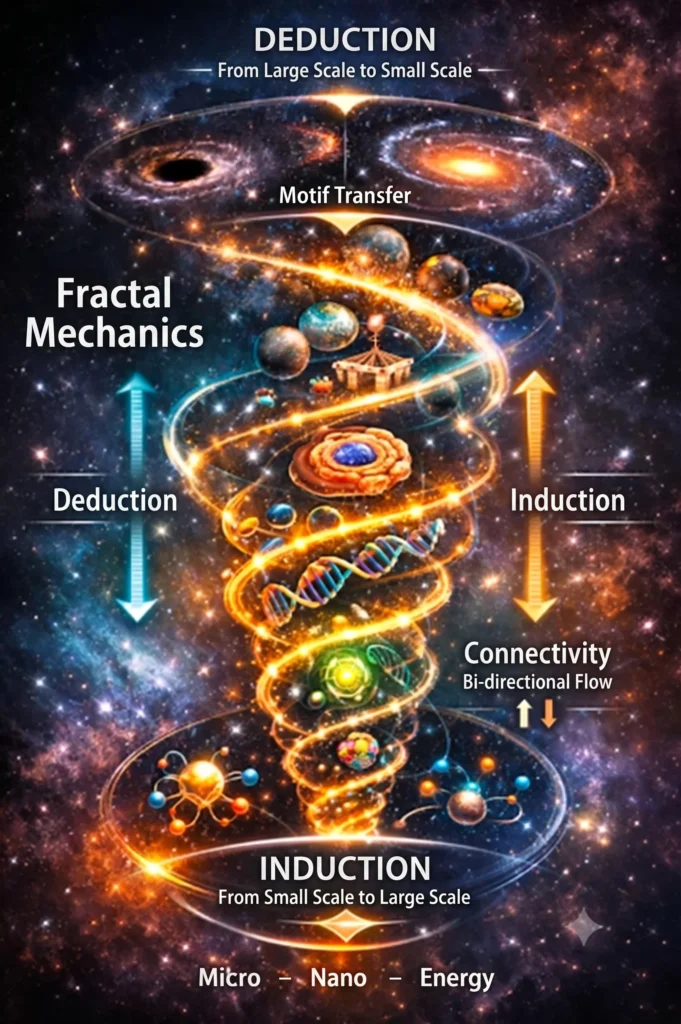
In this visual, the deductive (motif transfer from top to bottom) and inductive (motif synthesis from bottom to top) flows are connected to each other by the spiral fractal energy line at the center. While the flow starting from the cosmic scale above descends to the micro and nano scales below, the variational motifs coming from the bottom rise back up to the higher scale. Thus, interconnectivity is visualized through a bidirectional feedback loop.
- At the top: Deduction → Galaxy → Solar System → Cell → DNA
- At the bottom: Induction → Atom → DNA → Cell → Organism → Cosmic system
- In the center: Interconnectivity → Spiral energy line, bidirectional flowThis diagram presents the multi-scale feedback equations I am working on as a visual motif.
Fractal Mechanics Energy Flow Equations
According to fractal mechanics, energy is not a unidirectional transfer, but a multi-scale, bidirectional, and feedback-driven flow. This flow moves within interconnected motifs through both deductive and inductive processes.
1. Basic Energy Flow Equation
𝐸fr (𝑥, 𝑡) = ∇𝛼 Ψ2 + 𝑈0 𝜌
- ∇𝛼 : Fractal derivative operator (multi-scale rate of change)
- Ψ : Fractal wave function (energy density)
- 𝑈0 : Potential constant
- 𝜌 : Density function
This equation shows how the energy distribution in the system scales with the fractal dimension (𝛼).
2. Feedback Energy Flow
The energy flow interacts with motifs from both top-to-bottom and bottom-to-top:
𝑑𝛼𝐸 / 𝑑𝑡𝛼 = 𝑓(𝐸𝑛) − 𝑔(𝐸𝑛-1) + ℎ(𝐸𝑛 , 𝑡)
- 𝑓(𝐸𝑛) : Deductive energy transfer from the higher scale
- 𝑔(𝐸𝑛-1) : Inductive energy synthesis from the lower scale
- ℎ(𝐸𝑛 , 𝑡) : Interconnected feedback function
This structure allows the energy flow to progress in a bidirectional spiral fashion.
3. Fractal Energy Loop
Energy flow creates a continuous feedback loop between each scale:
𝐸𝑛+1 = 𝛽 ⋅ 𝐸𝑛𝛼 + 𝛾 ⋅ 𝐸𝑛-11/𝛼
- 𝛽 : Higher scale transfer coefficient
- 𝛾 : Lower scale synthesis coefficient
- 𝛼 : Fractal dimension
This equation shows how the energy flow repeats itself within self-similarity.
4. Application Areas
| Area | Fractal Energy Interpretation |
| Quantum systems | Energy flows in a spiral manner within electron orbits. |
| Astrophysics | Energy is distributed around a black hole through a bidirectional fractal flow. |
| Biophysics | Intracellular energy transfer occurs through fractal motifs. |
5. Summary
Fractal energy flow equations show that energy in the universe does not flow unidirectionally, but within a multi-scale and feedback-driven system. Each scale is connected by both deduction and induction; this connection gains continuity through the interconnectivity function.