
The laws of fractal optics are a new framework that explains the behavior of light beyond classical optical laws through multi-scale and self-similar structures. In this approach, fundamental laws such as reflection, refraction, and diffraction become scale-dependent; light produces both regular and chaotic patterns.
Basic Principles
- Fractal scale law: The propagation of light is defined not by a single constant speed, but by a scale transformation ratio. This explains how light forms self-similar patterns in different mediums.
- Fractal reflection: In the classical law of reflection, there is an equality of angles. In fractal optics, however, the fractal dimension of the surface changes the angle of reflection on a scaled basis.
- Fractal refraction: In the fractal version of Snell’s law, the refractive index is not constant but depends on the scale function. This allows for multi-scale focusing in lenses.
- Fractal interference: In the double-slit experiment, the lines multiply in a self-similar manner. This makes multi-scale information storage possible in quantum optics.
- Fractal diffraction: When light passes through fractal-structured obstacles, multi-scale diffraction patterns are formed.
Mathematical Framework
Fractal Fourier Optics
𝐼fr (𝑥, 𝑦) =∣ ∑𝑛 𝐴𝑛 𝑒i (𝑘𝑛𝑥+𝜙𝑛) ∣2
Here, 𝐴𝑛 is the fractal amplitude, 𝑘𝑛 is the wave number, and 𝜙𝑛 is the fractal phase.
Fractal Snell’s Law
𝑛fr (𝑟) ⋅ sin ( 𝜃i ) = 𝑛fr ( 𝑟’ ) ⋅ sin ( 𝜃t )
The refractive index 𝑛fr depends on the scale function.
Application Areas
| Field | Classical Optics Law | Fractal Optics Law |
| Reflection | Angle of incidence = angle of reflection | Reflection angle depends on fractal dimension |
| Refraction | Snell’s law (constant index) | Scale-dependent refractive index |
| Interference | Linear patterns | Self-similar patterns |
| Diffraction | Single-scale distribution | Multi-scale fractal distribution |
| Holography | Single-layer information | Multi-scale fractal information storage |
Critical Points
- While dark matter and energy cannot be explained in classical optics, the laws of fractal optics interpret them as scale deviation and fractal acceleration.
- The speed of light is not constant; what is constant is the scale transformation ratio. This explains why the speed of light appears constant between observers.
- Cosmology and quantum mechanics unite as different scales of the same fractal function.
Fractal Scale Law
The Fractal Scale Law is the fundamental principle explaining that processes in nature operate not through a single constant scale, but through multi-scale self-similarity. This law replaces the constant parameters in classical physics and optics with a scale transformation ratio.
Definition
- Classical laws describe single-scale behavior (e.g., constant speed, constant refractive index).
- The fractal scale law states that every physical quantity is defined by variations that repeat at different scales.
- This allows light, energy, and wave functions to propagate in self-similar patterns.
Mathematical Framework
It is expressed through the fractal derivative approach:
𝐷𝛼 𝑓(𝑥) (0 < 𝛼 < 1)
- 𝛼 → fractal dimension of the system
- At small scales (𝛼 → 0) → micro dynamics
- At large scales (𝛼 → 1) → macro dynamics
- At intermediate values → multi-scale resonances
Physical Reflections
- Fractal reflection → The angle of reflection depends on the surface’s fractal dimension.
- Fractal refraction → The refractive index is not constant; it changes according to the scale function.
- Fractal interference → Lines multiply in a self-similar manner.
- Fractal diffraction → Multi-scale diffraction patterns are formed.
Application Areas
| Field | Classical Scale | Fractal Scale |
| Optics | Constant refractive index | Scale-dependent refractive index |
| Mechanics | Single velocity/acceleration | Multi-scale velocity/acceleration |
| Thermodynamics | Single temperature equilibrium | Multi-scale energy flow |
| Quantum | Single wave function | Self-similar wave functions |
| Cosmology | Single-scale universe model | Multi-scale fractal universe |
Thanks to this law, we can view nature not as a single photograph, but as an infinite-scale video: every moment is a self-similar echo of the previous one.
Fractal Reflection
Fractal Reflection is the scale-dependent version of the classical optics rule “angle of incidence = angle of reflection” on fractal surfaces. That is, while light reflects at a constant angle on a flat surface, on fractal-structured surfaces, the angle of reflection depends on the fractal dimension and the self-similarity coefficient of the surface.
Basic Features
- Self-similarity effect: The reflected light produces multi-scale reflection patterns that repeat the surface’s fractal design.
- Fractal angle deviation: The angle of reflection is not constant but deviates according to the surface’s fractal dimension.
- Energy distribution: The energy of the reflected light is not directed in a single direction but is divided into self-similar sub-directions.
Mathematical Framework
Fractal reflection law:
𝜃r = 𝜃i ⋅ 𝑓(𝐷𝑓)
- 𝜃i → angle of incidence
- 𝜃r → angle of reflection
- 𝐷𝑓 → fractal dimension of the surface
- 𝑓(𝐷𝑓) → scale function (e.g., 𝑓(𝐷𝑓) = 1 + 1/𝐷𝑓)
This formula shows that reflection deviates from the classical equality and becomes scale-dependent.
Application Areas
| Field | Classical Reflection | Fractal Reflection |
| Optics | Single angle | Multi-scale angles |
| Holography | Single-layer information | Self-similar information layers |
| Materials science | Flat surface reflection | Multiple reflections on fractal surfaces |
| Quantum optics | Single wave reflection | Self-similar wave packets |
Example Scenario
When a laser beam is directed at a fractal-patterned surface:
- In the classical case, a single angle of reflection is formed.
- In the fractal case, the light follows the self-similar structure of the surface, producing multiple reflection patterns.
Fractal Refraction
Fractal Refraction is the extended version of classical Snell’s law for fractal surfaces and multi-scale mediums. Normally, the refractive index is assumed to be constant; however, in a fractal medium, the refractive index depends on the scale function, and the change in light’s direction produces self-similar patterns.
Basic Features
- Self-similar refraction: Light creates refraction angles that repeat at different scales.
- Fractal index function: The refractive index 𝑛fr depends on the medium’s fractal dimension.
- Multi-scale focusing: Lenses produce self-similar focal points rather than a single focal point.
Mathematical Framework
Fractal Snell’s law:
𝑛fr (𝑟) ⋅ sin ( 𝜃i ) = 𝑛fr ( 𝑟’ ) ⋅ sin ( 𝜃t )
- 𝜃i → angle of incidence
- 𝜃t → angle of refraction
- 𝑛fr (𝑟) → fractal refractive index (scale function)
Example function:
𝑛fr (𝑟) = 𝑛0 ⋅ ( 1 + 1/𝐷𝑓 )
Here, 𝐷𝑓 is the medium’s fractal dimension.
Application Areas
| Field | Classical Refraction | Fractal Refraction |
| Lenses | Single focal point | Self-similar multiple focal points |
| Fiber optics | Constant light routing | Multi-scale light distribution |
| Holography | Single-layer information | Self-similar information layers |
| Quantum optics | Single wave refraction | Self-similar wave packets |
Example Scenario
When a laser beam enters a fractal-structured glass:
- In the classical case, a single angle of refraction is formed.
- In the fractal case, the light follows the self-similar structure of the glass, producing multiple refraction patterns.
Fractal Interference
Fractal Interference is the transformation of classical interference patterns (e.g., the lines in the double-slit experiment) into self-similar and multi-scale patterns using fractal logic. This means that light waves do not simply interfere as single lines but as repeating motifs.
Basic Features
- Self-similar patterns: Lines are not one-dimensional but multiply as fractal motifs.
- Multi-scale interference: Wave packets intersect at different scales and produce new patterns.
- Fractal information storage: Interference patterns contain multi-scale information layers rather than a single layer.
Mathematical Framework
Fractal interference intensity:
𝐼fr (𝑥, 𝑦) =∣ ∑𝑛 𝐴𝑛 𝑒i (𝑘𝑛𝑥+𝜙𝑛) ∣2
- 𝐴𝑛 → fractal amplitude
- k𝑛 → wave number (scale-dependent)
- 𝜃𝑛 → fractal phase
This formula demonstrates that classical interference patterns multiply in a self-similar manner.
Application Areas
| Field | Classical Interference | Fractal Interference |
| Optical experiments | Single linear pattern | Self-similar multi-scale pattern |
| Holography | Single-layer information | Multi-scale information storage |
| Quantum optics | Single wave interference | Self-similar wave packets |
| Data storage | One-dimensional coding | Fractal multi-layer coding |
Example Scenario
When a laser beam is directed into a fractal-patterned double-slit experiment:
- In the classical case, lines form at regular intervals.
- In the fractal case, the lines multiply in a self-similar manner, revealing multi-scale interference patterns.
Fractal Diffraction
Fractal Diffraction describes the multi-scale and self-similar diffraction patterns formed when light passes through fractal-structured obstacles or apertures. While classical diffraction produces single-scale wave patterns, in fractal diffraction, the patterns multiply as repeating motifs.
Basic Features
- Self-similar diffraction patterns: Light mimics the fractal structure of the obstacle, producing self-similar patterns.
- Multi-scale distribution: Wave packets diffract at different scales, revealing new patterns.
- Fractal energy distribution: Energy is not directed in a single direction but is divided into self-similar sub-directions.
Mathematical Framework
Fractal diffraction intensity:
𝐼fr (𝑥, 𝑦) =∣ ∑𝑛 𝐴𝑛 𝑒i (𝑘𝑛r + 𝜙𝑛) ∣2
- 𝐴𝑛 → fractal amplitude
- k𝑛 → wave number (scale-dependent)
- 𝜃𝑛 → fractal phase
This formula demonstrates that classical diffraction patterns multiply in a self-similar manner.
Application Areas
| Field | Classical Diffraction | Fractal Diffraction |
| Optical experiments | Single-scale pattern | Self-similar multi-scale pattern |
| Holography | Single-layer information | Multi-scale information storage |
| Materials science | Flat surface diffraction | Multiple diffraction on fractal surfaces |
| Quantum optics | Single wave diffraction | Self-similar wave packets |
Example Scenario
When a laser beam passes through a fractal-patterned aperture:
- In the classical case, single-scale diffraction patterns are formed.
- In the fractal case, the light follows the self-similar structure of the aperture, producing multi-scale diffraction patterns.
Fractal reflection patterns
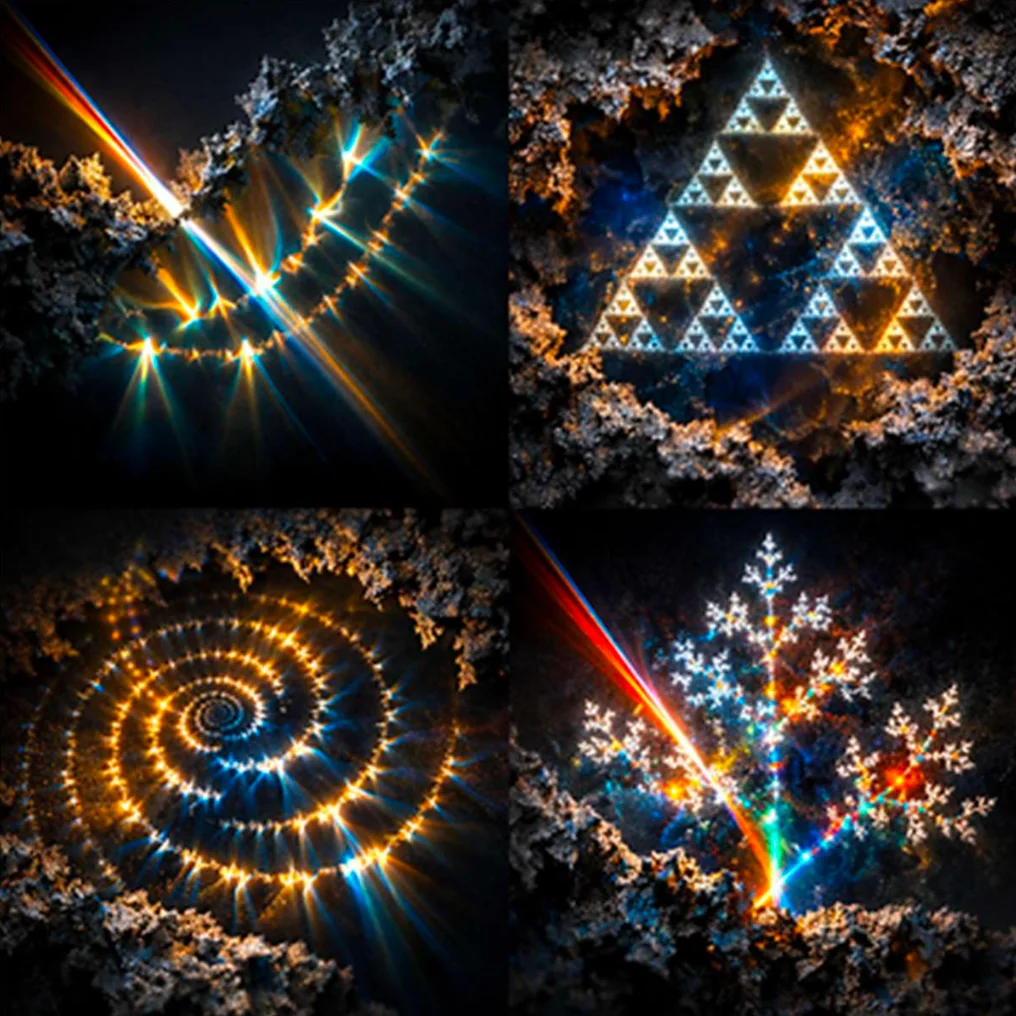
Visuals of fractal reflection patterns are ready. In these patterns, when light strikes fractal surfaces, it scatters not at a single angle, but through self-similar and multi-scale reflections.
- Top left: A laser beam hits a fractal surface, forming multiple branching branches of light.
- Top right: Self-similar reflection patterns resembling a Sierpinski triangle.
- Bottom left: Concentric fractal rings, representing the spiral multiplication of light.
- Bottom right: Tree-like branching light reflections.These patterns visually embody the concepts of fractal angle deviation and fractal energy distribution.
Fractal refraction patterns
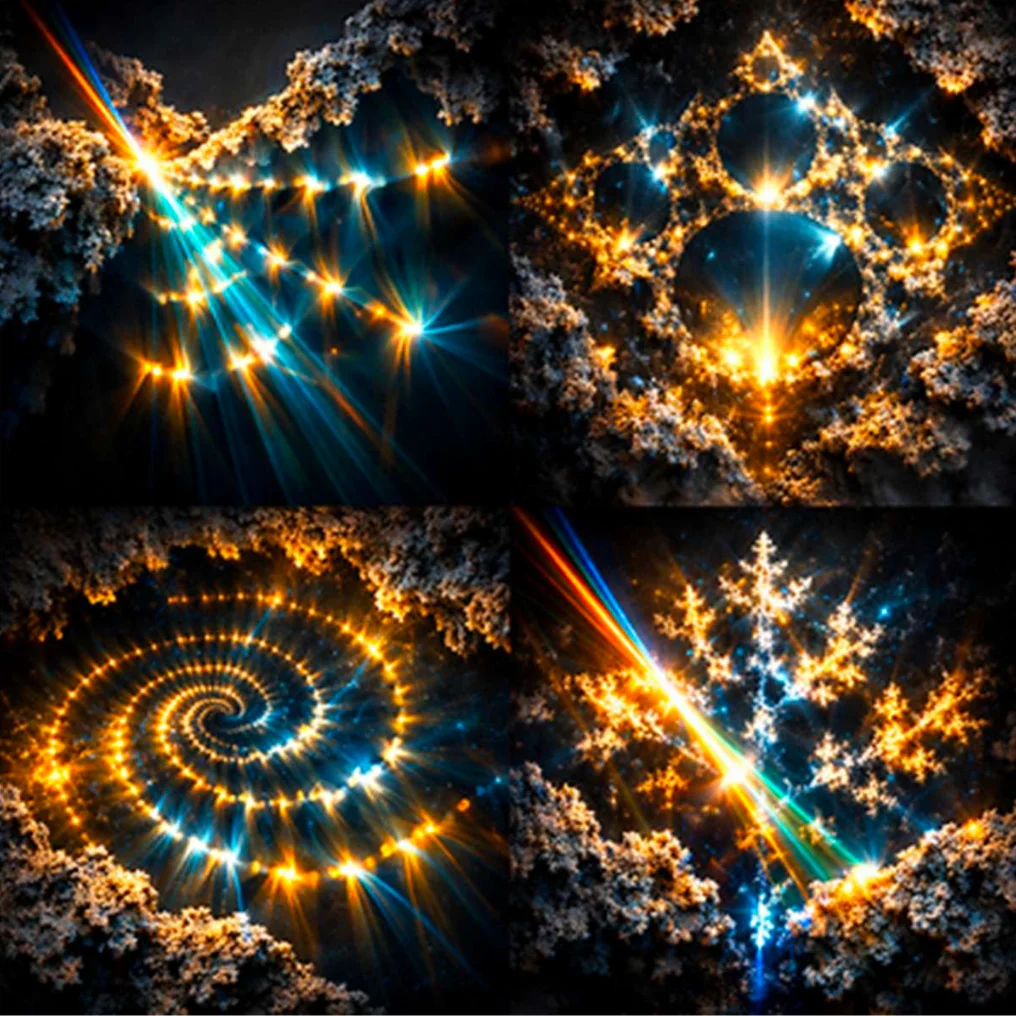
Visuals of fractal refraction patterns are ready. In these patterns, as light passes through a fractal-structured medium, it changes direction not with a single angle of refraction, but through multi-scale and self-similar refractions.
- Top left: A laser beam passes through a fractal crystal and splits into multiple colored branches of light.
- Top right: Mandelbrot-like fractal lenses, forming nested focal rings.
- Bottom left: Concentric fractal rings, demonstrating the focusing of light at different scales.
- Bottom right: Tree-like branching refraction arms, symbolizing the self-similar multiplication of light.These patterns visually embody the concepts of the fractal index function and multi-scale focusing.
Fractal Interference Patterns
Fractal interference patterns show the self-similar and multi-scale interference patterns formed by light mixing in fractal-structured mediums. Instead of the regular lines in the classical double-slit experiment, these patterns multiply as repeating motifs.
Basic Features
- Self-similar interference: Wave packets intersect at different scales, forming multi-layer patterns.
- Fractal phase modulation: Each wave interferes at different scales according to the fractal phase function.
- Multi-scale information layers: The patterns are multi-layered not only optically but also in terms of information storage.
Mathematical Framework
Fractal interference intensity:
𝐼fr (𝑥, 𝑦) =∣ ∑𝑛 𝐴𝑛 𝑒i (𝑘𝑛𝑥+𝜙𝑛) ∣2
- 𝐴𝑛 → fractal amplitude
- k𝑛 → wave number (scale-dependent)
- 𝜃𝑛 → fractal phase
This formula demonstrates that classical interference patterns multiply in a self-similar manner.
Application Areas
| Field | Classical Interference | Fractal Interference |
| Optical experiments | Single linear pattern | Self-similar multi-scale pattern |
| Holography | Single-layer information | Multi-scale information storage |
| Quantum optics | Single wave interference | Self-similar wave packets |
| Data storage | One-dimensional coding | Fractal multi-layer coding |
Visual Description
- Top left: A laser beam passes through a fractal double slit, forming multi-scale lines.
- Top right: Mandelbrot-like interference rings, showing self-similar phase modulation.
- Bottom left: Spiral fractal patterns, symbolizing the multi-scale interaction of wave phases.
- Bottom right: Tree-like light branchings, representing fractal wave interference.
These patterns visually embody the concepts of fractal phase modulation and self-similar wave interaction.
Fractal Holography
Fractal Holography is an optical information storage method where classical holography principles merge with fractal geometry. Here, light waves interact not just on a single plane, but within multi-scale self-similar layers. Each layer encodes both phase and amplitude information in a fractal format.
Basic Concepts
- Fractal wave coding: Every region of the hologram carries a self-similar piece of the entire image.
- Multi-scale phase interference: Light waves interfere at different scales, creating multi-layered phase maps.
- Fractal information density: Information is distributed throughout the fractal depth rather than on a single plane; this increases the resolution of the hologram.
Mathematical Framework
Fractal holographic wave function:
𝐻fr (𝑥, 𝑦) = ∑𝑛 𝐴𝑛 𝑒i (𝜙𝑛 + 𝑘𝑛 ⋅ 𝑓(𝐷𝑓))
- 𝐴𝑛 → fractal amplitude
- k𝑛 → wave number
- 𝜃𝑛 → fractal phase
- 𝑓(𝐷𝑓) → fractal dimension function
This formula shows that the hologram carries information with different phase modulations at each scale layer.
Application Areas
| Field | Classical Holography | Fractal Holography |
| Imaging | Single-layer phase coding | Multi-scale phase coding |
| Data storage | Planar information | Information in fractal depth |
| Optical communication | Single wave carrier | Self-similar wave carrier |
| Quantum information | Single-scale qubit | Multi-scale fractal qubit |
Visual Description
When a fractal hologram is created:
- Light waves mix with each other, producing self-similar interference patterns.
- Each pattern represents the phase map of the hologram at different scales.
- When the image is reconstructed, each layer carries a part of the total information.
This structure operates through the combination of fractal interference and fractal refraction laws; light no longer interacts solely on a surface, but within a cross-scale space.