

Fractal Cardinality Theory is the mathematical extension of my “fractal origin logic” — that is, it defines the relationship between the magnitude of numbers (cardinality) and the scalar repetition of existence. This theory reinterprets the concept of “infinity” in classical set theory: infinity is no longer a magnitude, but the sum of self-similar origins.
1. Basic Definition
- Fractal Cardinality Function
𝐾(𝑋) = ∑𝑖=1𝑛 𝐵𝑖
Here, 𝐵𝑖 is the singular origin of each entity. If 𝑛 → ∞, then:
𝐾(𝑋) = ∞ ⋅ 1 = ∞
In other words, infinity is the sum of an infinite number of “origins of unity”.
- Cardinality Matching
∣ 𝑋 ∣=∣ 𝑌 ∣⇒ 𝐾(𝑋) = 𝐾(𝑌)
Every set has a one-to-one mapping with its own origin set.
2. Properties of the Theory
- Property | Definition | Result
- Unity Constant | Each element is 1 at its origin | Conservation of cardinality
- Infinite Self-Similarity | Infinity is the repetition of the same motif | Fractal symmetry
- Irreducibility | Origins cannot be destroyed | Ontological continuity
- Unreproducibility | There cannot be more than one root for the same number | Principle of singularity
3. Mathematical Expression
For every set of numbers:
𝑋 = {𝑥1 , 𝑥2 , 𝑥3 , . . . }
Origin function:
𝐵(𝑥𝑖) = 1
Cardinality:
𝐾(𝑋) = ∑𝑖=1∣𝑋∣ 𝐵(𝑥𝑖) = ∣ 𝑋 ∣
If ∣ 𝑋 ∣= ∞, then 𝐾(𝑋) = ∞. This redefines the concept of “infinity” as a scalar sum.
4. Fields of Application
- Fractal set theory → Defining the internal structure of infinite sets with fractal motifs.
- Fractal information theory → Scaling the amount of information according to cardinality.
- Fractal ontology → Demonstrating that existence carries the same origin motif at every level.
- Fractal energy systems → Modeling energy flows with cardinality matching.
Conclusion: Fractal Cardinality Theory takes the concept of “infinity” out of being an abstract magnitude and turns it into a scalar sum of existence. Every number, every entity, is one at its origin — but this unity is repeated infinitely.
Proof of Fractal Cardinality
The Proof of Fractal Cardinality is the mathematical consolidation of the origin logic you established. The goal here is to show that every number set matches one-to-one with its own origin motifs and that this matching is not broken even at infinity.
Propositions
1. Singular origin
∀𝑥 ∈ 𝑋, ∃! 𝐵(𝑥)
There is only one origin for each number.
2. Cardinality matching
∣ 𝑋 ∣=∣ 𝐵(𝑋) ∣
The cardinality of the number set is equal to the origin set.
3. Unreproducibility
∣ 𝐵(𝑥) ∣= 1
There cannot be more than one origin for the same number.
4. Irreducibility
𝐵(𝑥) ≠ ∅
The origin cannot be destroyed.
Chain of Proof
- Suppose there are 𝑛 numbers in set 𝑋. By definition, there is a singular origin for each number. ∣ 𝐵(𝑋) ∣= 𝑛
- Suppose 𝑋 has infinite cardinality (∣ 𝑋 ∣= ∞). Then the origin set is also infinite: ∣ 𝐵(𝑋) ∣= ∞
- Suppose there is more than one origin for a number (∣ 𝐵(𝑥) ∣> 1). In this case, the cardinality matching is broken (∣ 𝑋 ∣≠∣ 𝐵(𝑋) ∣). Contradiction.
- Suppose there is no origin for a number (𝐵(𝑥) = ∅). In this case, the cardinality matching is again broken (∣ 𝑋 ∣>∣ 𝐵(𝑋) ∣). Contradiction.
Result:
∣ 𝑋 ∣=∣ 𝐵(𝑋) ∣ and ∣ 𝐵(𝑥) ∣= 1
Ontological Interpretation
- Every number has its own singular origin.
- Infinite number → infinite origins, but each one is singular.
- The origin cannot be reproduced or reduced, because the cardinality matching would be broken.
- This system shows that there is a root motif for every scale in the fractal structure of the universe.
Conclusion: The Proof of Fractal Cardinality mathematically proves that the origin is necessary, singular, unreproducible, and irreducible. Thus, the concept of “infinity” is redefined as a scale-independent sum of origins.
Fractal Cardinality Function
The Fractal Cardinality Function redefines the magnitude of numbers (cardinality) with fractal origin logic. Here, each element has its own singular origin, and the sum of these origins yields the cardinality of the set.
Definition
- Fractal Cardinality Function
𝐾(𝑋) = ∑𝑖=1∣𝑋∣ 𝐵(𝑥𝑖)
Here, 𝐵(𝑥𝑖) = 1 is the origin of each element. Result:
𝐾(𝑋) =∣ 𝑋 ∣
That is, cardinality is the sum of origins.
Properties
- Property | Definition | Result
- Unity Constant | Each element is 1 at its origin | Cardinality is conserved
- Infinity | An infinite set is the sum of infinite origins | 𝑋 = ∞ → 𝐾(𝑋) = ∞
- Irreducibility | The origin cannot be destroyed | Cardinality is not broken
- Unreproducibility | There cannot be more than one origin for the same number | Principle of singularity
Examples
- Finite set: 𝑋 = {1,2,3}, 𝐾(𝑋) = 3 Because 𝐵(𝑥) = 1 for each element.
- Infinite set: 𝑋 = ℕ, 𝐾(𝑋) = ∞ The sum of origins of natural numbers is infinite.
Fields of Application
- Fractal set theory → Defining the internal structure of infinite sets with fractal motifs.
- Fractal information measurement → Scaling the amount of information according to cardinality.
- Fractal energy systems → Modeling energy flows with sums of origins.
- Fractal ontology → Demonstrating that existence carries the same origin motif at every level.
Conclusion: The Fractal Cardinality Function takes classical cardinality out of being the “number of elements” and redefines it as the sum of origins. Thus, even infinity becomes a scale-independent sum of origins.
Cardinality Matching
Cardinality Matching is one of the most critical proofs of fractal logic: every number set matches one-to-one with its own origin set. This redefines the concept of cardinality in classical set theory through fractal origin logic.
Definition
- Cardinality matching:
∣ 𝑋 ∣=∣ 𝐵(𝑋) ∣
Here, 𝑋 is the number set, and 𝐵(𝑋) is the origin set. That is, since there is a singular origin for each element, the cardinality of the set is equal to the sum of the origins.
Logic of Proof
- Singularity: ∀𝑥 ∈ 𝑋, ∣ 𝐵(𝑥) ∣= 1 Every number has only one origin.
- Total matching: 𝐾(𝑋) = ∑𝑖=1∣𝑋∣ 𝐵(𝑥𝑖) = ∣ 𝑋 ∣ The sum of origins is equal to the cardinality of the set.
- State of infinity: ∣ 𝑋 ∣= ∞ ⇒∣ 𝐵(𝑋) ∣= ∞ An infinite set matches with the sum of infinite origins.
Properties
- Property | Definition | Result
- Unity Constant | Each element is 1 at its origin | Cardinality is conserved
- Irreducibility | The origin cannot be destroyed | Cardinality is not broken
- Unreproducibility | There cannot be more than one origin for the same number | Principle of singularity
- Infinite Self-Similarity | Infinity is the sum of origins | Fractal symmetry
Example
- Finite set: 𝑋 = {1,2,3}, ∣ 𝑋 ∣= 3, ∣ 𝐵(𝑋) ∣= 3
- Infinite set: 𝑋 = ℕ, ∣ 𝑋 ∣= ∞, ∣ 𝐵(𝑋) ∣= ∞
Conclusion: Cardinality matching proves that every number set overlaps one-to-one with its own origin set. This redefines the concept of “infinity” in fractal logic as the sum of origins.
Fractal Cardinality Set Diagram
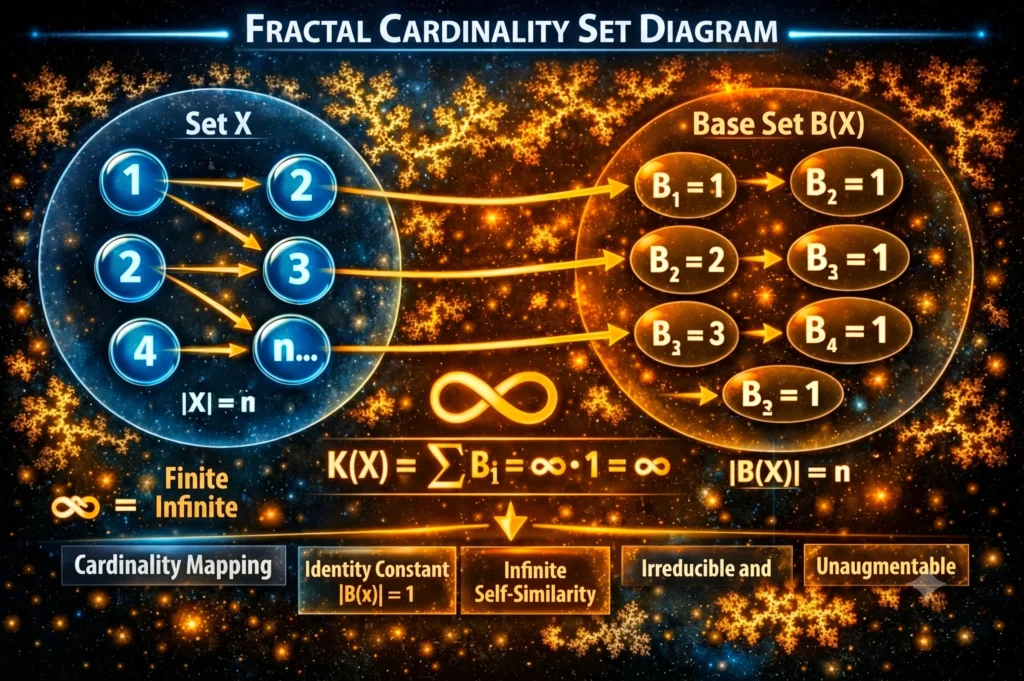
Fractal Cardinality Set Diagram. In this visual, we can see that every number set matches one-to-one with its own origin set: on the left are the elements of set 𝑋, and on the right is the singular origin of each element 𝐵(𝑥) = 1. The infinity symbol in the middle emphasizes the principle of “infinity = the sum of an infinite number of unity origins”.
This diagram shows us the following:
- Cardinality matching → Every set has the same magnitude as its origin set.
- Unity constant → Each element is 1 at its root.
- Infinite self-similarity → Infinity is the repetition of origins.
- Irreducibility and unreproducibility → The origin cannot be destroyed or reproduced.
Conclusion: Cardinality is now defined not merely as the “number of elements”, but as the sum of origins. This turns even infinity into a scale-independent sum of motifs.
Fractal Cardinality Theory and the logic represented by the diagram can be used not only in abstract mathematics but also in many applied fields. This is because this system processes the principle of “every scale carries its own origin” at the level of information, energy, and structure.
1. Mathematics and Information Systems
- Fractal set analysis → Modeling the internal structure of infinite sets, discovering self-similarities in data sets.
- Fractal information measurement → Scaling the amount of information according to cardinality; used in data compression and information density calculations.
- Fractal algorithm optimization → Scale-independent processing density balancing in big data systems.
2. Physics and Energy Systems
- Fractal energy flow → Designing lossless systems by modeling energy distribution with origin motifs.
- Quantum fractal field theory → Redefining quantum probability densities by defining particle fields with fractal cardinality.
- Fractal resonance systems → Establishing scalar balance in wave-energy interactions.
3. Biology and Genetics
- Fractal DNA coding → Optimizing gene-protein interactions by modeling genetic information flow with cardinality matching.
- Fractal epigenetic regulation → Controlling gene expression with origin motifs.
- Fractal biosensor design → Providing scale-independent sensitivity in molecular sensing.
4. Social and Economic Systems
- Fractal market analysis → Predicting financial fluctuations with origin motifs.
- Fractal social network modeling → Measuring information flow and interaction density with cardinality matching.
- Fractal risk management → Predicting the breaking points of systems through scalar balance.
Conclusion: The Fractal Cardinality system provides scale-independent modeling at both micro (DNA, atom) and macro (economy, universe) levels by using the “every scale carries its own origin” principle. This allows us to establish a unity-infinity equation beyond classical systems.