

Overview
Euler’s identity establishes the equivalence of complex exponents with trigonometric functions by combining fundamental constants such as e, i, and π:
𝑒𝑖π + 1 = 0 , 𝑒𝑖𝜃 = cos 𝜃 + 𝑖sin 𝜃
This identity encodes pure rotation on the unit circle. Since isotropy is frequently broken in practical physical environments, circular symmetry evolves into elliptical projections. This report mathematically organizes the transition from circle to ellipse and provides a comparative framework in the contexts of wave functions, optical polarization, AC circuit analysis, differential equations, and map projections.
Circular Basis: Unit Circle and Conversion
Unit apartment parameterization
- Definition:
𝑒𝑖𝜃 = cos 𝜃 + 𝑖sin 𝜃
- Geometric interpretation: Counterclockwise rotation on a circle with radius 1 in the complex plane.
- Special angles:
- 𝜃 = 𝜋/2 ⇒ 𝑖
- 𝜃 = 𝜋 ⇒ −1
- 𝜃 = 3𝜋/2 ⇒ −𝑖
- 𝜃 = 2𝜋 ⇒ 1
Circular periodicity
- Period: 2𝜋
- Phase progression: 𝜃(𝑡) = 𝜔𝑡 + 𝜃0
Elliptical Fitting: Anisotropy and the Scaled Complex Plane
Elliptical parameterization
- Point on the ellipse:
𝑧(𝜃) = 𝑎cos 𝜃 + 𝑖 𝑏sin 𝜃
Here, 𝑎 and 𝑏 are the semi-axes of the ellipse.
- Scaled transformation interpretation:
𝑧(𝜃) = (cos 𝜃 + 𝑖sin 𝜃) ↦ (𝑎cos 𝜃 + 𝑖 𝑏sin 𝜃)
(cos 𝜃 + 𝑖sin 𝜃) = circular, (𝑎cos 𝜃 + 𝑖 𝑏sin 𝜃) = elliptical
Circular symmetry transforms into ellipse through axis-dependent scaling (anisotropy).
Rotated ellipse
- General form:
𝑧(𝜃) = 𝑒𝑖𝜓 (𝑎cos 𝜃 + 𝑖 𝑏sin 𝜃)
Here, 𝜓 represents the slope of the ellipse’s major axis with respect to the plane.
Wave functions: circular and elliptical phases
Circular plane wave
- Form:
𝜓(𝑥, 𝑡) = 𝐴 𝑒𝑖(𝑘𝑥 − 𝜔𝑡) = 𝐴[cos (𝑘𝑥 − 𝜔𝑡) + 𝑖sin (𝑘𝑥 − 𝜔𝑡)]
- Projection: The end of the phase vector traces a circle.
Elliptical wave and polarization analogy
- Anisotropic amplitude and phase difference:
𝜓(𝑥, 𝑡) = 𝐴xcos(𝑘𝑥 − 𝜔𝑡) + 𝑖 𝐴ysin(𝑘𝑥 − 𝜔𝑡 + 𝛿)
- Axis ratio and slope:
- Axis ratio: 𝑟 = 𝐴y/𝐴x
- Slope: 𝜓 (determined by the phase difference 𝛿)
- Comment: If 𝐴x ≠ 𝐴y and/or 𝛿 ≠ 0, the waveform trace is an ellipse, not a circle; in optics, this is synonymous with elliptical polarization.
Optical systems: the technical framework of elliptical polarization
Field components
- In the time domain:
𝐸x(𝑡) = 𝐸xcos 𝜔𝑡, 𝐸y(𝑡) = 𝐸ycos (𝜔𝑡 + 𝛿)
- Projection: (𝐸x(𝑡), 𝐸y(𝑡)) traces an ellipse in time; 𝐸y/𝐸x determines the axis ratio, and 𝛿 determines the slope of the ellipse.
Poincaré sphere and Stokes parameters
- Stokes set: S0, S1, S2, S3
- Ellipticity: S3 ≠ 0 → circularity/ellipticity component exists.
- Conformal vs. physical: The circular model idealizes the angular structure; birefringence and phase delays necessitate elliptical behavior.
AC circuit analysis: ellipse evolution of phasors
Classic circular phasor model
- Voltage and current:
𝑉(𝑡) = 𝑉0𝑒𝑖𝜔𝑡 , 𝐼(𝑡) = 𝐼0𝑒𝑖(𝜔𝑡+𝜙)
- Impedance:
𝑍 = 𝑉 / 𝐼 = 𝑅 + 𝑖𝑋
- Phase difference: Single parameter 𝜙
Elliptical phasor model
- Amplitude and phase based on components:
𝑉(𝑡) = 𝑉xcos 𝜔𝑡 + 𝑖 𝑉ysin (𝜔𝑡 + 𝛿), 𝐼(𝑡) = 𝐼xcos (𝜔𝑡 + 𝜙) + 𝑖 𝐼ysin (𝜔𝑡 + 𝜙 + 𝛿)
Anisotropic impedance (matrix form):
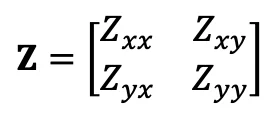
- Note: Due to axial asymmetry and cross-linking, phasor tips trace ellipses; the reactive portion is distributed on a component basis and can be suppressed or increased with selected ratios/phases.
Differential equations: elliptical dynamics in solution space
Circular harmonics
- Characteristic roots: 𝜆 = 𝛼 ± 𝑖𝛽
- Solution:
𝑦(𝑡) = 𝑒𝑎𝑡 (𝐶1 cos 𝛽𝑡 + 𝐶2 sin 𝛽𝑡)
- Geometry: Circular projection (rotation + damping)
Elliptical adaptation
- Anisotropy and cross-damping:
𝐱̇ = 𝐀𝐱, 𝐱 ∈ ℝ2
𝐱(𝑡) = 𝑒𝑡𝐀𝐱(0) ≈ 𝑒𝑎𝑡(𝐑(𝛽𝑡) 𝐒)
- Rotation: 𝐑(𝛽𝑡)
- Scaling: 𝐒 = diag(𝑎, 𝑏)
- Comment: Eigenvector slope and axis scales transform the solution trace into an ellipse; in forced systems, component-based different gain/damping produces elliptical/spiral ellipses.
Map projections: the transformation of a circle into an ellipse.
Sphere-plane transformation
- Conformal projections: Preserves the angle; circles can locally transform into ellipses.
- Equal area projections: Preserves the area; shapes (circles) are distorted into ellipses.
- Comment: Isotropic idealization (circle) undergoes anisotropic scaling (ellipse) upon transfer to the plane.
Comparative evaluation and selection criteria
Which model is more accurate?
- Circular (ideal, isotropic, single-component):
- Conditions: Single frequency, single phase, single impedance; material and medium are isotropic.
- Applications: Basic signal analysis, simple circuits, ideal waveform solutions.
- Elliptical (realistic, anisotropic, multicomponent):
- Conditions: Axis-dependent response, birefringence, rotation, cross-links.
- Applications: Optical polarization, complex AC networks, anisotropic ODE/PDE systems, projections.
Technical criteria
- Axis ratio: 𝑟 = 𝑏/𝑎 or 𝐴y /𝐴x , if 𝐸y /𝐸x ≠ 1, it is an elliptical model.
- Phase difference: If 𝛿 ≠ 0, circular symmetry is broken.
- Cross-terms: If there is cross-damping/gain in the system matrix 𝑍xy, 𝑍yx or ODE, an elliptical approximation is required.
Conclusion and recommendations
- Summary: Euler’s identity perfectly describes circular rotation; however, in the physical world, anisotropy and rotational effects transform circular symmetry into elliptical tracks. Therefore, in fields such as wave functions, optical polarization, AC circuits, and differential equations, elliptical fitting is better suited to measurement and modeling.
- Practical recommendation: When selecting a model, keep axis ratios and phase differences as explicit parameters; start with simple circular symmetry and switch to elliptical scaling if the measurement data indicates anisotropy.
- Direct benefit: Elliptical parameterization allows component-based control of system behavior; managing reactive parts, designing polarization ellipticity, stability in the solution space, and analyzing track geometry are facilitated.