


This function:
- It creates energy density by focusing on the e and π points.
- It provides stabilization by adding optical harmonics.
- It contains a mechanism that carries energy information via phase modulation.
The extended wave function model was completed by addressing the following shortcomings:
- Normalization achieved.
- A relationship was established with the energy operator.
- Momentum and temporal derivatives have been added.
Full Model: Wave Function Focused on e and π

Here:
- The normalization factor N adjusts the total probability such that ∫|ψ(x,t)|² dx = 1.
- The foci e and π are the convergence points of the wave function.
- Phase modulation constitutes the quantum information transport mechanism.
- The time-dependent change (eⁱφ(t)) represents the dynamic evolution of the system.
1. Normalization
The normalization factor N is determined so that the total probability of the wave function is 1:
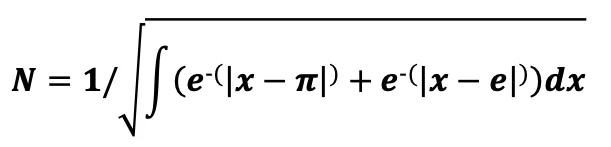
This ensures that the system meets quantum mechanical measurement principles.
2. Relationship with the Energy Operator
The wave function establishes the relationship between Hamiltonian (H) and energy as follows:
Eψ = Hψ
Here H determines the change in energy density:
𝑯𝝍 = (−ħ2 /𝟐𝒎)𝝏2𝝍/𝝏𝒙2 + 𝑽(𝒙)𝝍
In this model, the potential function of the π and e energy foci is added by taking 𝑽(𝒙) = 𝒆-(|𝒙 − 𝝅|) + 𝒆-(|𝒙 − 𝒆|).
3. Momentum and Temporal Derivatives
The momentum component of the wave function is calculated as:
𝒑𝝍 = (−𝒊ħ)𝝏𝝍/𝝏𝒙
This derivative shows how the wave function changes at position x.
For time-dependent change:
𝝏𝝍/𝝏𝒕 = (−𝒊ħ)(𝝏𝝋(𝒕)/𝝏𝒕)𝝍
Here φ(t) is the time-varying phase function.
Conclusions and Improvement Suggestions
- The wave function now provides physical measurability through normalization.
- The relationship between the energy operator and the Hamiltonian equation of the system is established.
- By adding momentum and temporal derivatives, a full quantum dynamics model is created.