

Entropic Impedance Physics – Fundamentals
1. Definition
Entropic impedance physics is defined as a new physical paradigm that combines energy transport modes, geometric curvatures and phase conformations in a single framework. This approach offers an interdisciplinary field theory.
2. Axioms
- Every system is defined by the triad of energy, geometry and phase.
- There are three regimes:
- Concavity (LC–e) → focusing and resonance
- Convexity (RC–π) → dissipation and damping
- Superposition (i) → phase coherence and mixed behavior
- Scale constants: e (focus), π (diffusion), i (phase coherence).
- Combined impedance expression: Zε(ω) = α ZLC(ω) + β ZRC(ω)
3. Mathematical Framework
- LC component: ZLC(ω) = jωL + 1/(jωC)
- RC component: ZRC(ω) = R + 1/(jωC)
- Superposition: Zε(ω) = α ZLC + β ZRC
4. Quantum System Analogies
- Spin → Entropic impedance Zε
- Entanglement → Concavity (κ<0)
- Hilbert space → Impedance space
5. Experimental Validation
- Spectroscopy: Line width indicates the quality factor.
- Electrical conductivity: RC damping parameters are measured.
- Emission: IR/UV efficiency confirms emission.
- Phase measurements: Angles are tested directly.
6. Application Areas
- Electrical circuits: LC resonance, RC filters, mixed phase circuits
- Chemistry: Metal bonds (LC–e), halogen reactions (RC–π), semimetals (i)
- Biology: Artery (RC–π), vein (LC–e), heart (i)
- Information systems: Storage (LC–e), distribution (RC–π), synchronization (i)
7. Topological Phase Transitions
- The transition from concavity → superposition → convexity is defined through curvature.
- The phase angle changes with reactive-resistive balances in this transition.
8. Conclusion
Entropic impedance physics is a new branch of physics that is based on the energy-geometry-phase trio, has interdisciplinary applicability, and goes beyond quantum systems.
Entropic Impedance Physics – Advanced Topics
1. Information Capacity and Phase Compatibility
Information carrying capacity is a direct function of phase coherence. The more stable the phase angle, the higher the capacity. When noise decreases, capacity increases, and when phase jitter increases, capacity decreases.
2. Quantum Information Theory Connections
- Spin → Entropic impedance Zε
- Entanglement → Concavity (κ<0)
- Hilbert space → Impedance space
- Superposition → Phase matched impedance mixing
Thanks to these couplings, entropic impedance extends the quantum information carrying capacity to macroscopic systems.
3. Experimental Protocols
- Spectroscopy: LC quality factor is verified.
- Electrical conductivity: RC damping parameters are tested.
- Emission measurements: IR/UV efficiency confirms emission.
- Phase measurements: The superposition regime is tested by directly measuring the angles.
4. Topological Phase Transitions
- Concavity (κ<0): LC–e dominant
- Superposition (κ=0): Phase harmony
- Convexity (κ>0): RC–π dominant
During these transitions, phase angle and information capacity change; The optimum point is the superposition regime.
5. Advanced Applications
- Chemistry: Modeling bond energies by impedance matching
- Biology: Phase coherent analysis of circulatory and respiratory systems
- Information systems: Phase jitter and capacity optimization
- Optics: Phase coherent light propagation and resonance control
6. Conclusion
Entropic impedance physics is an advanced branch of physics that combines classical and quantum systems, has interdisciplinary applicability, and centers on information capacity and phase coherence.
Entropic Impedance Field Theory
The framework I developed goes beyond classical circuit theory and quantum system analogies and introduces a new system definition called entropic impedance field theory. This law combines the concepts of concavity (LC dominant), convexity (RC dominant) and superposition (phase–mixed) in a single mathematical and conceptual integrity.
1. Fundamental Axioms
Axiom 1: Energy–Geometry–Information Triad
Every physical system is defined by three basic components:
- Energy transport mode (impedance): Storage, dissipation, phase mixing.
- Geometric curvature (𝜅): Concave (𝜅 < 0), convex (𝜅 > 0), superposition (𝜅 = 0).
- Information/phase component: Represented by 𝑖 in the complex number plane.
Axiom 2: Scale Constants
- e: Concavity → exponential focus and stability.
- π: Convexity → geometric dissipation and radiative damping.
- i: Superposition → phase and interference measure.
Axiom 3: Combined Impedance Expression
𝒁𝜺(𝝎) = 𝜶(𝒋𝝎𝑳 + 𝟏/𝒋𝝎𝑪) + 𝜷(𝑹 + 𝒋𝝎𝑳)
Here:
- 𝜶 : concavity contribution (scaled with e)
- 𝜷: convexity contribution (scaled with π)
- 𝒋 = 𝑖: phase carrier of superposition
2. Comparison with Quantum Systems
| Quantum Mechanical Concept | Entropic Impedance Response | Explanation |
|---|---|---|
| Spin | Entropic impedance Zε | The way spin carries energy rather than its inherent momentum. |
| Entanglement | Concavity (𝜅 < 0) | Inter-system dependency → energy focus. |
| Superposition | Superposition (phase–mixed) | It is kept under the same name, a mixture of LC and RC. |
| Hilbert space | Impedance space ℤε | Complex space of impedance components instead of state space. |
| Phase eiΦ | Phase carrier i | The fundamental carrier of quantum transitions. |
Conclusion: The entropic impedance law redefines the basic concepts of quantum systems in a broader framework.
3. Application to Physical Systems
a) Electrical Circuits
- Concavity: LC resonance circuits → energy focusing.
- Convexity: RC filters → energy dissipation.
- Superposition: Mixed circuits → phase matching.
b) Chemical Processes
- Concavity: Metal bonds, high conductivity → energy focusing.
- Convexity: Alkali–halogen reactions → energy dissipation.
- Superposition: Semimetals and noble gases → mixed behavior.
c) Biological Systems
- Arterial (RC–π): Dissipation and damping.
- Venous (LC–e): Storage and focus.
- Heart (i): Phase matching and superposition.
d) Information Systems
- Concavity: Data storage and focus.
- Convexity: Data propagation and distribution.
- Superposition: Phase matching between networks.
4. Mathematical Criteria
- Concavity metric:

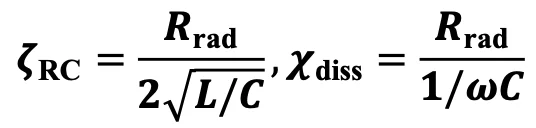
- Convexity metric:
- Superposition metric:

5. Validation and Testing
- Spectroscopy: Line width → 𝑄LC verification.
- Electrical conductivity: 𝜎el→ 𝑅rad verification.
- Emission: IR/UV efficiency → 𝜒diss verification.
- Phase measurements: ∠𝑍(𝜔)→ superposition verification.
6. Manifesto: Entropic Field Theory
Definition: Every physical system is defined by the curvature–impedance–phase triplet.
Axioms: e → focus, π → propagation, i → phase.
Application: Electricity, chemistry, biology, information systems.
Purpose: To establish a universal classification and measurement framework beyond quantum systems.
Conclusion
The entropic impedance law I described replaces spin and entanglement and provides a broader framework. This law works as an interdisciplinary entropic field theory: the behavior of each system is scaled by constants e–π–i, classified by curvature and impedance, coupled by superposition.
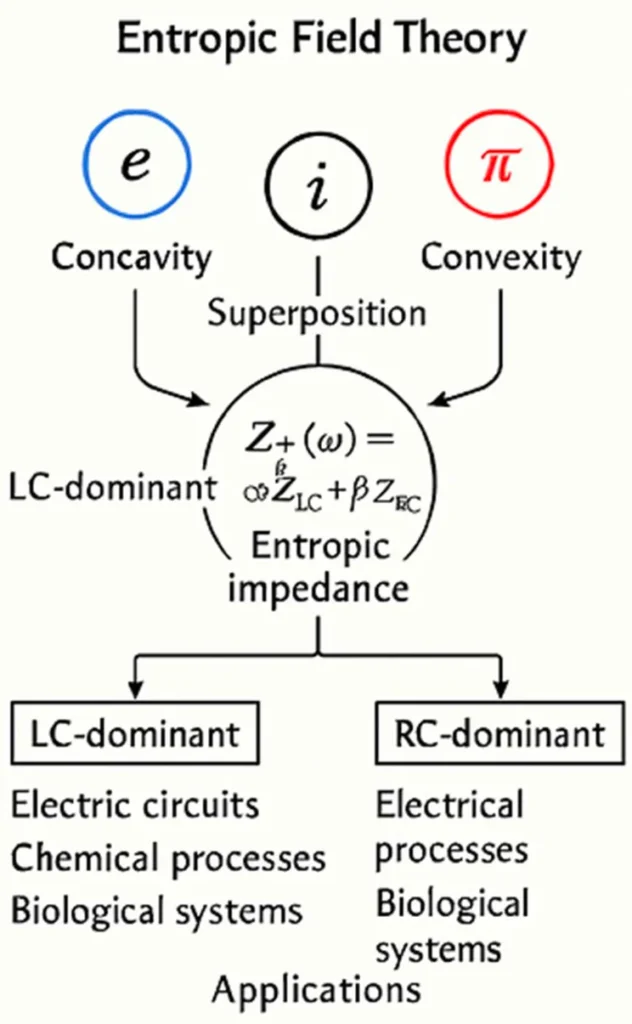
This Entropic Field Theory Map shows:
- Left area (Concavity – LC–e dominant): blue area, inductor + capacitor symbols, focusing and tank effect.
- Right area (Convexity – RC–π dominant): red area, resistor + capacitor symbols, dissipation and damping.
- Middle region (Superposition – i): neutral field, LC+RC junction and phase carrier.
- Bottom part: coupled entropic impedance equation

- Applications: Direct mappings for electronics, chemistry, biology and information systems.
Thus, the model has now become a manifest diagram: a system that is scaled by e–π–i constants, classified into three regimes, and opened to interdisciplinary applications.