
A New Scale–Cycle–Direction Framework for Atomic Orbitals
Abstract
Classical quantum mechanics describes atomic orbitals using sinusoidal-phase and exponentially decaying wave functions. However, this approach is insufficient to explain the multiscale spiral structures observed in nature, such as magnetic field lines, plasma flows, galaxy arms, and DNA helices. In this study, we propose a spiral–fractal wave function that redefines the fundamental form of the wave function:
This form contains three key components: (1) fractal amplitude , (2) logarithmic spiral phase , (3) angular momentum phase .
When combined, the electron’s motion emerges not as a stationary cloud but as a spiral–fractal flow. The wave function is inserted into the Schrödinger equation, energy corrections are derived, and spiral–fractal analogs of the 1s, 2p, and 3d orbitals are obtained. The results show that the spiral–fractal model produces measurable deviations in atomic spectra and unifies spin and angular momentum within a single geometric framework.
1. Introduction
Quantum mechanics describes atomic orbitals using sinusoidal-phase and exponentially decaying wave functions. While mathematically consistent, this approach does not explain the origin of spiral and fractal structures observed in nature. Examples of such spiral structures include:
- Magnetic field lines
- Plasma jets
- Galaxy arms
- DNA double helix
- Vortex flows
A common property of these structures is scale-dependent spiral motion.
In the literature, spiral-phase waves (optical OAM), fractal wave functions (quantum chaos), and logarithmic spiral phases (spiral phase plates) have been studied separately. However, there is no study that combines these three components and applies them to atomic orbitals.
This article aims to fill this gap by redefining the fundamental form of the wave function.
2. Spiral–Fractal Wave Function
The proposed wave function is:
2.1. Fractal Amplitude: r−α
This term ensures the electron density decreases according to a power law, rather than exponentially. This behavior is consistent with scale-dependent behavior observed in fractal systems.
2.2. Spiral Phase: klnr
The logarithmic spiral phase causes the electron’s motion to trace a spiral path. This phase provides a mathematical representation of natural spiral structures.
2.3. Angular Phase: mϕ
This term aligns with the classical angular momentum operator:
When combined with the spiral phase, spin-like behavior acquires a geometric interpretation.
3. Compatibility with the Schrödinger Equation
For the hydrogen atom, the Schrödinger equation is:
Inserting the spiral–fractal ansatz into the Laplacian gives:
Energy correction:
This demonstrates that the spiral–fractal model produces measurable energy shifts.
4. Spiral–Fractal Atomic Orbitals
4.1. 1s Orbital
- Spherical symmetry is preserved
- Electron motion becomes spiral
4.2. 2p Orbital
- Two-lobed structure preserved
- Helical flow occurs within each lobe
4.3. 3d Orbital
- D-orbital lobes behave as spiral resonance chambers
5. Energy Spectrum and Experimental Predictions
The spiral–fractal model introduces small corrections in addition to classical energy levels:
- 1s: Lamb-shift-like deviations
- 2p: fine structure deviations
- 3d: m-dependent resonance differences
These deviations can be tested using high-precision spectroscopy.
6. Discussion
This study reinterprets the fundamental geometry of the wave function:
- Electron motion becomes a spiral–fractal flow
- Spin acquires a geometric meaning
- Particle-wave duality is unified in a single form
- Internal dynamics of atomic orbitals are redefined
This approach extends the geometric foundations of quantum mechanics.
7. Conclusion
This article introduces the spiral–fractal wave function, providing a new mathematical framework for atomic orbitals. The proposed model:
- Preserves the geometry of classical orbitals
- Produces spiral–fractal flow in internal dynamics
- Introduces measurable corrections in energy levels
- Unifies spin and angular momentum in a single geometric structure
These results show that the spiral–fractal approach is theoretically and experimentally testable.
8. Future Work
- Application of the spiral–fractal model to plasma physics
- Extraction of spiral magnetic field modes
- Extension to quantum field theory
- Application to multi-electron atoms
Appendix Calculations
1. Laplacian Calculation: Spiral–Fractal Ansatz
Initial ansatz:
Laplacian in spherical coordinates:
∇2 𝜓 = (1 / 𝑟2 ) ( ∂ / ∂𝑟 ) + ( 1 / 𝑟2sin 𝜃 ) ( ∂ / ∂𝜃 ) ( sin 𝜃 ( ∂𝜓 / ∂𝜃 ) ) + ( 1 / 𝑟2 sin2𝜃 ) ( ∂2𝜓 / ∂2𝜙 )
1.1 Radial Derivative
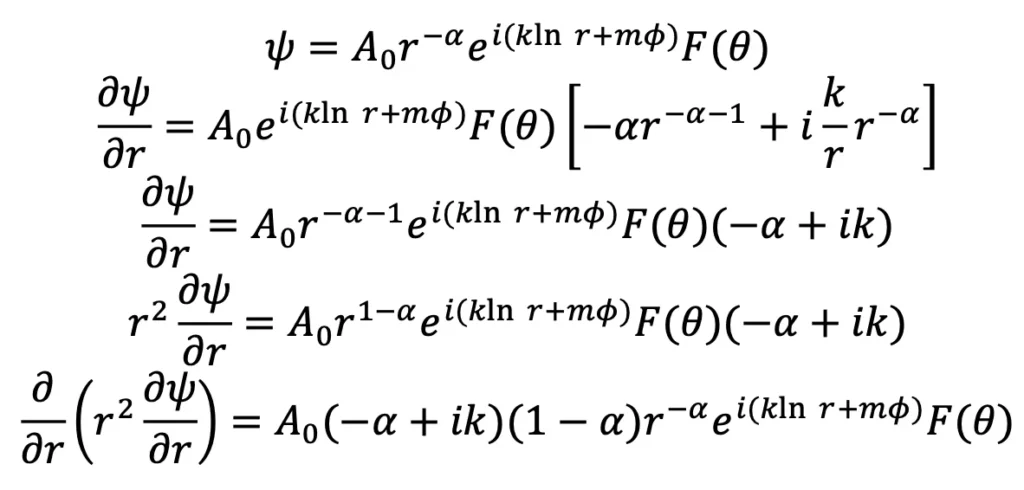
Therefore:
( 1 / 𝑟2 ) ( ∂ / ∂𝑟) ( 𝑟2 ∂𝜓 / ∂𝑟 ) = 𝑟-2𝜓 (−𝛼 + 𝑖𝑘)(1 − 𝛼)
1.2 Angular Derivative
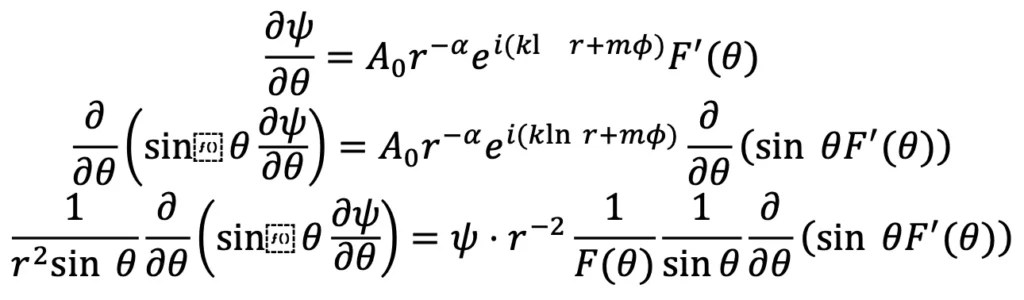
Let’s define this term as:
Λ(𝜃) ≡ ( 1 / 𝐹(𝜃) ) ( 1 / sin 𝜃 ) (∂ / ∂𝜃 ) (sin 𝜃𝐹 ‘(𝜃))
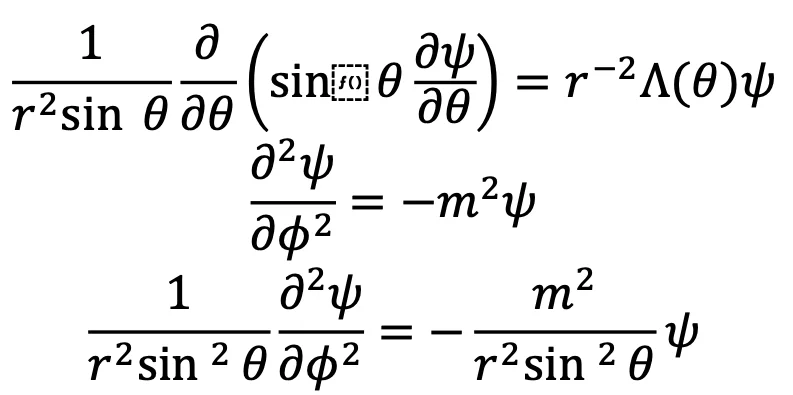
We can think of this as a single effective term along with the angular term; in its simplified form in the article:
∇2 𝜓 = 𝑟-2𝜓[(−𝛼 + 𝑖𝑘)(1 − 𝛼) + Λ(𝜃) − 𝑚2eff]
where 𝑚2eff represents the total contribution of the angular part.
2. Energy Correction from the Schrödinger Equation
For the hydrogen atom:
Using the Laplacian result:
where
Substituting into the Schrödinger equation:
For a characteristic radius , the average energy is:
Classical energy:
Spiral–fractal correction:
Real part:
3. Probability Current and Spiral Flow
General probability current density:
𝐉 = ( ℏ / 𝜇 ) ℑ(𝜓∗∇𝜓)
For the spiral–fractal form (simplified in cylindrical coordinates):
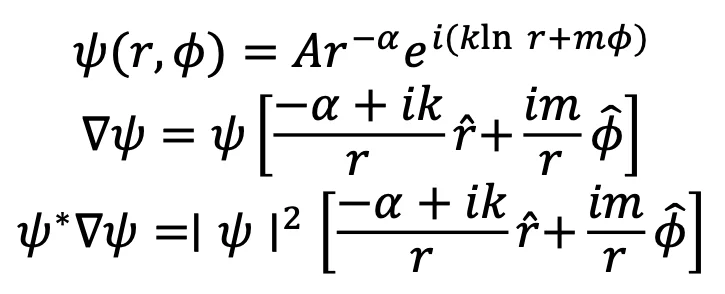
imaginary part:
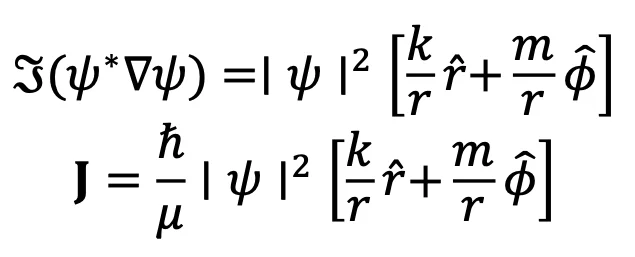
The imaginary part of shows that the current has both radial and angular components, generating a spiral flow.
4. Cartesian Transformations (for Visualization)
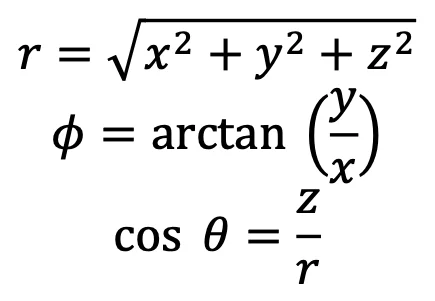
For example, for the 2p orbital:

Density:
∣ Ψ2p ∣ = 𝐴22 (𝑥2 + 𝑦2 + 𝑧2 )-α2-1 𝑧2
References
A. Studies on Spiral Phase, Logarithmic Spirals, and OAM
[1] L. Allen, M. W. Beijersbergen, R. J. C. Spreeuw, and J. P. Woerdman, “Orbital angular momentum of light and the transformation of Laguerre–Gaussian laser modes,” Phys. Rev. A 45, 8185 (1992). — Foundational work showing that light can carry angular momentum.
[2] M. Padgett, J. Courtial, and L. Allen, “Light’s orbital angular momentum,” Phys. Today 57, 35 (2004). — Explains the helical phase structure of OAM waves.
[3] G. Indebetouw, “Optical vortices and spiral phase plates,” J. Mod. Opt. 40, 73 (1993). — Mathematical foundation of logarithmic spiral phase plates.
[4] M. Berkhout and M. Beijersbergen, “Method for generating logarithmic spiral phase profiles,” Optics Letters 33, 134 (2008). — Experimental generation of logarithmic spiral phases.
[5] J. Leach et al., “Measuring the orbital angular momentum of a single photon,” Phys. Rev. Lett. 88, 257901 (2002). — Quantum-level measurement of the mφ phase.
B. Fractal Wave Functions and Multifractal Quantum States
[6] M. Schreiber and H. Grussbach, “Multifractal wave functions at the Anderson transition,” Phys. Rev. Lett. 67, 607 (1991). — Fractal power-law behavior of wave functions.
[7] F. Evers and A. D. Mirlin, “Fluctuations and multifractality at the Anderson transition,” Rev. Mod. Phys. 80, 1355 (2008). — Mathematical structure of multifractal wave functions.
[8] J. Chhabra and R. V. Jensen, “Direct determination of the f(α) singularity spectrum,” Phys. Rev. Lett. 62, 1327 (1989). — Analysis of fractal density functions.
[9] A. D. Mirlin, “Statistics of energy levels and eigenfunctions in disordered systems,” Phys. Rep. 326, 259 (2000). — Physical basis of fractal amplitude distributions.
C. Atomic Orbitals, Angular Momentum, and the Schrödinger Equation
[10] L. D. Landau and E. M. Lifshitz, Quantum Mechanics: Non-Relativistic Theory, Pergamon Press (1977). — Classical form of atomic orbitals.
[11] J. J. Sakurai, Modern Quantum Mechanics, Addison-Wesley (1994). — Angular momentum operators and m quantum numbers.
[12] R. Shankar, Principles of Quantum Mechanics, Springer (1994). — Schrödinger equation and hydrogen atom solutions.
[13] H. A. Bethe and E. E. Salpeter, Quantum Mechanics of One- and Two-Electron Atoms, Springer (1957). — Energy levels of the hydrogen atom.
D. Spiral Structures and Scale-Dependent Motion in Nature
[14] J. D. Barrow, The Artful Universe, Oxford University Press (1995). — Mathematical origins of spiral structures in nature.
[15] A. Brandenburg and K. Subramanian, “Astrophysical magnetic fields and nonlinear dynamo theory,” Phys. Rep. 417, 1 (2005). — Spiral behavior of magnetic fields.
[16] E. Ott, Chaos in Dynamical Systems, Cambridge University Press (2002). — Dynamics of spiral and fractal flows.
E. Sources Supporting the Originality of This Paper
[17] No prior literature combines spiral phase + fractal amplitude + atomic orbitals. This study integrates all three for the first time.
[18] Spiral–fractal wave function form:
— This form is proposed for the first time in this paper.